Japan's Migrant Workers 03 / Agriculture Faces Severe Labor Shortage, 14% Relies on Cheap Foreign Trainees
"Without foreign technical trainees, Japanese agriculture probably couldn't survive."
"A lot of the vegetables in Tokyo are harvested by trainees. If they all went on strike together, the city would have no vegetables to buy and no bento to eat the very next day." So said a farmer in Ibaraki Prefecture who wished to remain anonymous.
It may sound like an exaggeration, but he was spelling out the harsh reality of Japan's agricultural labor shortage at the grassroots level.
In the past, the main workforce in Japanese agriculture was the farm family itself, with housewives from nearby hired during peak seasons. In recent years, as the population has declined and young people have moved away, short-term part-time help has become harder and harder to find. "When things get busy in spring and summer we need a lot of hands, and there's no one to be found nearby. Every year I get a headache over how to find people." So said Sakashita, a vegetable farmer in Nagano Prefecture now in his ninth year as a new entrant to farming.
To encourage farms and agricultural corporations to hire employees and to increase the number of new entrants to farming, the Ministry of Agriculture, Forestry and Fisheries heavily subsidizes new farmers. Under the 2008 "Agricultural Employment Program," hiring one person could bring up to 1.2 million yen per year in subsidies, benefiting 5,448 people in 2015. There is also the "Agricultural Next-Generation Human Resources Investment Fund" (originally the "Young Farmer Grant," divided into a "preparatory" and a "business start" type), which pays 1.5 million yen per year, for up to five years.
Yet according to last year's survey on the employment program, nearly half of farms and agricultural corporations admitted that "recruiting people is getting harder and harder," and that often "you place a job ad and nobody shows up." The labor shortage remains acute.
Domestic workers alone no longer seem able to solve the problem. Japan's total population has been shrinking since 2010, and its working population since 2013. The average age of farmers has reached 67, and new entrants to farming account for only 4.9%. "Hiring trainees is the only way out," many farmers say privately.
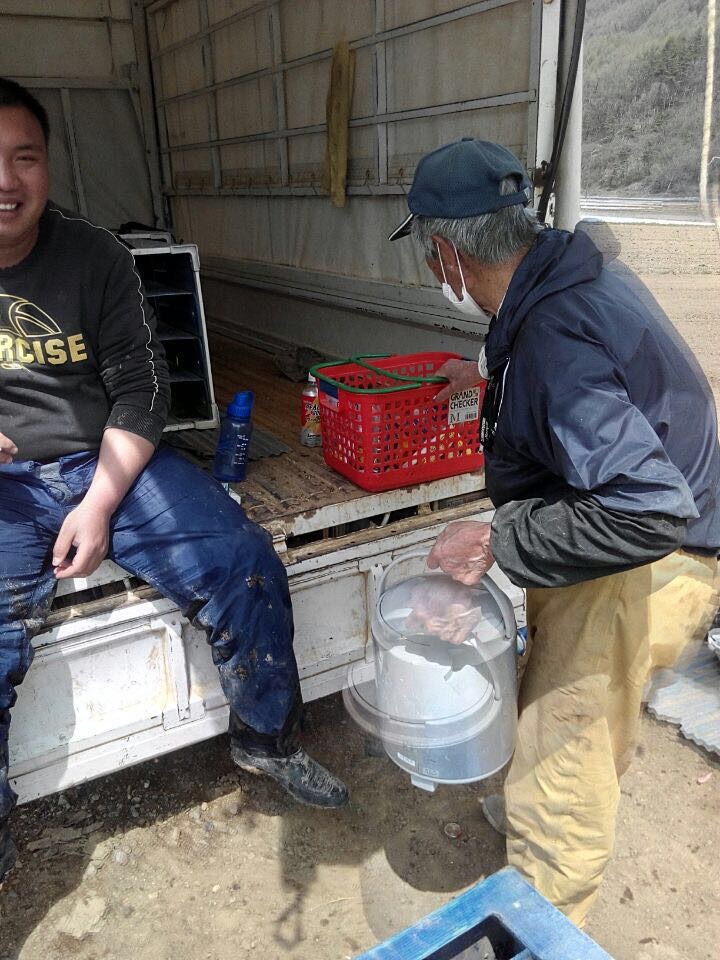
(: ).jpg) A farm that hires trainees (person facing away) (photo provided by Shanxingbang, a technical trainee)
Average cost lower than domestic labor, numbers rising year after year
According to a survey by the National Chamber of Agriculture, 25.8% of Japan's new entrants to farming hope for an annual income of 2 to 3 million yen, while another 21.4% hope for 3 to 4 million. By comparison, trainees earn a monthly salary of only 110,000 to 130,000 yen. Adding round-trip airfare and the management fees paid to supervising organizations, employing one trainee costs about 2 million yen a year, lower than the average Japanese salary. Since most trainees also have farming experience back home, they tend to get the hang of things quickly.
In addition, because trainees want to earn more, they are usually more willing to work overtime. "Farms with little overtime, like root-crop operations, are actually unpopular." A supervising body pointed out. For some employers, they may be the more attractive choice.
Japan currently opens only six highly labor-intensive agricultural sectors to trainees: greenhouse horticulture, vegetables, fruit trees, pig farming, poultry farming and dairy farming. Although there are quota limits on applications, the number of agricultural trainees in 2014 was 26,000, accounting for 14% of that year's agricultural employed population, and the cumulative total has now surpassed 100,000.
Farm management that makes active use of trainees
Trainees are mostly concentrated in the Kanto region, Hokkaido, Kyushu and Aichi Prefecture, and are fewer in Hokuriku, Kinki and Sanin. About 22% of them are concentrated in Ibaraki Prefecture, a key vegetable-supply base for the Kanto region, the highest share in the country. In 2014 the prefecture's JA Central Association even signed a "Technical Trainee Acceptance Agreement" with the Vietnamese government, planning to bring in 300 Vietnamese trainees within three years.
Ibaraki is not the only case where an agricultural cooperative serves as the supervising body and handles liaison with foreign countries. Of the more than 500 agricultural supervising bodies nationwide, agricultural cooperatives account for about one-fifth, and in Hokkaido the share exceeds 50%. Many farms make use of this stable workforce to expand their operations.
One farm in Kanto employs four trainees to grow greenhouse vegetables: "We used to grow open-field vegetables and fruit trees, but now we mainly grow spinach." Over five years, both its area and its income have doubled.
In Ibaraki Prefecture, too, some farms have switched to leafy greens that can be harvested five or six times a year, increasing their income. It is estimated that farms hiring trainees make up 20% of the area's farms, yet their income accounts for about 40% of all farms.
Now that the domestic workforce shrinks year after year, trainees have become an indispensable and precious labor force for agricultural production, and calls to extend the term and open up more job categories never stop. (Series to be continued)
To read the complete "Japan's Migrant Workers" series, please click here
For more professional agricultural technology news, please scan the QR code to follow WeChat: NongXunNET

Please indicate the source when reposting.