Brushes and iron chains can be called the weed whackers of the 21st century
Starting last year, I used my days off to bring long-fallow farmland back into cultivation and grow rice. For the first time, I used "8 cun spacing, take as few tillers as possible" natural cultivation with no fertilizer or pesticide at all, and used the traditional method of pulling weeds by hand. Not only did it take a lot of time, but after bending over in the field pulling weeds for so long, my back hurt so much I could not straighten up. It felt extremely hard and was also very ineffective.
However, the "duck-raising weeding method" suggested by experts, which means caring for the rice while also raising and managing ducks, poses difficulties for my caretaker farmer. Another expert suggestion, the "rice husk mulching method" and the "self-propelled weeder," is meant to suppress the dense growth of weeds, but for a thin and small woman, I cannot carry huge bags of rice husks to the field to spread over the rice paddy surface, and it is also not easy to operate machinery to turn around in the field.
This year I was very lucky to find a more labor-saving method. It costs little and is also lightweight, so I want to share my experience of using it with everyone.
1. Chain weeder
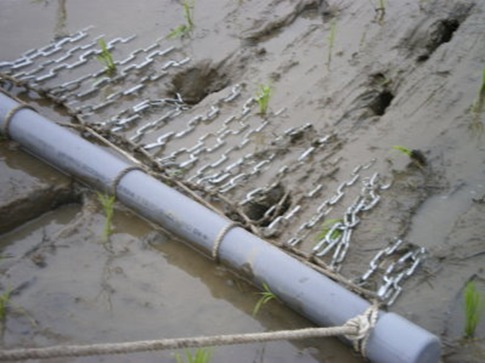
This year the results were remarkable
Everyone must be eager to know the "results of the two weeding methods." I went south on April 7. After the field had been dried for about 10 days, by then the rice had grown larger, and the brush could no longer get in to weed. "Only the tail end, where the terrain is higher and the water could not be controlled, had a small amount of weeds." Compared with last year, when weeding made my back hurt so much it nearly broke, this year's results truly made me happy. I wanted to be "flying over the grass"!!
The neighbors enthusiastically praised it: "This field has no fertilizer spread and no pesticide applied, and people rarely come to look at it, yet it is actually better than fields with fertilizer and pesticide. Not only are there fewer weeds, there is very little rice blast, unlike others where there is a lot, and the rice has grown evenly." Mr. Li Cunshou, the caretaker farmer whose water-watching work is widely praised by the neighbors, said very politely: "I do not know why it is good, but it is better than my own."
This year the weather has fluctuated greatly between cold and hot, and it is precisely because of the weather changes that the results of this area's natural cultivation have become evident. Many other rice paddies are infected with leaf rice blast, and the rice leaves are yellow and dirty from severe infection. In the professional agricultural areas, everyone is busy spraying pesticide, and the results are very different from everyone's last year. An aunt said that many of the five grains could not be grown at all.
I share my experience of using it with everyone, hoping that people will not remain stuck in the traditional farming idea that it is "very hard," which increases the barriers to entry. Please help spread the word and encourage more use of brush weeding, to reduce herbicides and the hardship of bending over, while also strengthening rice growth, which is better for the ecological environment. I hope to see more people together in the blue sky and green rice "brushing weeds" and "happily singing songs."