Taipei City detects dimethyl yellow again in dried tofu and tofu skin, both items from Taoyuan City
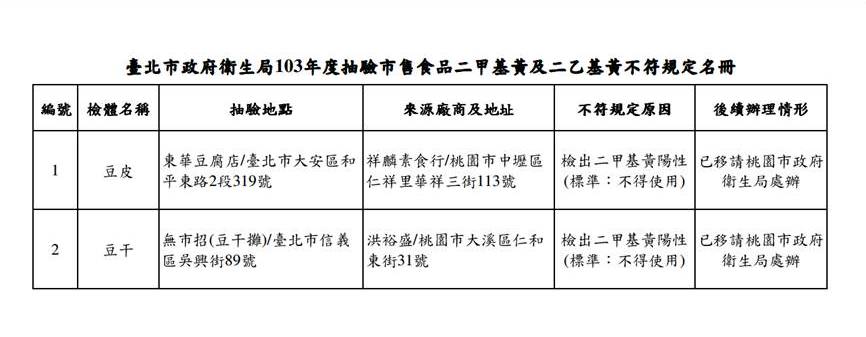
The Taipei City Government Department of Health set up a special project to conduct random testing of soy products (soy milk skin, dried tofu, tofu) and preserved radish, testing for dimethyl yellow and diethyl yellow. Of 20 product samples collected, 2 tested positive for dimethyl yellow: one was soy milk skin sold at "Donghua Tofu Shop" on Section 2, Heping East Road in Da'an District, and the other was dried tofu sold at a stall at No. 89, Wuxing Street in Xinyi District. Both items came from Taoyuan City. The Taipei City Department of Health has ordered them removed from shelves and has referred the matter to the Taoyuan City Department of Health for follow-up and penalties.
 Scene at Donghua Tofu Shop (photo provided by Taipei City Department of Health)
The Taipei City Department of Health pointed out that dimethyl yellow is an acid-base indicator, commonly found in oil-soluble dyes used in industry, and is not a colorant permitted for use in our country. In addition, on December 24 of ROC year 103 (2014), the Food and Drug Administration of the Ministry of Health and Welfare announced that "diethyl yellow," an industrial dye, had been detected in the emulsifier produced by Qianxin of Tainan City; its structure is similar to that of dimethyl yellow, and it is mostly added to wax oils, printing inks and plastic products. Neither may be used in food.
Under Article 15, Paragraph 1 of the Act Governing Food Safety and Sanitation, the use of the illegal additive dimethyl yellow is punishable under Article 44 of the same Act by a fine of not less than NT$60,000 and not more than NT$200 million; moreover, under Article 49 of the same Act, anyone who causes harm to human health may be sentenced to not more than 7 years in prison and fined not more than NT$80 million.
According to statistics from the Taipei City Department of Health, as of now the amount of problematic dried tofu products from Dechang and Huang Damu removed from shelves at retail outlets totals 2,329,292 items, or 248,307.75 kilograms. The Department of Health will continue to supervise random testing of the quality of food on the market to ensure that problematic products are not circulating, and will also inspect sites in accordance with the Good Hygiene Practice guidelines and coach operators to comply with hygiene standards.