[Tokyo Live]The Three Major Global Tokyo International Food Exhibitions: A Battleground Everyone Covets
The Tokyo food show is officially named the "Tokyo International Food and Beverage Exhibition." Founded in 1975, it stands alongside Germany's Anuga food fair (ANUGA) and France's Paris food show (SIAL) as one of the world's top three professional food exhibitions. In just four days it draws nearly 80,000 visitors. Although China's and Singapore's food import and export volumes have grown rapidly in recent years, Japanese consumers have strong purchasing power and do not hesitate to buy high-priced premium goods, making this a fiercely contested battleground. Every year you can see many not-yet-launched new products testing the waters, and all kinds of the most advanced food processing technologies, such as infrared dryers. The highly creative national pavilions are also a must-visit, and our upstream and downstream reporters will take you straight into Asia's largest food exhibition.
Thailand's design has quality; Taiwan's mascot steals the spotlight
This year's food show theme is "Japan, the gateway to asian markets," which speaks to Japan's swagger as the leader of Asian food. Japanese quality and specification requirements are first-rate; if you can get into Japan, exporting to other countries is almost no problem. This time there are a total of 10 exhibition halls and 3197 exhibitors, covering 78 countries vying for a foothold, spread across halls 1-5, while halls 6-8 are mostly Japanese exhibitors, and 9 and 10 are themed exhibitions, including the Japan Washoku Industry Exhibition, tea and coffee, organic food, food packaging materials and equipment, and so on.
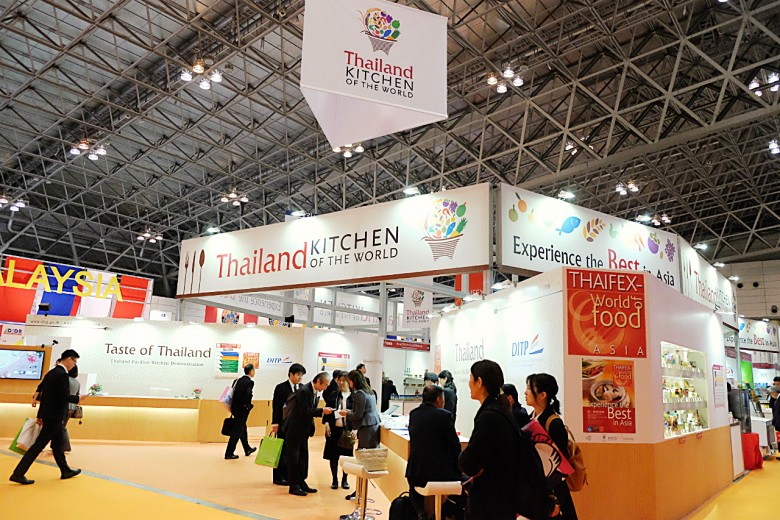
To attract buyers' attention, every country pulls out all the stops. In the Thailand pavilion next door to Taiwan, the overall design is a real eye-opener. Thailand set its theme as "Kichen of the world," focusing on fragrant rice and tropical fruit. The frontage resembles a hotel counter, and during events it becomes the chefs' cooking table; the triangular extension creates a welcoming effect, simple, elegant and full of quality.
Spain promoted its national pride, Iberian pork, bringing out a handsome chef to carve and offer tastings on the spot. Korean sales staff wore traditional hanbok and served traditional kimchi and pickles, inviting people on site to taste and score at the same time, increasing interactivity.