No pesticides for native mangoes: Tse-Xin and Maolin farmers conserve purple butterflies
If you see a road sign reading "Purple butterflies ahead, please slow down," don't doubt it: this is a traffic signal set up for butterflies, telling you that you have arrived at Maolin National Scenic Area in Kaohsiung.
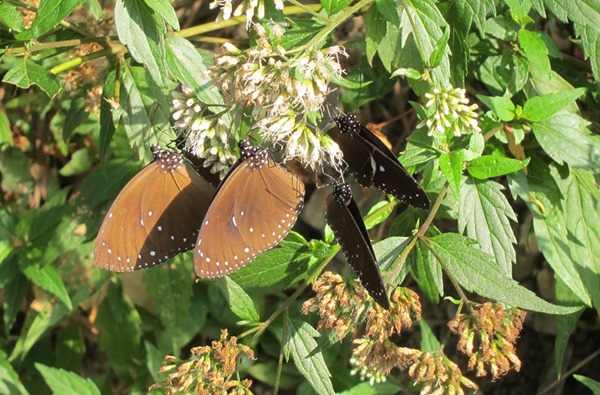
Every winter, millions of purple butterflies (Euploea) fly south to spend the winter in the valleys of Maolin, a phenomenon known as the "Purple Butterfly Valley." Any valley that is warm and sheltered from the wind will have purple butterflies overwintering in it, and Maolin alone has seven Purple Butterfly Valleys.
Each purple butterfly comes to Maolin only once in its life
The beauty of the purple butterfly, along with its migratory-bird-like overwintering habits, has inspired a group of butterfly lovers to establish the "Taiwan Purple Butterfly Ecological Conservation Association."
Liao Chin-shan, a council member of the butterfly association, says the purple butterfly is a tropical butterfly species suited to environments above 15 degrees Celsius, so every winter it follows the northeast monsoon and "spreads its wings and flies from Taipei to southern Taiwan to spend the winter." Taiwan's purple butterflies and Mexico's monarch butterflies are the only two remaining overwintering butterfly species in the world, making them very distinctive.
This year Maolin Elementary School began developing a school-based curriculum on the "purple butterfly." Principal Yu Po-fen believes that although millions of purple butterflies come to Maolin to overwinter each year, the butterfly's lifespan is only six to eight months, so each purple butterfly comes to Maolin only once in its life, "and it deserves to be treated well and understood well."
However, Liao Chin-shan, who has observed purple butterfly ecology for many years, has found that the butterfly's life comes into conflict with the livelihoods of local mango farmers. Purple butterflies that feed on pesticide-sprayed mangoes do not survive, while local farmers lament: "When you grow native mangoes, can you really do it without pesticides?"

In the first year Tsyr-Hsin purchased 6.8 metric tons of mangoes, sent them to a processing plant to be made into dried mango, and sold them at Leezen organic stores, where they sold out within a month. With these concrete results, the willingness of Maolin's farmers increased greatly; this year Tsyr-Hsin purchased 22.8 metric tons, and as for next year, Chen Yi-chen, chairperson of the Maolin Community Development Association, says: "We hope Tsyr-Hsin will purchase 50 metric tons!"
After Maolin mangoes are purchased and processed by Tsyr-Hsin, there are two product lines, "Dried Native Green Mango Fruit" and "Green Native Mango Love Fruit," which are stocked in all 97 Leezen organic stores across Taiwan. What Maolin farmers gain in return is not just tangible income, but also confidence in their own mangoes: "Seeing the green mangoes I grew made into dried mango and stocked at Leezen makes me very happy. I bought a lot of packs to take back and share with my people!"
Over these two years, farmers have reduced pesticide use, and the purple butterflies have faced fewer threats. Local farmer and elder Chen Sheng says that switching to organic mangoes has given him some income, while the butterflies fluttering all over the sky stir his memories: "There aren't that many purple butterflies now. When I was a child, when a swarm of purple butterflies flew across the sky, the ground would go dark!"
(This article was funded by the Chien-Chen Environmental Education Foundation for personnel expenses, but the foundation does not interfere at all with news topic selection or interview writing, ensuring journalistic independence.)