Encountering Monsanto in tbahua (Tianpu)?!
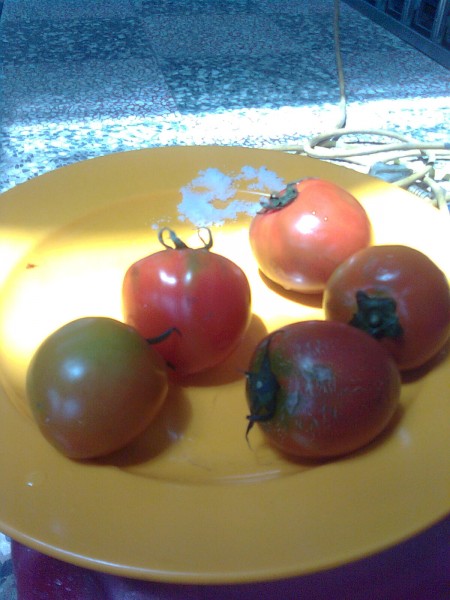
On the first day back in the tribe, the tribal plant survey was disrupted and put on hold by behuy (typhoon) Tembin, so I had no choice but to start finding households to help with work. It happened that many families were harvesting warang (tomatoes), so I began the job of packing tomatoes.
Once the tomatoes are brought back from harvest, they first go through a washing and sorting machine and are packed according to size, and then, based on how "red," how "beautiful," and how "large" they are, they are graded as extra-large, extra-medium, or premium, red, and so on. Actually, friends from Gengxin Tianpu should be quite familiar with this; every year during summer in the mountains, most of the time is spent repeating this kind of work.
The "Monsanto" that has appeared in the tribe: pesticides, seeds
But this time I want to ask a few more questions, because I saw the three words "Monsanto" actually appear in qalang (the tribe). I had not expected that! I did not expect that Taiwan also sells Monsanto pesticides? Or is it called "Niannianchun," a pesticide very commonly used in the tribe? It shows that our understanding of the entire ”intensive agriculture” planting and production-and-marketing process in Tianpu still has a very large gap.
This year I have seen several phenomena. I will not call them problems, because the tribe has actually maintained this for quite a while, and there really is no issue of right or wrong. It is just that the degree of friendliness to the environment varies.
First, the purchased tomato seedlings are of different varieties:
As a result, after Assyut No. 10 tomatoes were harvested for one or two rounds, the leaves turned black, and of course they could no longer continue to be harvested; so tribal people who planted them all discussed whether it was their own care problem, or whether the seedlings given by the seedling shop had a problem, or whether this variety was unsuited to the mountain. Relying on seedlings supplied from outside is a fatal weakness of this traditional intensive agriculture. And could it also be related to Monsanto? If genetically modified seedlings are provided, must their fertilizer or pesticides be used? This is what happened in India. (Readers who are interested can see the book "Food Wars")
Second, the farmers' association drove a large truck up to carry goods!
Whether it is the Hengshan or Qionglin District Farmers' Association. I want to ask whether other tribes in the back mountains have this situation? Tribal people say it has been like this since last year. Is it really that exaggerated? The farmers' association's supply volume is already mostly supplied by Tianpu, so in order to compete for business, it has actually begun to provide this kind of transport service with a commission cut. Although it is a service, it saves the cost of sending goods down the mountain, but it also adds another layer of exploitation. And everyone's frequency of going to harvest work has also risen even more, because the farmers' association also hopes that a 3.5 large truck can come up each time to carry more goods down. Each family transporting 20 boxes at a time is normal; 20 boxes counts as little. Some households can actually send 100 boxes down at once… which is astonishing.
Intensive agriculture depends very heavily on pesticides and fertilizers. If the farmers' association's dependence on Tianpu's crop supply increases, it will inevitably make tribal planting households continue to raise the amount cultivated, which will also consume soil fertility more severely, and the pressure for land development will also become heavier. The original ecology nearby will also come under pressure.
Third is the lack of understanding of the toxicity and residues of pesticide use.
"When it rains, you have to spray pesticide. The more it rains, the more pesticide is sprayed, so costs rise." This is what tribal people see. But for urban consumers, fruits and vegetables rushed to harvest before a typhoon, pesticide residues… can that really not be a problem? Actually, even I myself am a bit alarmed. I know everyone wears gloves when sorting tomatoes, because they need to wipe off dirty water or soil, but could residual pesticides be absorbed through the skin during this action? I myself did not wear gloves while sorting, and after finishing, when it was time to eat, I had to run off and wash my hands thoroughly, just out of fear. But tribal people clearly do not treat this as a big deal. This perhaps counts as a problem at the "technical" level, so in tribal agricultural technology, especially pesticide use safety, there may still be a lot we can work on together?!
Many people in the tribe have poor liver health. Could liver cancer also be related? Could chronic kidney disease (CKD) also be related? Symptoms of acute poisoning are actually not uncommon. People often feel dizzy while spraying pesticide, almost faint, and see stars, but they all just rest a bit and then continue spraying, and they do not have the habit of wearing masks. Sigh, the more I think about it, the more I feel it is not worth it.
Fourth, knees are bad
Because many mama (uncle) and yata (aunt) are already in poor health, they cannot carry or shoulder very heavy baskets full of crops along mountain roads or climb slopes (many orchards are up in the mountains), so they have bought additional equipment, for example: a 700,000 Japanese-made rail transport machine, or a crawler carrier. To cope with the still huge amount of harvested crops, everyone's tali (knees) are already no good. Everyone is dealing with sciatica, and everyone is looking for folk remedies that will cure it without surgery or medicine. Tribal yata and mama ask me, if you apply medicated patches, will ligaments and cartilage really grow? What do you want me to answer? I can only smile and say, in theory it will not, but let us wait for God to move and perform a miracle!
The corresponding solution I think of is: home-delivered fruits and vegetables. If there is a way to home-deliver to urban consumers' homes, remove the layers of exploitation in the middle, and find a way to raise the unit price, then there is a way to reduce the amount planted, and at the same time reduce the use of fertilizer and pesticides. But whether tribal people accustomed to conventional farming methods can accept it, not shipping batch by batch, not a large sum of income coming in all at once.
Can they accept not seeing the original large sum of income? But in fact this can also reduce the amount of labor, and can also reduce the time spent and the cost of physical illness, or the cost of expensive transport machines. Especially when Tianpu is constrained more and more deeply by intensive agriculture, can we still think of any ways together with the tribe?