Rice Knowledge Challenge: Can You Become a Rice Expert?
First, two amusing stories.
One year during university, our high school alumni association held a sports day at National Chung Cheng University in Chiayi, and I was tasked with bringing along a junior schoolmate from National Tsing Hua University. I had never been to National Chung Cheng University either, so while we were waiting for the bus in Chiayi, my schoolmate asked a passerby where we should get off. After the bus had gone a while and turned a corner, my schoolmate, while I was still clueless about what was going on, rang the bell and happily got off, and once I realized what was happening I had no choice but to jump off after her, only for us to discover that National Chung Cheng University was still several kilometers away.
So we had no choice but to walk there, and as we walked along the edge of fields that were green with rice on every side, my schoolmate suddenly asked me why the grass in Taiwan was planted so neatly. I burst out laughing XD It turned out that what my schoolmate called the neatly planted grass was the rice seedlings in the paddy fields Orz. For years afterward, I teased her about that "neatly planted grass."
Last month, a few of my high school classmates, along with the younger sister of one of them, came to Taiwan for a trip. I took advantage of the weekend to take them to Yilan for fun, and we stayed at a bed and breakfast surrounded by paddy fields on all sides (Note 1). Looking at the emerald green paddy fields all around, I told them this joke. Then the classmate's younger sister suddenly wore an awkward expression and said that she had actually wanted to ask me too why all the lawns in Taiwan were flooded Orz.
It seems they are all city kids through and through XD. But come to think of it, in Malaysia there are probably quite a few people who have never seen a paddy field. Especially in our state, the crops grown on a large scale are nothing but rubber trees and oil palms. If my mother's family had not been rice farmers, I might never have seen a paddy field before coming to Taiwan. After coming to Taiwan, one of the things that opened my eyes was that paddy fields can be seen everywhere in Taiwan's farmland, and there are even paddy fields on the Guandu Plain in Taipei City. In Malaysia, not to mention that there would be paddy fields within the capital, for dozens of kilometers around there are only industrial and commercial districts and residential areas.
In Taiwan, almost every county and city has paddy fields, and the coverage of paddy fields is so high that it is truly rare in the world, especially considering that Taiwan is already highly industrialized! When we foreigners come to Taiwan, what we admire most about Taiwan is its strong sense of human warmth, which is a fine tradition left behind by an agrarian society!
The Rice Expert Challenge, a Big Supplement of Rice Knowledge
Taiwan is very deeply influenced by rice culture. Even Taiwan's long working hours may well be one of the profound influences of rice culture, although long working hours mainly arise in industry and commerce. In his bestselling Outliers (Outliers: The Story of Success), Malcolm Gladwell gives an extremely interesting theory, namely the relationship between rice culture and mathematical ability.
Rice is basically a food crop that requires a huge amount of care and labor during cultivation. In the process of growing rice, from seedling raising and base fertilizer, land preparation, irrigation, applying base fertilizer, transplanting seedlings, pest and disease control, weeding, top dressing, cutting off water, drying the field, applying ear fertilizer, plowing, rotational irrigation, drainage, chasing off birds, to harvesting, there is not a single idle day, and one must expend enormous physical and mental effort to care for the paddy field.
But the advantage of growing rice is that effort and harvest are often directly proportional, unlike growing wheat, which often depends on the mercy of the weather. So the ancient rural proverb of China, where rice is grown, is more positive than that of the high-latitude wheat-growing regions; for example, the ancient Chinese proverb says: "One part of cultivation, one part of harvest." Gladwell points out that the cultivation of mathematical ability precisely requires students to continuously work hard at practice, so the culture of rice, which encourages people to study hard, can promote the cultivation of mathematical ability.
Although in "How to Become an Extraordinary Outlier?" I pointed out that rice culture and mathematical ability are not necessarily truly related. However, the diligence advocated by rice culture may be one of the main reasons why Chinese, Koreans, and Japanese can endure long working hours. After industrialization, the ability of Japan, South Korea, Taiwan, Singapore, Hong Kong, China, and China's coastal provinces to strive for the economy with one heart is also very likely influenced by the culture of the past, when rice planting required all the villagers of a village to work together to harvest.
Rice also brought about the prosperity of Chinese culture. Before the Industrial Revolution, the only cities whose populations could exceed a million were Angkor, Beijing, and Edo. These large cities all relied on rice as their staple food to varying degrees, and all could effectively use waterways to transport grain. Before the Industrial Revolution in Europe, the main reason it was difficult for urban populations to exceed a million was that using animal power to transport grain such as wheat was extremely energy-consuming; before the invention of railways, the energy cost of transporting wheat from remote areas to large cities was completely uneconomical. But Angkor had a complete canal and irrigation system, China had the Grand Canal for grain transport, and Edo had Tokyo Bay for water transport. In addition, rice is easy to preserve and nutritionally balanced, and can feed a population of a million (Note 2). Rice is nothing less than the finest food crop of the Old World!
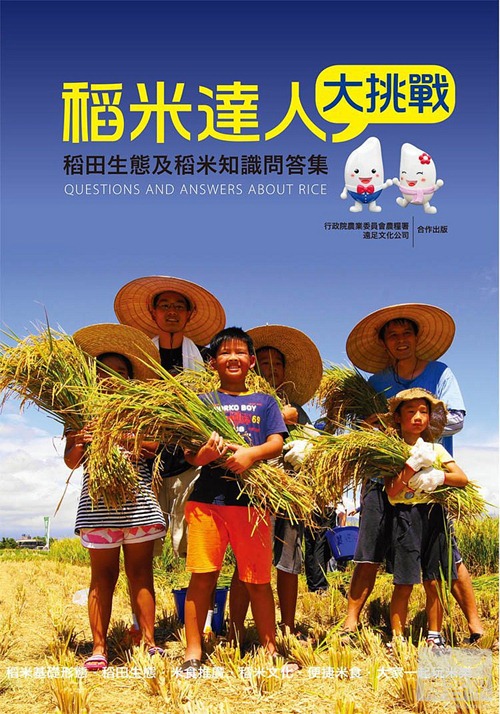
Since rice is not only one of our most important staple foods but has also had such a profound influence on our history and culture, shouldn't we understand rice even more deeply? This book published at the end of last year, The Rice Expert Challenge: A Question-and-Answer Collection on Paddy Field Ecology and Rice Knowledge, is a good choice. Through this book's wonderful, vivid real-life photographs, illustrations, and charts, we can understand in simple terms the relevant knowledge of paddy field ecology, the nutrition of rice foods, rice and rice-food culture, and excellent domestic rice foods. The Rice Expert Challenge also provides wonderful information on rice-related museums and hands-on activities across Taiwan, encouraging everyone, parents and children alike, to get close to the paddy fields and experience rice culture.
Unlike the essay-style narration of ordinary knowledge books, The Rice Expert Challenge adopts an editing method of "knowledge Q&A" paired with an "encyclopedic illustrated guide," introducing in simple terms the relevant knowledge of paddy field ecology, the nutrition of rice foods, local consumption, and excellent domestic rice foods. The Rice Expert Challenge has more than 180 common questions and 600 illustrations and photographs, easily answered with concise and easy-to-understand pictures and charts, fully presenting Taiwan's rice culture.
The Rice Expert Challenge has six major sections in all, covering six major themes of rice knowledge and revealing the diverse face of Taiwan's rice culture:
- Basic Forms of Rice: Discusses the history, types, and forms of rice, making the past and present, the ins and outs, and the plant characteristics of rice clear at a glance.
- Paddy Field Ecology: Discusses the growth and ecology of rice, the management techniques of cultivation, and the diversity of paddy fields, exploring what ecological environment paddy fields have, how rice grows and is cultivated, and how farmers manage rice cultivation.
- Promotion of Rice Foods: Discusses the processing, nutrition, and marketing of rice foods, exploring how the processing, production, and sales of rice are carried out, what nutrition rice foods have, and letting us know the price of rice even as we eat it.
- Rice Culture: Discusses rural villages and farmers, traditional farm tools and modern farm tools, festival customs and rice foods, and straw crafts, exploring the folk festival customs closely tied to rice foods, the Taiwan rice matters that Taiwanese people should know, and the early memories contained in the countless rural rice cultures.
- Convenient Rice Foods: Discusses the methods of rice-food cooking, rice-food DIY, rice-made snacks, and more, providing a variety of recipes and illustrated guides, so you can easily master the secrets of rice-food DIY.
- Everyone Plays with Rice Together: Discusses rice expos and rice hands-on activities, providing information so everyone knows where to see old farm tools, where to experience rice harvesting, and where there are rice-food-making demonstrations, letting everyone enjoy themselves in rice.
Notes:
Note 1: That bed and breakfast is Yilan Lou Shi Image B&B (The Art Gallery B&B), which only opened at the end of last year, and whose owner is a photography enthusiast. In the living room he displays his father's black-and-white photographic works, preserving precious memories of the local rural culture, and the owner also explains things very enthusiastically; it is worth recommending.
Note 2: See The World That Trade Created: Society, Culture, and the World Economy, 1400 to the Present (The World That Trade Created : Culture, Society and the World Economy, 1400 to the Present) (please see "The World Created by Diverse Trade").
Note 3: In Venerable Father: A Life with Ajahn Chah (Venerable Father: A Life with Ajahn Chah), the author, American Paul Breiter, describes his years of practice at the forest monastery in northeastern Thailand of the Thai meditation master Ajahn Chah (ชา สุภัทโท, 1918-1992).