Agri-tech expo focuses on infrared rapid pesticide testing and aerial 3D crop damage assessment
In recent years, technological agriculture has flourished. Units under the Council of Agriculture, including agricultural improvement stations, the Agricultural Research Institute, the Pingtung Agricultural Biotechnology Park, and partner manufacturers, have specially brought 68 research and development results to the Taipei Nangang Exhibition Center, where from the 21st they will be exhibited for 4 consecutive days for the public to feast their eyes on.
These include infrared technology for pesticide residue testing, which is more accurate than traditional rapid screening methods and will be a great blessing for group-meal caterers and fruit and vegetable wholesalers. There are also the most popular drone aerial photos; the Agricultural Research Institute has already actually applied them during Typhoon Nepartak, and if operations go smoothly, they can be used for frontline agricultural damage surveys after natural disasters, greatly saving manpower.
Introducing infrared technology to precisely detect pesticide residues
What troubles school nutrition-lunch group-meal caterers and fruit and vegetable cooperatives most is the inability to quickly screen out pesticide residues. Once products are delivered downstream and a local health bureau detects pesticide levels exceeding standards, they must bear legal responsibility. However, the Taiwan Agricultural Chemicals and Toxic Substances Research Institute has developed a new product that, through Raman spectroscopy (a type of infrared), can accurately, quickly, and at the field edge conduct semi-quantitative testing of pesticides.
This system is quite simple to operate: just extract the sample, filter out impurities through an intermediary, then drip it onto a chip, place it into a computer for Raman spectroscopy scanning, and in about 3 minutes a "peak chart" will be produced; through computer comparison, it is possible to precisely determine exactly which pesticide is present.
Zeng Zhaoming, assistant research fellow in the Residual Toxicity Control Division, explained that the principle is to irradiate the solution with Raman spectroscopy, and the chemical substances in the solution will reflect different amounts of Raman spectra, thereby identifying the "peak chart" of each pesticide. At present, the establishment of peak charts for more than 100 pesticides has been completed, and the database will continue to be expanded in the future.
In other words, in the future, just one computer, one set of test tubes, and a chip will make it possible to test pesticides in the field and reduce risk.
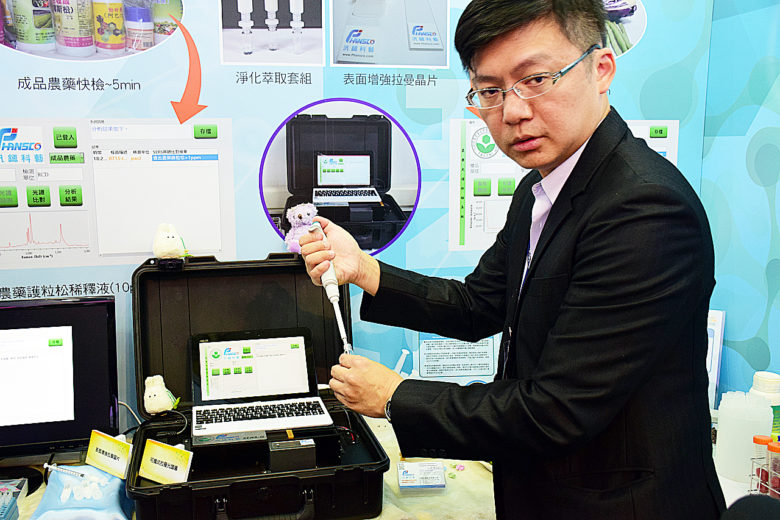


Taiwan International Bio Tech Exhibition, exhibition time is July 21 to 24, located on the 4th floor of the Taipei Nangang Exhibition Center.