Acid Pollution Case Against ASE Reversed on Appeal: Environmental Groups Say City Government Was Reckless in Enforcement
At the end of 2013, the ASE (Advanced Semiconductor Engineering) K7 plant discharged strongly acidic wastewater into Houjin Creek. Four defendant plant employees had originally been found guilty in the first trial last year. Earlier today, the Kaohsiung High Court handed down its second-instance verdict, acquitting all of them and also revoking the NT$3 million fine imposed on ASE in the original trial. In response, the Citizens of the Earth Foundation, which has long followed this case, exclaimed: "There is no justice!"
Regarding the dramatic reversal in the second trial of the ASE Houjin Creek pollution case, Tsai Hui-hsun, director of the Citizens of the Earth Foundation's Industry and Energy Policy division, said bluntly that after the incident the Kaohsiung City Government submitted only a single fish specimen for testing, leaving the judge with nothing to compare against, which precisely shows that the city government's enforcement process was too reckless, and that there is "reason to suspect it was raised high only to be set down lightly."
There are many industrial zones upstream of Houjin Creek. ASE is located within the Nanzih Export Processing Zone, and the wastewater it discharges flows into two downstream agricultural irrigation intake points, affecting nearly a thousand hectares of farmland in the Qiaotou and Ziguan areas. Provided by / Citizens of the Earth Foundation
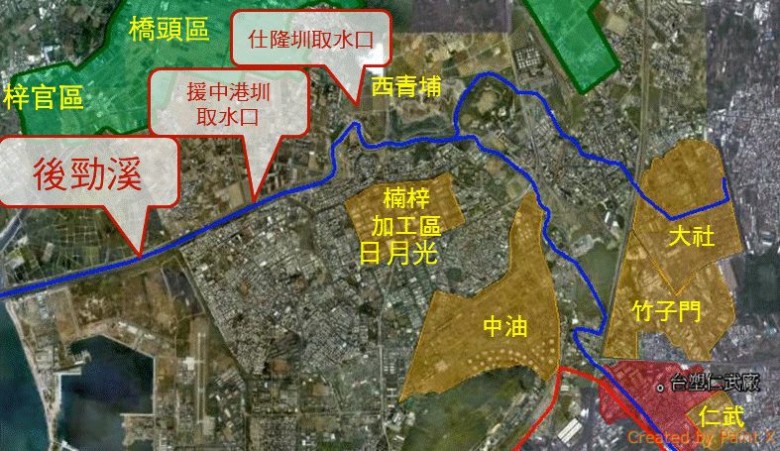
In October of the year before last, when the Kaohsiung City Environmental Protection Bureau inspected Houjin Creek, it found that the ASE K7 plant was discharging industrial wastewater that did not meet standards. After more than two months of evidence gathering, on December 9 it issued a fine of NT$600,000 and ordered a work stoppage. After the incident came to light, the Kaohsiung City Environmental Protection Bureau, the Agriculture Bureau and the Irrigation Association also went to farmland near Houjin Creek to conduct spot checks and test the extent of farmland contamination.
In October last year, the Kaohsiung District Court, under the Waste Disposal Act, fined ASE NT$3 million and sentenced four people including Su Ping-shuo, head of plant affairs at the ASE K7 plant, to prison terms ranging from 1 year and 4 months to 1 year and 10 months, with some receiving suspended sentences.
At the time, civil environmental groups said outright that the sentence was too light. Environmental lawyer Jan Shun-gui pointed out: "The Environmental Protection Bureau and prosecutors used only one dead fish and sediment from more than 70 days later to prosecute under such a heavy statute and ask the judge to impose a heavy sentence. That is simply climbing a tree to look for fish!"
Environmental groups: The Kaohsiung City Government was too reckless, submitting only a single fish specimen and leaving the judge with nothing to compare
Earlier today the second-instance result was announced. The panel of judges at the Kaohsiung High Court held that the wastewater from the ASE K7 plant was discharged through pipelines or ditches after being treated by wastewater treatment facilities, and that the discharged wastewater did not fall within the scope of industrial waste, so the Standards for Determining Hazardous Industrial Waste did not apply, and there was no relevant penalty provision under which it could be punished. This was a legislative omission in the Water Pollution Control Act. Although later amendments to the law could regulate such conduct, at the time this case occurred there was no law under which it could be punished.
The panel pointed out that in the 10 years before this case occurred, the Kaohsiung City Environmental Protection Bureau's inspections of the K7 plant had never resulted in penalties for wastewater copper or nickel content or pH values exceeding discharge standards, and that there were also 2 or 3 other electroplating and acid-pickling factories upstream that likewise discharged wastewater containing copper and nickel. Therefore, it could not be confirmed that the heavy metal content in the sediment under Demin Bridge and the excessive nickel content in fish from the fish ponds were caused by ASE over a long period or by this hydrochloric acid overflow incident.
The panel also criticized that the sediment and fish samples submitted by prosecutors were single in number, with no other sampling and testing results from different times, the same location or the same fish ponds available for cross-checking, and that they did not cover other areas of the Houjin Creek watershed. Therefore, it could not be proven that ASE's pollution had reached a level endangering environmental ecology, nor did it meet the constituent elements of the crime of "discharging toxic substances" under Article 190-1 of the Criminal Code.
Regarding the dramatic reversal in the second trial of the ASE Houjin Creek pollution case, Tsai Hui-hsun, director of the Citizens of the Earth Foundation's Industry and Energy Policy division, said bluntly that after the incident the Kaohsiung City Government submitted only a single fish specimen for testing, leaving the judge with nothing to compare against, which precisely shows that the city government's enforcement process was too reckless, and that there is "reason to suspect it was raised high only to be set down lightly."
In view of ASE's acquittal in this case, the Citizens of the Earth Foundation once again called on the government to accelerate the establishment of a "pollution fingerprint database" and to promptly disclose "pollution monitoring information." Tsai Hui-hsun added that every factory along Houjin Creek discharges different types and quantities of pollutants, and local environmental authorities must have long had this information in hand. Now, as long as it is integrated and a database is built, when a certain heavy metal is sampled again in Houjin Creek in the future, this evidence can be used to trace the investigation, and only then will the Kaohsiung City Government no longer fail to produce data, making it impossible to prosecute factories that maliciously discharge toxic wastewater under the charge of "public endangerment."
The Citizens of the Earth Foundation pointed out that ASE is not the only source of pollution in Houjin Creek, yet downstream there are 1,390 hectares of farmland and offshore fisheries that have been forced to bear the suffering of decades of economic development. Citizens of the Earth called on the central and local governments to reduce pollution in Houjin Creek, accelerate disclosure of Houjin Creek pollution monitoring information, guide polluting industries toward transformation, carry out health risk assessments, and restore life to Houjin Creek's ecosystem and to residents' health.
Industrial Wastewater Pollutes the Environment; ASE Must Be Held Responsible; Changhua Farmland Pollution May Be a Thousand Times Worse Than Kaohsiung
Houjin Creek Drinks Wastewater; Environmental Groups: Water, Soil and Crops Should All Be Comprehensively Tested for Contamination
Kaohsiung High Court Press Explanation on the ASE Second-Instance Case
For more professional agricultural science and technology information, please scan the QR code to follow WeChat: NongXunNET

Please indicate the source when reprinting.