Pesticides to Blame? Bee Death Cases Surge, Parasitic Wasps Replace Pesticides to Control Lychee Stink Bugs
To solve the vexing problem of the litchi stink bug (Tessaratoma papillosa) running rampant, the Bureau of Animal and Plant Health Inspection and Quarantine opened more than 20 pesticides for farmers to choose from, including neonicotinoid pesticides such as imidacloprid and clothianidin, and insecticides such as chlorpyrifos, carbosulfan and cartap. However, during the flowering period of litchi and longan, many beekeepers in Kaohsiung and Nantou reported successive cases of bee colony deaths, suspecting that the above-mentioned "neonicotinoid pesticides" were to blame, and they have repeatedly demanded that the Council of Agriculture promptly remove this pesticide from the list so that sustainable development can be restored.
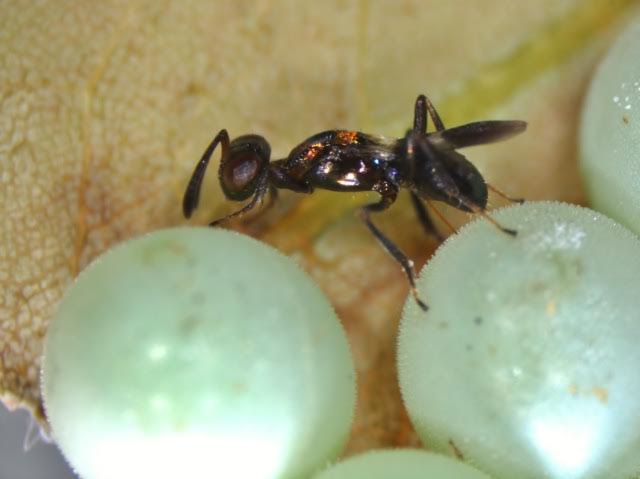
In response to the litchi stink bug, the Miaoli District Agricultural Research and Extension Station recently announced a biological control approach using the "flat-bellied wasp" (Anastatus fulloi), exploiting the trait by which the flat-bellied wasp parasitises its eggs inside litchi stink bug eggs, to achieve an "insect against insect" clearance effect. It is expected that in March and April, 120,000 flat-bellied wasps will be provided each month to the longan and litchi production areas of Kaohsiung and Taichung. However, Wu Deng-Chen, deputy director of the Miaoli District Agricultural Research and Extension Station, admitted frankly that the flat-bellied wasp is also easily affected by pesticides, and advised farmers that the two must be staggered.


Solving the litchi stink bug infestation: scholars say both "precision pesticide use" and "physical control" are essential
To cope with the litchi stink bug infestation, Hsu Ju-Chun, associate professor in the Department of Entomology at National Taiwan University, proposed an approach that gives equal weight to "precision pesticide use" and "physical control", advising farmers to avoid the three types of pesticide that pose relatively higher risk to the human body, namely carbosulfan, chlorpyrifos and fenobucarb, and to choose to apply pesticide during the early-instar nymph stage, when the litchi stink bug is most sensitive to the chemicals, spraying at dawn or dusk when the insects are not disturbed, which can achieve better results. In addition, care must be taken to absolutely avoid the flowering period of litchi and longan, so as not to interfere with the survival of honeybees.
In addition, Hsu Ju-Chun also said that physical control is the king's way. In winter, when the temperature drops below ten degrees, the adult litchi stink bugs have weak mobility and cluster together to overwinter; as long as gloves and a face mask are prepared, and attention is paid to the discharge of the corrosive liquid, they can be removed by hand. As for the eggs, advantage can also be taken of the egg-laying peak in March and April to deal with them; farmers can try crushing the clustered eggs, or immersing whole leaves in alcohol, freezing them, or sealing them in plastic bags, and then combining this with the parasitic method of the flat-bellied wasp, which can effectively remove the litchi stink bug menace.