A major outbreak of tainted oil products has erupted; the Ministry of Health and Welfare and manufacturers are protesting their innocence, and the Taipei District Prosecutors Office has stepped in to investigate.
The tainted cooking oil scandal continues to spread, and well-known major manufacturers such as Carrefour and De-Yi-De-Yi-Tian (A Day of Satisfaction) have also been implicated. Legislator Huang Wei-Che today presented documents, pointing out that last year the Ministry of Health and Welfare commissioned Meiho University of Science and Technology to conduct the "Study on the Compliance of Labeling of Packaged Blended Oils Sold on the Market." Through experimental comparison, it was concluded that the oils and fats of brands such as Wei-Yi, De-Yi-De-Yi-Tian, and Carrefour are suspected of not matching their labels, being adulterated with cheap soybean oil and canola oil. In response, the Ministry of Health and Welfare emphasized that "it was only a commissioned study, not an inspection, and there was no concealment," while the businesses all cried foul, denying the oil adulteration.
However, the Taipei District Prosecutors Office today stated that it will intervene to investigate whether the Ministry of Health and Welfare was derelict in its duties. Deputy Premier Mao Chi-Kuo of the Executive Yuan also came forward to state that unscrupulous manufacturers will be severely punished, following the model of cracking down on illegal and inferior drugs, under the Food and Drug Safety Report, establishing a "Joint Task Force for Food Safety Inspection and Crackdown," smoothing cross-ministerial communication mechanisms, and strengthening the investigation and handling of illegal businesses.
According to the original report from Meiho University of Science and Technology, the research project was aimed at "developing detection technology for the adulteration ratio of blended oils," attempting to use fatty acid PCA analysis, two-dimensional fatty acid ratio plotting analysis for adulteration, triglyceride PCA analysis, and other methods to sample and test 25 types of commercial oils.
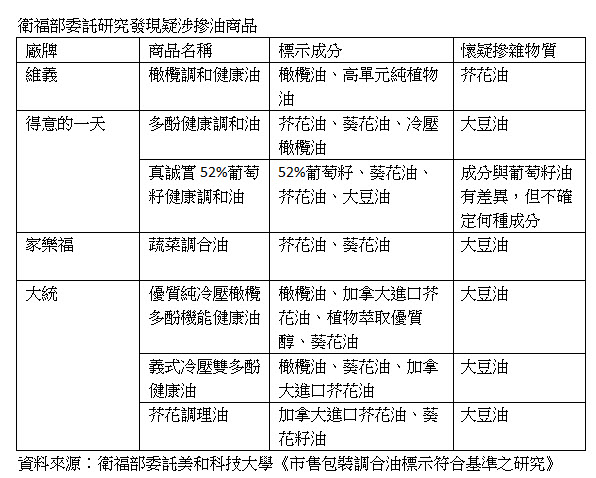
Ministry of Health and Welfare: Commissioned study, not sampling inspection 4 manufacturers, 7 oil products suspected of adulteration with other substances
Tsai Shu-Chen, then head of the Food Section of the Food and Drug Administration under the Ministry of Health and Welfare who chaired the relevant meeting, today repeatedly emphasized that the purpose of the report was experimentation to improve scientific testing methods; using commercial oils for analysis was merely one step in the experiment and cannot determine with 100 percent certainty that businesses definitely mislabeled, and it was absolutely not an official sampling inspection. The Ministry of Health and Welfare did not shield businesses.
The research report pointed out that Wei-Yi Olive Blended Healthy Oil was suspected of being adulterated with canola oil; De-Yi-De-Yi-Tian Polyphenol Healthy Blended Oil was adulterated with soybean oil; De-Yi-De-Yi-Tian Truly Honest 52% Grape Seed Healthy Blended Oil was determined to be "(analysis data) far from grape seed oil, possibly somewhat inconsistent with the label, but further experiments comparing data from mixing grape seed oil and sunflower oil in different ratios are needed; Carrefour's Vegetable Blended Oil was also said to be adulterated with soybean oil without honest labeling.
Da-Tong, which was recently confirmed by prosecutors and investigators to have illegally blended oils, was also questioned in this same research report; multiple products labeled as "olive oil" and "canola cooking oil" were adulterated with soybean oil without clear labeling.
Food and Drug Administration: A lipid database must be established for accurate comparison
Tsai Shu-Chen pointed out that these research results were merely "the process of establishing a testing method for oil adulteration." Through experiments, it was found that although precise experiments can analyze oil properties, without a sound lipid database for reference comparison, the comparison results could also be wrong. "For example, the data for De-Yi-De-Yi-Tian grape seed oil deviates from ordinary grape seed oil, but this cannot be used to conclude that it violated rules by blending oils; a more sound oil product database must be established to compare and determine which type of oil this experimental property tends toward."
Tsai Shu-Chen explained repeatedly that the conclusion of the meeting that year was to establish a lipid database based on the experimental results, collecting data on peanut oil, sesame oil, grape seed oil, and brown rice oil, in order to establish testing methods. Zhou Jian-Guo, a manager of Standard Foods who attended the discussion that year, and Li Min-Hsiung, a professor at National Taiwan University, and others also suggested that "even though they are all olive oil, olives from Tunisia, Turkey, or Italy have compositional differences," making it necessary to establish a lipid database to avoid wronging manufacturers.
De-Yi-De-Yi-Tian: No ingredients found to be falsified; Carrefour: Labeling was misunderstood
Last year's scientific research report, affected by the Da-Tong scandal, became the focus of everyone's attention today, and manufacturers rushed to clarify. Huang Hsiang-Jung, a business department manager of Standard Foods, the manufacturer of De-Yi-De-Yi-Tian oil products, who participated in the discussion that year, came forward today to clarify that the conclusion of the research report was that "these scientific methods cannot clearly detect the combined ingredients of oil products," and that Standard Foods absolutely did not mislabel or add illegal substances. Carrefour stated that the product had always labeled soybean oil as the main ingredient, and that the research unit "misread the label," which was very unfair.
Faced with manufacturers crying foul, Tsai Shu-Chen stated that to calm public concerns, Meiho University of Science and Technology will be asked to find the experimental photos from that year for comparison, "but as far as we currently know, Carrefour did indeed label that it was blended with soybean oil; perhaps Meiho University of Science and Technology made a clerical error."
Faced with external doubts that the Ministry of Health and Welfare concealed research data and failed to conduct serious inspections, Tsai Shu-Chen said: "This is too heavy an accusation against colleagues who have done their utmost to develop scientific testing methods," emphasizing that the Ministry of Health and Welfare absolutely did not shield manufacturers.
Yeh Yen-Po, Director-General of the Changhua County Health Bureau, also stated that since last year when illegal oil blending by Da-Tong was discovered, the Ministry of Health and Welfare fully supported local testing and investigation, and ultimately requested prosecutors and investigators to search the factory under the Act Governing Food Safety and Sanitation. "The process consumed manpower and resources and required operating time; there was absolutely no shielding or delay."