Soil also needs an annual health check, and agricultural improvement stations provide free services.
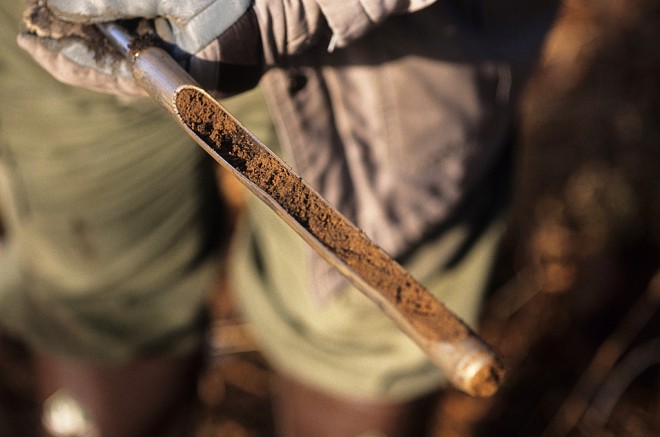
As the year draws to a close, how is the soil in your farmland doing? Is there over-fertilization or insufficient fertilizer? Every agricultural improvement station across Taiwan offers a free soil testing service each year. Farmers and members of the public simply need to take soil samples from their fields or garden plots and send them to the agricultural improvement station nearest their residence for analysis, to learn about the soil's pH, organic matter content and electrical conductivity. Researchers say that when farmers take soil, they should collect two sets of samples, one from 0 to 15 cm and one from 15 to 30 cm, and avoid spots such as fertilizer application points and water intake points, so as to accurately grasp the soil condition.
Electrical conductivity is an indicator of over-fertilization
Organic matter can promote plant growth; with it, soil has "nutrients"; otherwise it would be no different from simply weathered stone bricks or boulders. But organic matter can also be washed away by rainwater and leach into the soil, so areas with heavy rainfall also have lower organic matter content. "But there are exceptions, such as swampy areas where organic matter accumulates."
Electrical conductivity is usually the indicator used to determine whether over-fertilization has occurred. Ni Li-feng says that when using liquid fertilizer for irrigation, if temperatures are too high and evaporation is great, salts will be left on the soil, and over time the soil will become salinized and electrical conductivity will rise, which is also unfavorable for crop growth.
As for trace elements and heavy metals in the soil, such as phosphorus, potassium, calcium, magnesium, cadmium, chromium, nickel and so on, they will in fact appear in trace amounts in soil to begin with. Only phosphorus and potassium are also related to fertilization conditions; if they are too high, the agricultural improvement station will further inquire with the farmer who provided the sample about fertilization conditions and discuss it on a case-by-case basis.
Ni Li-feng says that agricultural improvement stations nationwide provide soil health testing services year-round, and monitoring by the Hualien District Agricultural Improvement Station has also found a trend of declining phosphorus content and pH values shifting from strongly acidic to weakly acidic in the soils of Yilan and Hualien counties, which is related to the stations' work in promoting rational fertilization.
Free service at agricultural improvement stations: points to note when sampling soil
Farmers who want to submit samples for testing must be careful to avoid water intake points and fertilizer application points. Ni Li-feng says, "Previous monitoring found that within 30 cm of a water intake point, elements are diluted by water flow; generally only beyond about 50 cm is it relatively unaffected."
For soil sampling points, it is recommended to take 1 point each at the east, south, west, north and center of the field, collect two sets of samples from the surface downward, one from 0 to 15 cm and one from 15 to 30 cm, and after clearly noting the sample name, section, plot number, crop type, soil layer, name, address and telephone number, send them by post or deliver them in person to the agricultural improvement station near the farmer's or resident's home.