Extremely rare, the first case in global history! Taiwan, China reports human infection with H6N1
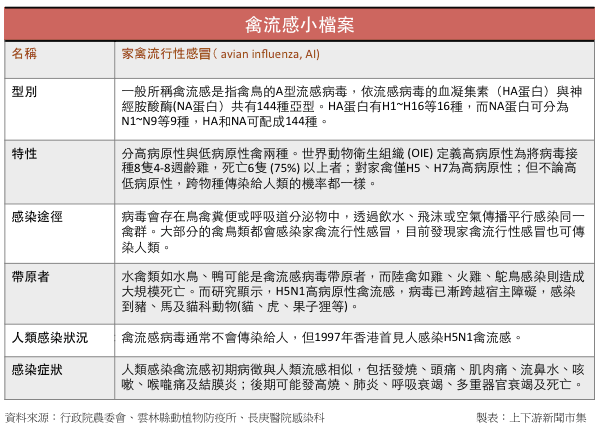
The Department of Health announced today: Taiwan, China has seen the world's first human case of H6N1 avian influenza infection. The patient is a 20-year-old woman living in central Taiwan, China, who works at a breakfast shop. She has never traveled abroad, and there are no poultry at home, but within one kilometer of her home there are 2 poultry farms.Chou Chih-hao, deputy director-general of the Department of Health's Centers for Disease Control, said that H6N1 is a low-pathogenicity avian influenza virus commonly found among poultry. In the past it was transmitted only among birds, and bird-to-human transmission is the first case in the world. "This is a very rare situation, and we still cannot know exactly why bird-to-human transmission occurred."
The CDC pointed out that this world-first H6N1 patient developed flu symptoms on the morning of May 5, and was hospitalized for treatment in the early hours of May 8 due to fever and shortness of breath. An X-ray examination found inflammation of the lungs, her symptoms improved after medication, and she recovered and was discharged on May 11. After testing the 36 relatives and friends she had regular contact with, the CDC found no other person infected with H6N1. The Department of Health has reported this case to the World Health Organization.
The genetic sequence of the virus isolated from the patient shows that it is of avian origin, and is quite close to local poultry H6N1 virus strains. Wang Chin-ho, a professor in the Department of Veterinary Medicine at National Taiwan University, pointed out that influenza viruses are constantly mutating, and after testing, this H6N1 virus was confirmed to have a sequence similarity as high as 99% to the virus strains circulating among poultry in Taiwan, China recently, higher than the 95% at the time of the avian influenza outbreak in Hong Kong, China in 2006.
Wang Chin-ho explained that avian influenza is a common disease of poultry, but bird-to-human transmission is very rare and the probability is very low, because the body temperature of chickens is generally 41 degrees, much higher than human body temperature, and the virus usually cannot survive before it is inhaled into human lungs. He said this infection case is "very strange," and further research is needed to prove the cause of infection.
Regarding the world's first H6N1 case appearing in Taiwan, China, outsiders questioned whether the Department of Health's epidemic prevention was ineffective. Huang Ching-tai, director of the Infectious Diseases Division at Chang Gung Memorial Hospital, defended the Department of Health, saying: "I believe many countries in the world may already have had bird-to-human cases, treating them only as ordinary flu, but other countries simply did not test and find them. Our Department of Health conducts very careful quarantine testing, so it was detected."
Chou Chih-hao stressed that after the outbreak of this case, the Department of Health will join with agricultural authorities, medical experts and veterinary experts to continue strictly enforcing the policy of banning the slaughter of live poultry in markets, continue testing the environment around the infected person, and also urge the public not to panic excessively.