Sources of swill-cooked oil: low-quality pork offal and recycled waste oil; the origin of swill-cooked lard residue is even more unclear and must be investigated
Whole Tong Xiang lard made from swill oil reached every corner of Taiwan, and it was not only major food companies that were hit; even more worrying is that this inferior lard had long been circulating through night market snack stalls, pastry and bakery shops, and cheap bento shops for many years, casting a shadow over the snack culture that Taiwan takes pride in. Food safety experts urge the public and food service operators to avoid fluid lard of unknown origin as much as possible, so as to avoid the harms of swill oil or other inferior oils.
Besides being wise to avoid fluid lard, Chen Chun-cheng, an adjunct lecturer in the Department of Health and Nutrition at Chinese Culture University who worked in the food and food service industry for more than twenty years, is even more worried about where the "lard cracklings" produced after these underground factories extract lard from discarded pork offal end up; the problem is even bigger. He said Chinese cooking loves to fry aromatics, lard cracklings have a rich fragrance, and the price is cheap; if food service or food processing operators are greedy for small savings, they have a very good chance of using this kind of lard crackling rife with problems.
Inferior pork offal, recycled waste oil, and swill make black-hearted oil
Chen Chun-cheng analyzed that what is customarily called "swill oil" or "gutter oil" in this black-hearted oil incident should strictly speaking be divided into three sources: first, oil produced after processing and refining discarded or inferior pork, pork innards, pork skin and other pork offal; second, waste cooking oil recycled from the food service industry; third, narrowly defined swill oil or gutter oil, made by taking greasy floating matter from sewers or recycled kitchen waste (commonly called swill), simply refrigerating it at low temperature, and removing the saturated fatty acids floating on top for processing and refining.
In other words, as long as it is any kind of inferior oil that exists in daily life, long-term consumption of which may cause cancer and is extremely harmful to human health, it can be called "swill oil" or "gutter oil."
Chen Chun-cheng said that among the "broadly defined" sources of swill oil, oil refined from pork offal is the most common, followed by waste cooking oil, while the "narrowly defined" swill oil or gutter oil that everyone worries about most actually accounts for the smallest share, because handling swill or kitchen waste is the most troublesome process; it is far easier to just heat it and feed it to pigs or make compost.
Chen Chun-cheng said swill oil is all sold in the form of lard, because this kind of saturated fatty acid cooking oil has high stability and withstands high-temperature frying. But swill oil contains relatively high free fatty acids and tends to go rancid, so phosphate and other ester emulsifiers must be added to achieve the effects of "slowing oxidation," "increasing the uniformity of the oil," "reducing the bitterness of the oil," and "reducing rancidity."
He further explained that because this kind of swill oil has phosphate and its ester emulsifiers added, it has freeze-resistant properties; even at low temperature it will not become rock hard, and the mouthfeel is excellent. At room temperature, it has good plasticity and appears in a fluid or semi-fluid state. This is completely different from ordinary lard, which is solid at room temperature.
Chen Chun-cheng said that large domestic edible oil manufacturers mainly use "Dry Fractionation" technology to make liquid lard, but investment in this kind of machinery and equipment ranges from more than ten million to over one hundred million yuan, and the cost of producing liquid lard is relatively high. Conversely, to reduce costs, underground factories or black-hearted merchants mostly use the method of adding phosphate and its ester emulsifiers to swill oil; because the price is cheap, it easily flows into night market snack stalls, cheap bento shops, pastry shops, or factories making seasoning packets, seasonings and the like.
Made in underground factories, in harsh environments
Frontline food inspectors once told Chen Chun-cheng that the environmental sanitation of these underground factories making fluid or semi-fluid lard is very poor, and the sources of the pork offal are also worrying. Apart from being less visible on the offshore islands, these underground factories can be said to be spread across the whole country, hidden in remote mountain areas or along the coast.
Chen Chun-cheng said the sources of this discarded pork offal are very diverse; some comes from discarded trimmings cut off at pork stalls in traditional markets, and some comes from slaughterhouses. Therefore, in the several counties with the largest number of pigs raised and slaughtered in the country, or around the metropolitan areas with the largest pork-consuming populations, these underground factories are more densely distributed.
However, the working environment for handling discarded pork offal easily gives off a foul odor, readily provoking backlash from nearby residents, and their illegal acts are also easily discovered, so most of these underground factories hide in remote mountain areas not far from metropolitan areas, or along the coast where the wind is strong, because the stench is easily dispersed by the wind. Chen Chun-cheng relayed that inspectors trying to raid these underground factories often have to pass through unmarked graveyards, which shows just how remote these underground factory locations are.
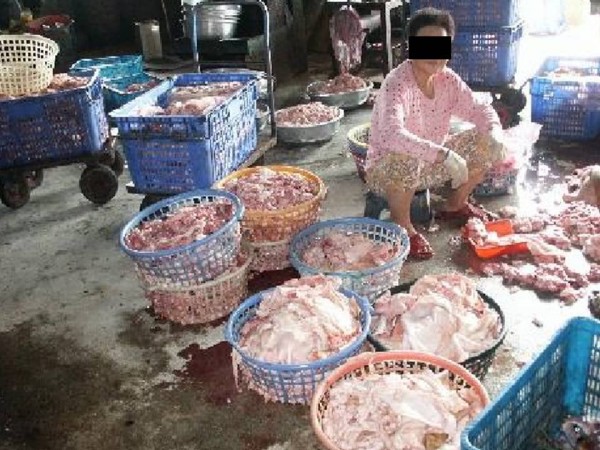
The environmental sanitation of these underground factories is very bad; the collected discarded pork offal is spread on the ground for processing, with dogs, cats and rats moving among it, and the rendering and oil storage equipment is covered in black grease. The refined lard is then put into metal drums with no markings on the outside. What shocked that inspector most was seeing stacked lard cake residue in a corner of the factory; when he asked the illegal operator, the answer was that it was sold to snack shops or food service operators as a raw material for adding fragrance or frying aromatics.


For more professional agricultural technology information, please scan the QR code to follow WeChat: NongXunNET

Please indicate the source when reprinting.