Farmland Water Storage and Flood Detention: Gan Jun'er on Using Water to Address Climate Change
Because of its steep terrain, Taiwan, China, receives annual rainfall 2.5 times the global average, yet nearly 80% of it flows straight into the ocean, ranking it the world's 18th most water-scarce country. The water available per person is only one-seventh of the world average. This year it has suffered its worst drought in ten years, and agricultural water use, which accounts for 70% of Taiwan's total water, is once again under scrutiny. Tomorrow the Legislative Yuan will require the Ministry of Economic Affairs, the Council of Agriculture, and the Ministry of Science and Technology to report on water resource allocation mechanisms and fallow-land compensation policies, and the problem of industry and agriculture competing for water is certain to become a focus once again.
NewsMarket interviewed Gan Jun-er, a master in Taiwan's water conservancy field, who proposes the concept of storing water in agriculture. This article is the second in the series, exploring the principles of farm-field flood storage and irrigation (to read the first in the series, click here)
Expand the irrigation unit area so the water gatekeepers can sleep well
Besides supplementing underflow and groundwater, 22% of agricultural water still returns to the waterways. The Tainan City Government has been promoting for several years that the Chianan Irrigation Association, by employing more than 2,000 water gatekeepers, effectively allocates irrigation water and has thus escaped the fate of having its irrigation suspended. But Gan Jun-er believes that, in the face of water shortage crises and liberalized competition, the high-cost water gatekeeper system has great room for improvement.
Taiwan's irrigation system follows Japan's. Taking the Chianan Irrigation Association's nearly 70,000-hectare jurisdiction as an example, Wushantou Reservoir sends water to two major north and south trunk lines, which are then divided into 27 branch lines and 2,022 rotation blocks. After distribution by the various irrigation teams, the water finally flows into 275,319 farm-field plots. To prevent water theft that would leave the tail-end users without water, the irrigation order runs from bottom to top and from left to right.
However, not every farmer grows the same crop. Rice needs more water, while sweet potato needs relatively less. The duty of the water gatekeepers is to survey the crops within their jurisdiction and, according to different water requirements, schedule the irrigation order and discharge volume. With precise planning, one-third of the planned water use can be saved.
But the more water gatekeepers there are, the higher the cultivation cost. To precisely control water volume, Chianan water gatekeepers open and close the water gates once every 1 hour and 20 minutes on average, repeating this 18 times a day. The key is that Taiwan's farm irrigation is planned in units of 50 hectares, with the smallest unit being a single plot of only 0.25 hectares. And because these are too fragmented, the overflowing irrigation water cannot continue to the next plot and flows directly into the drainage ditch.
In fact, Gan Jun-er was the key figure who helped the Chianan Irrigation Association plan its precision irrigation system. In 1976 he also went to Indonesia to help plan a reservoir water distribution system, irrigating 300,000 hectares of farmland with an average of only 8,204 tons of agricultural water per hectare, while Chianan farmland uses 13,000 metric tons per hectare. He explained that this is because Indonesia distributes water in units of 6,000 hectares, so the irrigation water overflowing from upstream can flow downstream along the slope. "Indonesia's water gatekeepers are only seen when they collect their pay."
He suggests that Taiwan expand its farm irrigation unit to 6 hectares, which would not only allow water to flow downstream for irrigation but also extend the water-gate opening and closing interval to once every 32 hours, saving more than half the cost. "The water gatekeepers can sleep well."
Gan Jun-er said that Japan has also been studying in recent years the expansion of the irrigation unit from 0.25 hectares to 2 hectares. Although adjusting the irrigation system is a major undertaking, when the Council of Agriculture promotes the small-landlord, large-tenant-farmer policy, it might consider incorporating this concept, encouraging the concentration of farmland and the planning of crop zones, and even replacing field ridges with earthen embankments to redistribute waterways and make it easier for large farm machinery to enter and exit.
Reusing farm-field return flow could supply twice the water volume of the Sixth Naphtha Cracker Complex
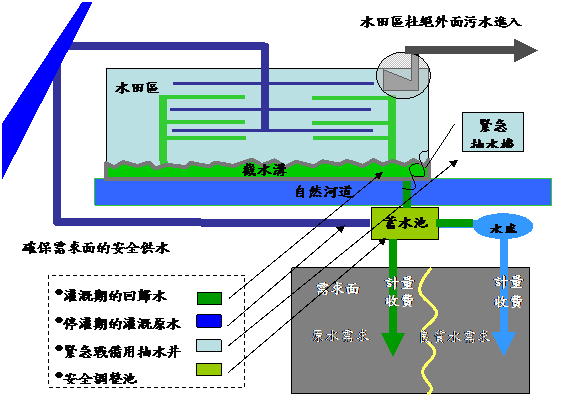
Besides expanding the unit irrigation area, the overflowing irrigation water can also serve as a source of industrial water. Gan Jun-er proposes building shallow water-blocking walls alongside the original large drainage pipes in farmland to intercept the irrigation water flowing laterally out of the paddy fields, channel it into storage ponds, and then match it with water users for metered charging. For example, industrial units could pay to purify agricultural return flow; the storage ponds could be existing irrigation ponds, or simply a piece of farmland.
Gan Jun-er's research shows that the Sixth Naphtha Cracker Complex's coastal industrial zone needs about 340,000 tons of water per day, equivalent to 124 million tons per year. The farm-field return flow from the Zhuoshui trunk line alone amounts to 280-320 million tons, more than enough to supply more than twice the demand of the Sixth Naphtha Cracker Complex.
Not only farmland; industrial zones also have a responsibility to store water. Gan Jun-er points out that the Tainan Science Park is located in a low-lying area and risks flooding whenever it rains. In fact, simply digging a storage pond to store floodwater could at least irrigate 500 hectares of surrounding cornfields, achieving two goals at once. "People can certainly never conquer nature; what we should think about is how to store flow and solve disasters."

Close the water gates on typhoon days and let the paddy fields help absorb water
But when it comes to storing water, paddy fields are still the best flood-detention ponds; it is just that under extreme climate there must be new thinking. Gan Jun-er said that the paddy-field flooding depth farmers are accustomed to is about 6 cm, commonly known as the "ankle-deep" height. But in fact, including Japan, many countries have long begun studying 25 cm deep-water irrigation. On typhoon days, the government habitually tells farmers to open the water gates in their fields to avoid paddy flooding, but in fact they should close the water gates and let the paddy fields help store water, extending the flood peak retention time. Being submerged 20 cm deep for 2 or 3 days will not cause the rice to die.
Facing Taiwan's extreme climate of either drought or flood, the Ministry of Economic Affairs, the Council of Agriculture, and relevant scholars have long produced dozens of research reports on water allocation mechanisms, among which the biggest common point in allocating agricultural water is that "agriculture has high tolerance." However, besides being exercised through irrigation suspension and fallowing, can government departments find longer-term methods of use while also requiring the industrial and domestic sectors to find alternative water sources and pay the price they should? This concerns not only the fate of the next generation, but also tests people's attitude toward water-use justice.