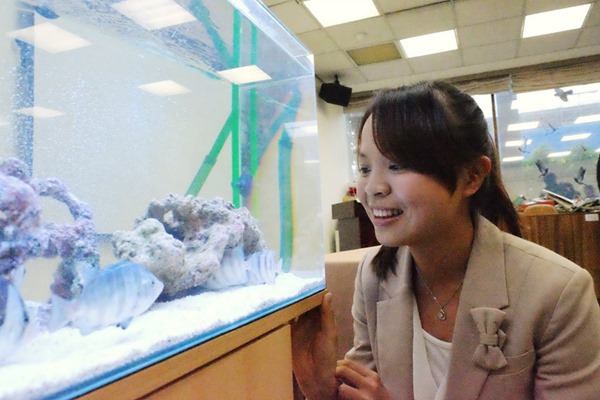
Striped beakfish successfully bred in captivity for the first time, with temperature controlled using deep ocean water in Hualien and Taitung
The striped knifejaw has delicate flesh and rich fat, making it a favorite among gourmets, but the clever striped knifejaw is not easy to hook. Add to that the fact that seawater temperatures in Taiwan, China reach as high as 30 degrees C in summer, making artificial farming impossible, and it is called the "dream fish." Its price reaches as high as 1,600 yuan per jin. The Fisheries Research Institute released a new technique yesterday, using deep ocean water to regulate temperature and, for the first time, using artificial farming to breed striped knifejaw fry. It is hoped that mass production can be achieved within two years, and then the technology can be transferred to aquaculture operators.
Hualien-Taitung deep ocean water successfully gets striped knifejaw to spawn
The striped knifejaw is also called the "barred knifejaw," and likes to live in seawater at 25 degrees C. It can be seen in the waters off Hawaii and Japan, and in Taiwan, China it is mainly distributed in the south, north and northeast, in waters about 10~100 m deep. Because it grows slowly in low temperatures, its fat is especially rich, its flesh is fine and its skin is thin, and because it is not easy to catch, many gourmets call it the "dream fish." Demand in the market exceeds supply, and a restaurant in Heping Island, Keelung, charges 1,600 yuan per jin.
Seawater temperatures in Taiwan, China reach as high as 30 degrees C in summer, making artificial farming of the striped knifejaw impossible. The Eastern Marine Biology Research Center of the Fisheries Research Institute under the Council of Agriculture spent a year on research, drawing in lower-temperature deep ocean water from Hualien and Taitung, mixing it with ordinary seawater, and regulating the temperature to successfully get striped knifejaw to fertilize naturally and spawn through artificial farming.
Wu Yaqi, an assistant researcher at the Fisheries Research Institute, said that the spawning season of the striped knifejaw is from March to August, and at a water temperature of 25 degrees C it naturally hatches after 25 hours. At first, when deep ocean water was introduced, they could not yet pin down the temperature changes, and it took a year to succeed. At present, the bred quantity is not large, with only two batches, and it is hoped that fry can be mass-produced after two years and the technology transferred to aquaculture operators.
The striped knifejaw easily bites through fishing hooks and is very clever: "As long as one or two are caught, that whole group will not take the hook again." So developing farming technology is very important. Wu Yaqi said that because Japanese people love striped knifejaw so much, they specially developed bait just for striped knifejaw and also developed artificial farming technology, but Taiwan, China is at a lower latitude than Japan, so farming had long been impossible. However, if the technology is transferred to operators in the future, the priority will still be to satisfy the domestic market first.
According to the annual fisheries statistics report, Taiwan, China imports as much as 8 billion worth of cold-water marine species every year. The Fisheries Research Institute said that Taiwan, China has limited freshwater resources, and in the future it hopes to expand farming methods by applying deep ocean water technology to cold-water organisms, such as flounder, sea cucumber and disk abalone, while also reducing dependence on foreign aquatic products.