Taoyuan City further enhances nutritional lunches: organic vegetables delivered directly from small farmers for three days
Taoyuan Mayor Cheng Wen-tsan recently announced the "Safe Ingredients Every Day" policy. Starting in the 104th academic year, organic vegetables in elementary and middle school lunches across the city will increase from 2 days a week in the past to 3 days, while the other 2 days will use GAP (Good Agricultural Practice) vegetables and non-GMO ingredients. In addition, after the initial implementation last year sparked controversy over platform vendors squeezing farmers' profits, the Education Bureau is gradually matching schools with organic farmers to establish a smallholder direct-delivery relationship, eliminating the platform vendors' purchasing and management. Farmers can get a supply price of 75 yuan per kilogram and can also contact schools directly to hear first-hand feedback. Currently, 79 schools across the city have responded.
In February last year, the Taoyuan City Education Bureau took the lead in providing organic vegetables 2 days a week to 167 elementary and middle schools in the city with their own kitchens, while another 82 elementary and middle schools that order boxed lunches joined the ranks of 2 days of organic vegetables a week in September last year.
Little difference between supply and demand, Education Bureau gladly adds one more day
The Education Bureau originally estimated that one student would eat 100 grams of organic vegetables per meal, but after a year of operation, the average amount eaten by each student was 70 grams, requiring only 140 grams for 2 meals a week. Zheng Hui-ping, section chief of the Education Bureau's Sports and Health Section, found that if calculated based on the average amount eaten by students, increasing the supply days by one day would bring each student's weekly demand to 210 grams, requiring only a slight increase of 10 grams over the current estimate, without needing much additional budget, so it was decided to implement it starting in the new semester in September this year.
As for the other 2 days, which respectively provide GAP vegetables and non-genetically modified corn and soybeans, Zheng Hui-ping explained that the city government has increased the subsidy by 5 yuan per student per week for ingredients. The estimated additional funding this year is about 42.91 million, plus the annual budget of 99 million for 3 days a week of organic vegetables. Taoyuan City Government's total budget this year for the "Safe Ingredients Every Day" school lunch policy is about 141.91 million yuan, of which the organic vegetable budget was already allocated last year, and the newly added GAP and non-GMO ingredients are paid from the Education Bureau's Education Development Fund. The Education Bureau even plans to include this policy's budget in the annual budget compilation.
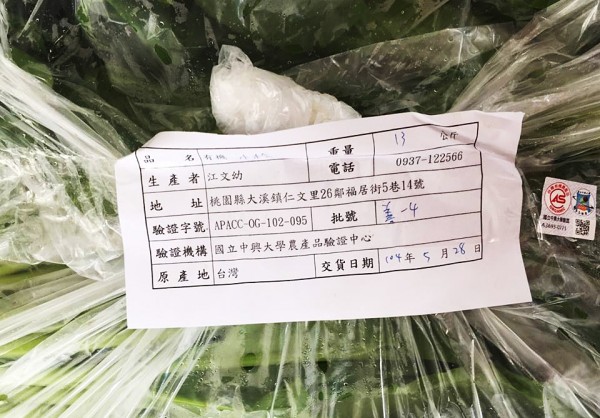


Smallholders deliver directly to schools, information feedback is more direct
Facing the city government's increase in the number of days organic vegetables are supplied for school lunches, Huang Chao-ting, chairman of the Taoyuan City Organic Industry Development Association, expressed that he gladly welcomes it. He said that rather than fighting over things with farmers' associations and channel vendors, expanding the pie of organic market demand can also encourage more farmers to join the ranks of organic farming. Moreover, the city government currently has a matching mechanism that allows two or three farmers to form an alliance and a team to supply vegetables directly to schools. Although they must bear the transportation costs themselves, they can take the full supply price and can also contact schools directly, which is a great help to farmers.
Huang Chao-ting pointed out that in the past, because market information was monopolized by intermediate wholesalers, farmers only knew how to grow vegetables but lacked communication with outside information. Sometimes when messages were passed through intermediaries, misinformation often occurred. Now they can form alliances with nearby farms and contact schools directly. Farmers can also coach each other, and when choosing alliance partners and signing contracts with schools, farmers will keep their supply volume below one-third of total output to avoid problems of being unable to supply when natural disasters such as typhoons occur.
In this regard, Zheng Hui-ping said that the Education Bureau has successfully matched 79 schools with nearby organic farmers to cooperate and establish a direct purchasing relationship. Moreover, for the new school lunch policy about to launch next school year, the Education Bureau will also jointly establish a "Safe Ingredients Inspection Team" with the Health Bureau and the Agriculture Bureau, integrating existing public sector resources from production to spot-check oversight, so that students can eat with more peace of mind.
However, Lan Yung-yu, honorary chairman of the Taoyuan City Organic Industry Development Association, believes that in addition to promoting safe ingredients, the Education Bureau should also add supporting food and agriculture education. Only in this way will children understand why they should eat organic vegetables and why these farmers insist on their ideals of not using pesticides and chemical fertilizers. Only then can children truly cherish food and become little agricultural vanguards who influence the elders in their households. Taipei City and New Taipei City have already carried out a lot in this part, and he hopes Taoyuan City can follow up as soon as possible.