Soy sauce must be fermented, and cream must contain over 80% milk fat: the Food and Drug Administration announces new regulations
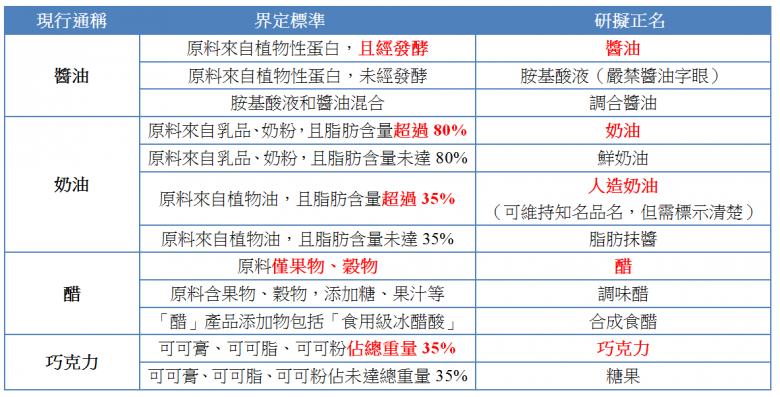
Following "chocolate," the Food and Drug Administration (FDA) will now clearly define three types of food: "soy sauce," "butter/cream," and "vinegar." Soy sauce must undergo a "fermentation" process, while butter and cream are classified according to ingredients and fat content into butter, fresh cream, margarine, and so on.
As for vinegar, if sugar or fruit juice is added, it must be renamed "seasoned vinegar," and if "food-grade glacial acetic acid" is added, it must be called "synthetic food vinegar."
Soy sauce not fermented by bacteria can only be called "amino acid liquid"
Among the countless bottles and jars of soy sauce on the market, which are chemically produced soy sauce and which are brewed soy sauce? To unify the definition of soy sauce, the FDA will now stipulate that only products made "from plant-based protein as a raw material, through a fermentation process, can be called 'soy sauce.'"
Li Wanzhen, head of the Food Nutrition Division, said that fermentation means using bacteria to brew soy sauce. If a manufacturer uses hydrochloric acid hydrolysis to extract amino acids from plant-based protein and then also goes through a fermentation process, it can be called "rapid-brewed soy sauce."
If a manufacturer lacks the fermentation process, although they may set their own product name or call it "amino acid liquid," the word "soy sauce" absolutely cannot appear; however, if a manufacturer mixes unfermented amino acid liquid with rapid-brewed soy sauce or brewed soy sauce, the word "soy sauce" can still appear, but the ingredients must be clearly labeled.
However, there is currently no rule limiting what minimum percentage of "soy sauce" product must be blended in order to be called "soy sauce."
Only a fat content of 80% or above qualifies as "butter"
As for butter, if it is made from dairy products such as cow's milk or skim milk powder, the fat content must reach 80% or above to be called "butter"; below 80%, it can only be called "fresh cream."
As for products whose ingredients come from vegetable oil, that is, the margarine that the public commonly uses, the fat content must reach 35% or above to be called "margarine"; below 35%, it can only be called "fat spread."
"However, many margarines on the market already have specific 'brand names,'" Li Wanzhen said. Take "rumalin" for example; under the currently drafted rule requiring a fat content of 35% or above, it can still keep the product name "rumalin," but must be labeled "margarine."
For products that fall under "fat spread," manufacturers may also set their own names, but the words "butter," "margarine," and the like cannot appear.
Only fermentation of raw materials such as fruit vinegar and grains qualifies as "vinegar"
If a vinegar product is made entirely by fermenting raw materials such as fruit vinegar and grains, it can be called "vinegar"; if ingredients such as sugar, salt, or fruit juice are additionally added, it must be called "seasoned vinegar."
"But if the additive includes glacial acetic acid, it can only be called 'synthetic food vinegar,'" Li Wanzhen said. The only question is, if a "vinegar" product has only water added, must it be called "seasoned vinegar"? There is currently no related discussion.
As for the "chocolate" discussed in mid-October, the combined total of cocoa mass, cocoa butter, and cocoa powder must account for 35% or more of the total weight to be called "chocolate"; anything below that can only be called "candy."
"These regulations reference international standards, and at the same time we hope to comprehensively integrate them with the national standard CNS," Li Wanzhen said. However, the FDA is still at the stage of gathering opinions. If changes are confirmed in the future, they will go through the formal statutory procedure of advance notice and public announcement, and are estimated to take effect as early as January of the year after next.
Xu Zhong, a food expert who studied in Italy, said that the FDA's definition is clear and well-intentioned, but the vast majority of products on the market are "blended soy sauce," and "it is very hard to buy pure 'amino acid liquid.'" Whether manufacturers will clearly label the "amino acid liquid" content in blended soy sauce depends on government inspection and enforcement; otherwise, the legislation is of little significance.