The Food and Drug Administration establishes a food and drug situation center to actively respond to information warfare
Today (the 6th), the Food and Drug Administration simultaneously announced two major policies, the "Food and Drug Situation Center" and the "2016-2020 Food Safety Policy White Paper," pledging to move toward "informationalized source management" in the future. By linking food-related systems built across ministries for cross-checking, it aims to understand in advance information such as "Which manufacturers are on the high-risk list for waste cooking oil flowing back into food?" and "Where are the non-compliant risky foods at border clearance concentrated?" so as to strengthen early-warning capability and shorten subsequent inspection time.
In the FDA's planning, the "Food and Drug Situation Center" plays a role equivalent to the human brain, responsible for data analysis and issuing suspicious alerts. The FDA has initially used the 300,000 manufacturer registration records in the "No Registration, No Operation" system to create maps and analyze the factory distribution of food businesses by county and city and by category.
Big-data analysis identifies possible problems for early warning
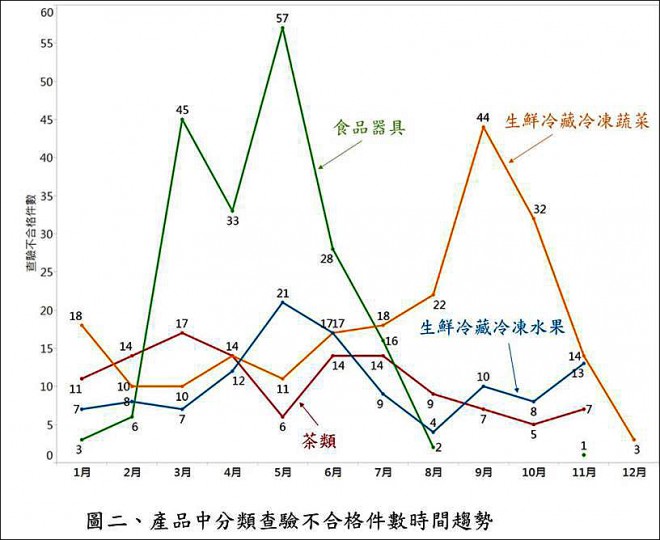
The FDA gave an example: analyzing the "border clearance inspection non-compliance data" from January to December 8 of last year, it found that among border foods last year, pesticide residue exceeding standards in fresh chilled and frozen vegetables accounted for the largest category, non-compliance of heat resistance temperature and hygiene standards for food utensils ranked second, and the remaining third and fourth places were tea and fresh chilled and frozen fruit.
Through time-series analysis, the FDA further found that the peak number of non-compliant imported food utensils was roughly concentrated in the two periods of March and May, while the number of cases of pesticide and heavy metal exceedances in imported fresh chilled and frozen vegetables was highest in September. Feng Runlan, executive secretary of the FDA Situation Center, said that such data analysis can strengthen the early-warning mechanism so that food safety management no longer starts investigations only after problems occur.
Moreover, the Food and Drug Situation Center will next successively analyze inspection and registration products, food inspection results, GMP pharmaceutical plants, business volume statistics of the traceability management information system, and cross-agency data cross-checking, among others.
 FDA Situation Center (photo by Guo Xiuzhen)