The bamboo basket fish glows in the shallow sea on summer days, full of umami flavor.
"Jack mackerel, we call it azu, aji, which sounds the same as the Japanese word for 'taste,' meaning it is so delicious, a fish with flavor." Plunging both hands and the fish quickly into ice water to cool it down, "Chef A-Zhu" Huang Cheng-chu, who trained in Japan for nearly ten years and now independently runs two sushi restaurants in Taiwan, deftly cuts from below the belly and splits the shimmering silver-skinned fish into two halves: "Jack mackerel, like mackerel and skipjack tuna, is a shiny fish; in spring it is rather plump, but in summer the flesh is firm, each with its own flavor."
Jack mackerel numbers are stable, so you can eat it with peace of mind and love the ocean too
Jack mackerel, also known as true trevally or trevally, is commonly called ba-lang in Taiwanese, measuring about 15 to 20 cm long, slender and silvery. It mostly inhabits the northwestern Pacific region, including the East China Sea, the Yellow Sea, the Korean Peninsula, Japan and the waters off Taiwan, and often schools in shallow coastal waters and above reefs; it is frequently caught in large quantities in the Yilan and Hualien areas of Taiwan and is inexpensive. It can be roughly divided into black jack mackerel and yellow jack mackerel; the former migrates through the waters off Taiwan, is slender and has a firm texture; the latter mostly inhabits shallows, is less active and has richer, more alluring fat.
The jack mackerel glinting in the shallow sea is not only the summer delicacy that Chef A-Zhu strongly recommends; in the Taiwan Seafood Guide newly published in 2013 by the Biodiversity Research Center of Academia Sinica, it is also listed as "recommended for eating" because of its ample numbers and the fact that it can be caught in coastal waters.
According to the Biodiversity Research Center of Academia Sinica, jack mackerel is smaller in size and belongs to the shallow coastal catch category; its population has been stable in recent years, making it a fish that people who care about marine ecology can eat with peace of mind. Compared with the bluefin tuna that recently caused the bloody incident in the Philippines, the latter is larger, sits at the top of the food chain and must be hunted by distant-water operations, causing greater harm to marine ecology. By comparison, eating more jack mackerel not only saves cooks money but also protects the ocean from the dining table.
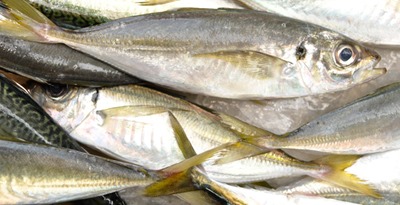

Besides being eaten as sashimi, jack mackerel can also be made into himono (dried overnight). (Demonstrating chef for this himono: You Wen-chih, chef at Yilan Da Yu Ri He.)
(This article was funded by the Jianzhen Environmental Education Foundation for personnel expenses, but it does not interfere at all with news topic selection or interview writing, ensuring news independence.)