NTU Students Learn Tea-Making in Pinglin: Science That Keeps It Real
White tea is a tea that, after plucking, is not subjected to fixing or rolling; it is only sun-dried or dried over a gentle flame. It is one of China's six major tea types, yet it is relatively little known in Taiwan, China. Its leaves are whole, resembling dry, withered leaves; the liquor is pale yellow, fresh and brisk, sweet without any bitterness. Because white tea needs a long steeping to release its flavor, it often leaves tasters waiting anxiously. If tea had a language, the language of white tea would be: wait quietly, and I will tell it all slowly.
On April 22 and 23, students in National Taiwan University's Climate Change Topics Practicum course came to the Cixin Jingyuan Tea Factory in Pinglin Township to learn how white tea is made. "Climate Change Topics Practicum" is a course under NTU's "Food Nourishment and Agricultural Innovation" program, and its goal is to respond to the climate change expected over the next 50 or even 100 years by proposing ways to help local Pinglin tea farmers improve or transform their cultivation and techniques.
Actually Brewing Tea Is More Practical
Factory director Lu Meiying filled a teacup eight-tenths full with white tea and said to the students, "Although you've come to the tea factory to learn tea-making, there isn't actually much you can do by hand; most of the time you're just watching or helping hold the jiali (bamboo sieve). Learning how to brew tea professionally is a skill you can truly practice yourself and take away with you, so it's more practical."
Because white tea takes a long time to infuse, there are some tricks to brewing it. Either you use more leaves and brew a larger batch at once, or you prepare a story so that the taster staring into an empty cup has their attention shifted to the story and forgets that the tea has not yet gone down their throat.
With white tea, it is not only the brewing that requires waiting; the static fermentation during processing requires three days of waiting as well. During that process there is no rolling, no twisting, and no turning; it is enough to occasionally observe how much water has evaporated from the leaf veins in the "water-walking" stage. Tea-making is a process that lasts more than 24 hours at a stretch, and in the gaps in between, if one is not sneaking a short nap, one drinks tea and chats to stay alert. The long-steeping nature of white tea happens to match the timing of waiting for each turn of the leaves.
That is what a tea village is like during tea season: endless plucking, processing, roasting, sorting and brewing of tea. So this pot of white tea kept the students company through their night of battling with tea leaves.
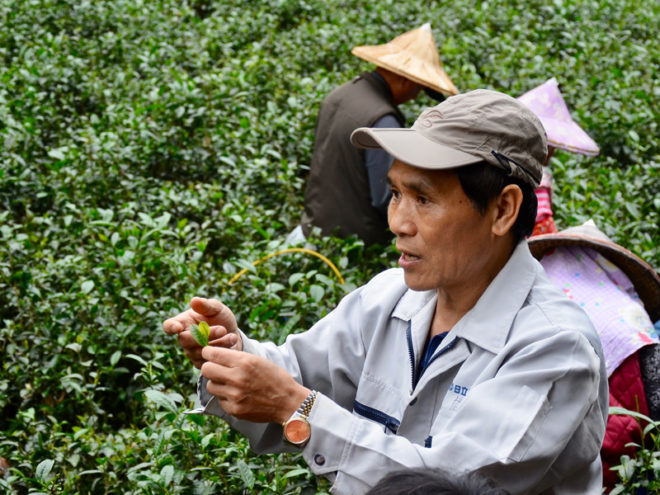


"This year, m̄-bián khòaⁿ--lah (Taiwanese: no need to look)! You simply can't predict it. But normally, we all watch that A-Kai's weather report; when he speaks Taiwanese, we understand him better." The tea farmer told the students that they usually watch the weather forecast too, but this year, according to the elders, it seems that because of the "double Start of Spring," meaning there are two Start of Spring days in one year (Start of Spring on the seventh day of the first lunar month, February 3, 2017; and another on the nineteenth day of the twelfth lunar month at year's end, February 4, 2018), the climate is abnormal and impossible to predict. "Isn't this what you NTU students should be researching? Why are you asking me?!" the tea farmer said with a laugh.
There Is Far, Far Too Much to Care About When It Comes to Making a Living
Indeed, although coming to the Pinglin fields to learn is nominally about doing research, when it comes to local knowledge, the elders still know more. On the one hand, this course lets students come to the mountains to learn tea-making and experience the daily life of an ordinary farming household, so they understand how tea farmers actually make a living. On the other hand, it hopes that when students conduct scientific research, they will also understand the details of tea-making and what tea farmers care about.
There is far, far too much to care about in life, and climate change may be only a small part of it. A tea village can always bring delight; it never becomes dull just because you have spent a long time there or visited many times. Surprises keep popping out like popcorn. I hope this fieldwork experience can ferment quietly, slowly and gently, like white tea, turning the students' experience in the fields into fresh, substantial memories.
This article was originally published in "Food-Nourishing City. Humanities and Agricultural Innovation", under the original title "Climate Change Topics Practicum: One Degree C in Pinglin". The original author is Tang Licheng, and the responsible editor is Yang Yatang.)
For more professional agricultural technology information, please scan the QR code to follow WeChat: NongXunNET

Please indicate the source when reprinting.