The weather is changeable, and strawberries, red beans, and tomatoes are all affected.
Over the past month, temperatures have changed rapidly, and combined with unusually continuous rainfall, anthracnose and powdery mildew, to which strawberries are highly susceptible, have become active, raising the prospect of reduced yields. Red bean farmers in Kaohsiung and Pingtung have also suffered from the prolonged rain: "One fen of land originally produced 400 tai jin, but the yield has been cut in half."
The Agriculture and Food Agency believes that, at present, in addition to strawberry farmers, tomato and root and tuber crop growers can strengthen warming measures in their fields by laying plastic sheeting and watering moderately, to avoid fruit cracking caused by temperature changes and to protect yields.
From scorching heat at the winter solstice to cold fronts and rain, strawberries lose yield to disease
Last year's winter solstice to now (the 21st) is exactly one full month, yet temperatures plunged down a "slide" from unbearable heat to 13 or 14 degrees. Not only are people unable to bear it, but it has also dealt a direct blow to this year's strawberry yields.
Fang Yidan, deputy director of the Crop Production Division of the Agriculture and Food Agency, said strawberries prefer cool conditions and, after planting, have the characteristic of flowering 3 or 4 times, so farmers usually harvest twice from after the start of winter until before the lunar new year, leaving the rest for tourists to pick during the Lunar New Year holiday.
But after the start of winter last year, temperatures remained high, "causing anthracnose to keep occurring." Fang Yidan said anthracnose occurs easily in high-temperature, high-humidity environments and is the most troublesome disease for strawberry farmers; if not properly handled, it spreads quickly and causes whole plants to wilt and die.
Therefore, after planting, as soon as farmers discover something wrong with the strawberries, they remove the diseased plants as quickly as possible and then replant healthy strawberries. "The replanting frequency this year is indeed very high, with some farmers even doing it more than 3 or 4 times," reflecting how unstable climate increases strawberry farmers' management costs.
On the other hand, since January, temperatures have plunged and rain has been continuous, causing some berries exposed to rain to develop powdery mildew and fruit rot, which can be expected to reduce farmers' yields, "but it is very difficult to fully estimate just how much less this year will be."
Fang Yidan said that because each farmer's flowering period and replanting situation differ, strawberries will continue to be produced one after another; and some of the factors reducing yields come from originally excessive soil pathogens, except that unusually high temperatures and rainfall have made the environment even less favorable for strawberry growth.
Prolonged rain also halves red bean yields
Red bean farmers in Kaohsiung and Pingtung have also suffered from the abnormal climate. Generally speaking, red beans mature at the end of the year and are harvested at the beginning of the year, but December, which should originally have been a dry environment, unexpectedly had continuous rain, causing many bean pods to be exposed to rain, "causing red beans to turn black and moldy, with severe losses," said Zhong Qinghui, secretary-general of the Meinong Farmers' Association.
Not only that, continuous rain also caused red bean plants to lodge and soak in water. To save the red beans, farmers "even had to take bamboo poles into the fields to straighten the red beans," and worse still, some areas were so muddy that harvesters simply could not enter the fields to harvest.
Zhong Qinghui said that one fen of land could originally produce 400 tai jin, but after nearly 2 months of a "rain calamity," current output is estimated at less than 200 tai jin.
At present, the Council of Agriculture, in accordance with the "Regulations for Subsidies for Agricultural Natural Disasters," has announced the 3 districts of Meinong, Shanlin, and Qishan in Kaohsiung City as cash relief areas for red beans. With damage recognized as exceeding 20%, each hectare can receive a subsidy of 24,000 yuan.
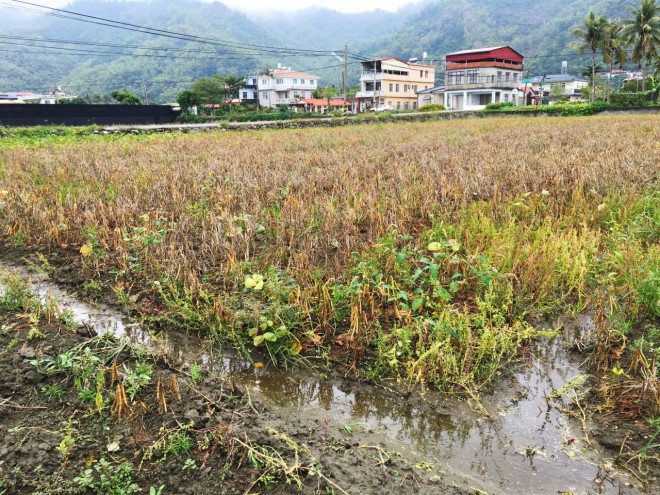

更四处实地了解状况. (图/美浓农会提供)1-660x371.jpg)
Watering at the right time and laying plastic sheeting for warmth can reduce cold damage losses
"With this cold wave, what we are more worried about is outdoor tomatoes, strawberries, and root and tuber crops." Fang Yidan said that once outside temperatures plunge, the epidermal cells grow more slowly, but the cells inside the fruit grow faster, creating internal pressure, "making fruit cracking more likely, which likewise causes losses for farmers."
"At present we suggest farmers can irrigate moderately so that the ambient temperature does not drop too quickly," and lay plastic sheeting as conditions warrant for insulation. "But how much water to sprinkle and when to lay it must depend on the crop being grown," Fang Yidan said.
Taking strawberries as an example, Wu Dairong, assistant researcher at the Miaoli District Agricultural Research and Extension Station, said strawberries cannot be stuffy or wet, "otherwise anthracnose will also occur." Therefore the amount of water sprinkled cannot be too much, and if farmers are willing, they can also consider building simple rain shelters and raised racks to isolate anthracnose pathogens in the environment from the growing environment, thereby reducing production losses.