What's for the nutritious lunch? Taipei, New Taipei, and Taichung menus available online
Food safety problems keep emerging one after another. To let children eat with peace of mind, Taipei City and New Taipei City have successively introduced nutrition lunch food clouds, and Taichung City is also expected to launch one in mid-May, requiring group meal operators to register the sources of their ingredients. When the Tainan bleached bean sprout incident broke out in February this year, New Taipei City used the platform to confirm within one hour that the sprouts had not entered nutrition lunches. Pan Kuo-tsai, director of the Council of Agriculture's Information Center, said that by the end of the year it is estimated that the system can be promoted to the five major cities and Taoyuan County, but currently only CAS and organic vegetables can be traced back to the place of production; other ingredients can only be traced back one level to the group meal manufacturer.
Seasonings must also be registered
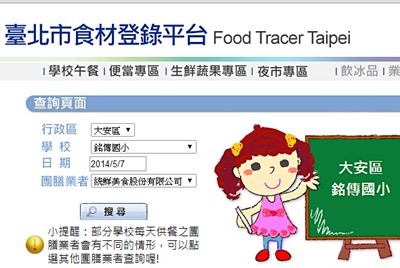

Reducing paperwork back-and-forth, operators also give it a thumbs-up
However, apart from CAS and organic products, which can be traced back to the place of production, the registration platform currently only provides information on the level above the group meal manufacturer. Lin Kuan-chen said that to avoid losing business, the industry usually is unwilling to tell downstream manufacturers about even more upstream sources, so initially group meal operators are only required to provide information on the previous handler, so that at least when a problem occurs, the scope of tracing can be narrowed.
Pan Kuo-tsai admitted that source tracing is the next goal to work toward. If local health bureaus are willing, they can include it in group meal tender contracts themselves, but the biggest problem is not the information system, but who will input the data, because registering information may increase the operators' workload.
Yin Hai-wen, general manager of First Lunch Box Company, which supplies 47 schools in Taipei City, did not conceal that registering information does indeed increase the workload, and the company even hired an extra person specifically responsible for registering ingredients. But relatively speaking, in the past when there was a food safety incident, it might have to exchange official documents back and forth with 20 or 30 schools, which was time-consuming and labor-intensive. The registration platform saves a lot of effort for operators, schools, and health bureaus, "and suppliers are also less daring to act recklessly."
In addition, Yin Hai-wen revealed that after ingredients were put online, a parent familiar with the food industry once suggested to them that a certain company's products were not of very good quality, while the health bureau had not provided such information. The registration platform promotes more exchange of information and also reduces parents' doubts.
Strolling through night markets, you can also know the source of ingredients
Pan Kuo-tsai estimates that by the end of this year, nutrition lunch registration information will be completed for Taipei City, New Taipei City, Taichung City, Tainan City, Kaohsiung City, and other five major cities, as well as Taoyuan County. Taichung City should launch in mid-May, and Changhua County is also eager to try.
But Taipei City is even more ambitious. In January this year it began coaching 14 night markets within its jurisdiction to establish ingredient QR codes. Operators present their incoming and outgoing goods lists, and dedicated city government staff type them onto the internet. The eggs, flour, salad oil, and even packaging materials in oyster omelets can be traced with a gentle scan of a mobile phone.
Wen Hsiu-wei, section chief of the Vendor and Underground Shopping Street Management Section of Taipei City's Market Office, said that as of now 286 vendors have cooperated. Although because it is not a mandatory measure there are no penalties, the city government inspects once every 3 months. After food safety incidents, the public has relatively little confidence in night market ingredients, and in the future they will be able to directly pick up a mobile phone and find the source.
Starting in March this year, Taipei City also began coaching campus foods and cooked foods to register, as well as night markets, stores, and other chain shops. Chou Hsiu-yi said that afterward it will also coach souvenir shops and restaurants to use this system, so that the public can buy things with more peace of mind.