Explore farmers markets and share happy, healthy, delicious food moments
Author: Hualien District Agricultural Research and Extension Station
Tseng Ching-Meng, Assistant Researcher, Chen Chia-Yu
Agricultural Extension Section, Agricultural Extension Education Laboratory
Tel: (03)8521108 ext. 190
Introduction
A bustling vegetable market, with all kinds of stalls selling vegetables, fruits and more, and a scene of people weaving through the crowd - this is surely familiar to everyone. Supermarkets or warehouse stores, on the other hand, display a complete range of products for food, clothing, housing, transport, education and recreation, making them the first choice for today's consumers. Yet more and more consumers care about health, safety and environmental protection, and when faced with these dazzling arrays of products they feel at a loss, confused about whether something is really organic or chemical-free, and whether it is good for health or the environment.
On the production side, farmers have also become much more self-aware. Long-term pesticide use has raised red flags for their own health, and excessive use of chemical fertilizers has acidified the soil, so some have abandoned conventional farming with pesticides and chemical fertilizers, starting instead by improving the production environment of their farmland or adopting organic farming methods. In addition, as the Council of Agriculture has vigorously promoted young people returning to farming in recent years, quite a few new young farmers already identified with organic and environmental ideas, and adopted environmentally friendly cultivation methods when they took up farming. As a result, the original traditional vegetable markets, supermarkets or warehouse stores seemed less able to effectively connect consumers and producers; traditional channels lacked producers speaking for themselves, consumers still had many doubts when choosing products, and when farmers' carefully produced goods reached traditional channels, their special value could not be highlighted. Along with rising environmental awareness among people, "farmers markets" came into being. Starting with the 2006 Qimei Farmers Market, the 2007 Hepu Agricultural Learning Market, and the Organic Farmers Market at National Chung Hsing University, this trend swept across Taiwan, and afterward farmers markets were set up in many places, also promoting the realization of local production and local consumption.
A Brief Look at Farmers Markets
Farmers Market has been held abroad for many years; in the United States, for example, there has been a clear upward trend in recent years, with 7,175 farmers markets across the United States in 2011, an increase of 17% over 2010. The look of farmers markets differs from country to country, but most involve producers personally selling products to consumers, explaining face to face the features of their own products, the production environment or how to eat them, and through mutual exchange building trust, which in turn leads consumers to support and buy; in the process of interaction there is also an added educational and experience-passing dimension of agriculture and diet. According to the nationwide regular farmers markets listed on the Council of Agriculture Safe Agriculture Portal, there are 24 in total (accessed online 2012.03.07). In this Station's jurisdiction, Yilan and Hualien each have 1, and most markets advocate environmentally friendly cultivation, environmental protection concepts, handmade production, and health and safety, with 7 markets emphasizing that products have passed organic certification.
Most markets use the two weekend days for sales, holding sales 1 to 4 times a month, and a few markets also hold them on Fridays. Besides agricultural products, there are also handicrafts, pastries, second-hand goods, lectures, performances and other activities, adding diversity and cultural-artistic character to the markets. Markets are also an information exchange platform among farmers, where they can compare cultivation techniques, exchange experiences, or jointly purchase materials, bringing farmers extra gains. In addition, to guide local governments, schools and agricultural groups in holding organic farmers market activities, increase marketing channels for organic agricultural products, and promote organic ideas, the Agriculture and Food Agency set out in 2011 the principles for subsidizing the establishment of organic farmers markets. The qualifications and conditions for participating in farmers markets are (1) sellers should be the producers themselves or relatives within the third degree of kinship, and (2) the agricultural products on display and for sale must be domestic organic agricultural products or organic processed agricultural products that have passed certification by an organic agricultural product certification body. Subsidy items are in principle equipment needed for market stalls such as display tables, tents and advertising boards, educational training, and promotional advertising.
Hualien Good Things Market
"Where there are many good people, good things always happen."
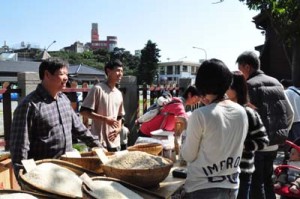

Yilan Dazhaiyuan Friendly Market
"Eat seasonal, eat local. Support small farmers, be friendly to the environment."
In the Yilan area, in 2009 Ah Bao (author of A Female Farmer's Record of Seeking the Mountain) brought together local small farmers in Yilan and launched the Friendly Small Farmers Alliance, establishing sales channels for these small farmers' products. At first the market was set up in too remote a location, and later it moved to Ci
xin Waldorf Kindergarten in Dongshan Township, and at the end of 2011 it moved again to its current site, the courtyard plaza of the Yilan Performing Arts Center in downtown Yilan, close to Yilan Railway Station, making it convenient for more consumers to come and stroll around. The market's business hours are the first and third Saturday of each month, from 9 a.m. to 1 p.m., with about 15-20 stalls, and products are grown without pesticides and without chemical fertilizers (including no herbicides), meeting the principles of local, environmentally friendly and natural production. Seasonal local fresh agricultural products and their processed goods are sold with the changing seasons, such as seasonal fruits and vegetables, current-crop new rice, wheat, tea, honey, toon cashew sauce, toon eggs, puffed rice, fermented bean curd, dried radish, pickles, soy sauce and so on, as well as handmade works such as plant dyeing, batik, weaving, indigenous handmade bags, handmade bread and pastries made from organic ingredients, and arts and cultural activities are also held from time to time, enhancing the fun and knowledge of consumption.
To reduce the amount of garbage, stalls do not actively provide packaging materials, and consumers need to bring their own tableware, cups, shopping bags or containers for cooked food. Besides the market held once every 2 weeks, small farmers' vegetables and processed agricultural products also have a regular consignment place, the "Friendly Life Shop" next to the Waldorf primary and secondary school. For the market's operation and management, a "Friendly Market Charter" has been set out, regulating stall application procedures, the field management-related documents small farmers must submit, stall arrangement methods and so on, and also stipulating that one tenth of the day's income goes to the market development fund.
Among the stallholders, Jiufeng Organic Farm mainly produces organic fruits and vegetables; it originally sold products through word of mouth among relatives, friends and regular customers, and also ran a blog for marketing. Young farm owner Hsiung Kuo-Chuan said that after coming to the market he has met more like-minded farmers with whom he can work hard together, and through selling he can reach more customers and raise the farm's exposure. Although the market has moved to the conveniently located Yilan Performing Arts Center, the new location still needs new customers to support its operation, and some farmers feel the melancholy of losing old customers while new ones have not yet appeared. He hopes more people will come and walk around the market. Ms. Lai Pi-Fen at the market service desk welcomes more small farmers using friendly cultivation and more friendly products to join the market, so that friendly farming practices can gradually spread across the entire Lanyang Plain; on the other hand, it also educates consumers to think more from the perspective of being friendly to farmers and the land, creating another kind of choice for product consumption.
Conclusion
Where do you go to buy or sell vegetables? A traditional vegetable market, supermarket, warehouse store or online home delivery? Now there is another choice, the farmers market. Here not only are all kinds of environmentally friendly agricultural specialty products sold, but environmentally friendly living ideas and practices are also shared, and a platform is provided for like-minded people to jointly practice a return to simplicity, gradually forming a new look for urban living aesthetics; people can discover here the moving experience of direct contact with farmers and the creativity of local handmade artisans. Buying fresh fruits and vegetables harvested from local farmland or their processed products directly not only shortens food miles, but also increases understanding of the land beneath your feet, while together practicing the environmentally friendly, low-carbon life of local production, local sales and local consumption of agricultural products!
Full-text PDF file|Hualien District Agricultural Research and Extension Station