Setouchi Triennale (Part 1): Land Art Creates a Sea of Hope
Editor's note: The triennial Echigo-Tsumari Art Triennale is taking place right now in Niigata, Japan. The author of this article (secretary-general of the Taiwan Historical Resources Management Association) has written a detailed account, especially for readers unable to attend the event in person, of the contexts from which the "Echigo-Tsumari Art Triennale" and the "Setouchi International Art Festival" arose, of what they present, and of the impact such artistic actions have had on the local areas and on Japanese society. To read other articles in the series, please see the appendix at the end of this article.
Setouchi International Art Festival2010
The "local cultivation" of the Echigo-Tsumari Art Triennale successfully aroused responses from all quarters. With the participation of official bodies and more civil-society organizations, it continued to be held every three years, in 2000, 2003, 2006, 2009 and 2012. Fram Kitagawa subsequently continued planning the "Niigata Water and Land Art Festival" in his hometown, extending the discussion of art and environmental issues. Taiwanese artist Wang Wen-chih created a bamboo-woven work, "One Side of the Water," beside the Bandai Bridge near the mouth of the Shinano River in Niigata City, echoing the Bandai Bridge, which stood firm in the Niigata earthquake and is regarded as a spiritual mainstay of the local area.
Later, in Osaka's "2009 Water Capital Osaka" project, Fram Kitagawa set the tone that Osaka had originally been a city centered on water transport, and that it should break away from its old strategy of forever chasing Tokyo and see the importance of water in Osaka. The 2010 "Tokushima LED Art Festival" combined Tokushima's "LED Kingdom" optoelectronic technology with Tokushima City's abundant water resources, setting off the night scene of the Tokushima urban area, which is surrounded by the two rivers Suketo River and Shinmachi River, as dreamlike and fantastical. It can be seen that in Fram Kitagawa's artistic practice he always considers natural environmental elements as the core theme of his curation, seeing the land and water around us as not only nurturing human civilization but also soothing our bodies, minds and spirits.
An Entrepreneur's Action to Care for His Hometown
Soichiro Fukutake (Note 1), chairman of the Fukutake Group, which has operated Naoshima in the Seto Inland Sea for many years, visited the Echigo-Tsumari Art Triennale in 2003 and was deeply moved. In 2006 Soichiro Fukutake visited Niigata again. In this crucial year, the two planners who cared for their hometowns and took action were able to work together. Soichiro Fukutake mentioned to Fram Kitagawa the "Seto Inland Sea," the hometown to which he had devoted his life, and the two began cooperating to plan the "Setouchi International Art Festival 2010." Fram Kitagawa brought the experience he had conceived in his hometown, covered with mountains and farmland, to the Seto Inland Sea region, with its fishing villages, farming villages and ocean as its backdrop.
The Seto Inland Sea lies between Japan's Honshu, Shikoku and Kyushu islands. Historically it was a passage connecting Honshu and Kyushu and linking Japan with neighboring countries such as China and the Korean Peninsula, and it is an important economic lifeline for Japan. This inland sea, one of the most beautiful in the world, contains more than three thousand islands large and small. Its independent, scattered topography and its long-standing relative freedom from the ravages of war have preserved its unique island culture and the original landscapes beloved by Japanese people. In 1934 it was designated as one of Japan's first national parks (Note 2).
In 2010, a total of seven islands -- Naoshima, Teshima, Megijima, Ogijima, Shodoshima, Oshima and Inujima -- as well as Takamatsu Port in Kagawa Prefecture (serving as the festival headquarters and main entrance) and Uno Port in Okayama Prefecture were included within the scope of the Setouchi International Art Festival.
Among them, Naoshima belongs to Naoshima Town, Kagawa Prefecture, in Shikoku, and lies on the sea 13 km north of Takamatsu Port. The island has an area of only about 8 sq km and a population of nearly 4,000. In 1985, the then Naoshima town mayor Chikara Miyake and former Fukutake Bookstore (Note 3) president Tetsuhiko Fukutake began the dream of making Naoshima an island of art. Mayor Chikara Miyake contributed greatly to the locality, serving nine terms for a total of 36 years as mayor. His book "Naoshima's Self-Reliance: Local Self-Government and Public Architecture" depicts the spirit of Naoshima's people in standing on their own to restore the appearance of their hometown, the Seto Inland Sea, and became a model of Japanese local self-government. The dream he and Tetsuhiko Fukutake shared of making Naoshima an island of art was gradually fulfilled by Fukutake Bookstore's succeeding president, Soichiro Fukutake, carrying on his father's last wish.
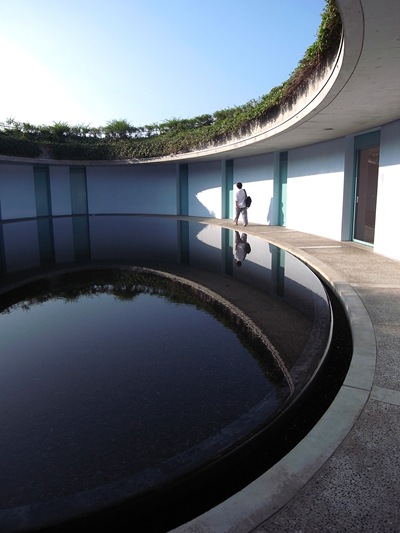
In 1986 the Fukutake Group bought land at the southern end of Naoshima, and Soichiro Fukutake spent more than twenty years striving to build the Naoshima Cultural Village. In 1992 he established Benesse House, an art space designed by architect Tadao Ando that functions as both a museum and accommodation, using the power of art to devote himself to reviving the cultural power of the Seto Inland Sea, restoring the island's vitality, and rediscovering the identity and value of his hometown. The Art House Project launched in 1998 had artists move into houses to create works, attempting to extend art into the private-house settlements of the island's Honmura district.

Series reading:
(Note 1) Soichiro Fukutake is chairman of Japan's Benesse Corporation, whose predecessor was Fukutake Bookstore, founded in 1955.
(Note 2) National parks established under the Natural Parks Act and managed by the state (the Ministry of the Environment) to represent Japan's natural scenery. By the end of 2011 Japan had designated a total of 30 national parks within its territory.
(Note 3) Fukutake Bookstore, founded in 1955, initially published educational books, and also issued the literary magazines "Kaiyan" and "Fukutake Bunko" and founded the "Kaiyan Newcomer Literature Award." In 1995 it was formally renamed Benesse, and its businesses now range across early-childhood and school-entrance education, language teaching materials, and care for the elderly, including the early-childhood learning materials "Kaleidoscope."
(Note 4) "Marine Day" is a Japanese national holiday set on the third Monday of July each year, meaning to give thanks for the blessings the ocean gives Japan. In 2010 Marine Day fell on July 19.