Over 10,000 hectares of land excessively expropriated; civic groups urge voters to deliver a ballot-box rebuke
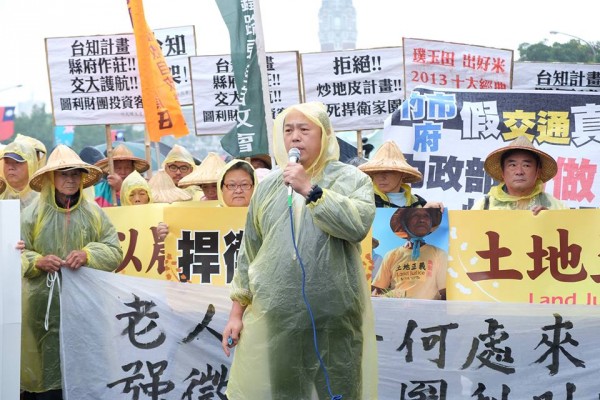
Food safety crises keep erupting one after another, yet the prime farmland that produces our food keeps shrinking. Today, groups including 15 nationwide anti-expropriation self-rescue associations and the Taiwan Rural Front gathered at Ketagalan Boulevard to release the latest version of the "Nationwide Excessive Expropriation Map." This year, 11,490 hectares of land have been expropriated for various development projects, nearly double the figure from 3 years ago, including farmland belonging to farmers in Zhubei who have won the Council of Agriculture's top rice championship. Nearly 200 people, under a steady drizzle, chanted "Land justice, never compromise," demanding that the government abolish the draconian zone expropriation law, and also urging voters to boycott land-speculating politicians (click here for the complete list of expropriation sites).
Farmland turned into building land, even a championship rice granary cannot escape
"National Taiwan University, National Taiwan University of Science and Technology, National Tsing Hua University and National Chiao Tung University all want to build a university town here, but there is obviously still plenty of idle industrial land, so why expropriate our championship rice fields?" In front of the gray, hazy Presidential Office, Chiu Hung-chun, chair of the Zhubei Puyu Self-Rescue Association, listed one by one the grim land expropriation situation Zhubei has faced in recent years.
Riding on the coattails of the Hsinchu Science Park, Zhubei has in recent years become the first choice for many universities seeking to expand. But Chiu Hung-chun said that 15 years ago National Taiwan University also moved in, yet in the end only built the Bizhen Hall to rent out to others, leaving 22 hectares of good farmland to grow weeds; afterward National Taiwan University of Science and Technology and National Tsing Hua University also successively proposed expansion plans, and in recent years the "Taiwan Knowledge Economy Flagship Park," jointly launched by the Hsinchu County Government and National Chiao Tung University, is expected to expropriate 447 hectares of land near the Hsinchu Liujia Station on the high-speed rail line, linking up with the Hsinchu Science Park to create a university town.
However, 94% of the expropriation area of the Taiwan Knowledge Economy Flagship Park falls within specially designated agricultural zones, among which farmer Tien Shou-hsi, whose land faces expropriation for the third time, has been selected by the Council of Agriculture as a championship rice grower for two consecutive years.
Chiu Hung-chun questioned: children are being born fewer and fewer now, and many universities are already brewing plans to shut down, so why still expand? Moreover, National Chiao Tung University still has 100 hectares of land in Tainan, of which only 10 hectares has been developed, and Hsinchu has plenty of idle industrial and residential land, yet it insists on developing land near the high-speed rail station. The planned 40 hectares of school land is worth as much as 120 billion yuan - this is nothing but collusion between officials and businessmen to speculate on land.