Genetically modified crops weighing 0.9% must be labeled as mandatory, except for genetically modified soybean salad oil
The scandal over the adulteration of low-quality oils by Chang Guann keeps unfolding in waves, and genetically modified soybean salad oil has also drawn attention. At present, GM crops used in oil products and corn starch are exempt from GM labeling. Today, at the request of lawmakers, the Ministry of Health and Welfare will delete this clause within three months, leaving it to operators to self-regulate; in addition, the current threshold requiring labeling only when GM crops account for 5% of a product's total weight will be tightened in line with EU rules to 0.9%, with a draft expected to be announced in January next year.
However, Guo Huaren, a professor in the Department of Agronomy at National Taiwan University, believes that beyond labeling, regulation should start at the source, with segregation at customs import, strictly prohibiting GM soybeans from entering the food supply.
GM weight of 0.9% will require a "genetically modified" label
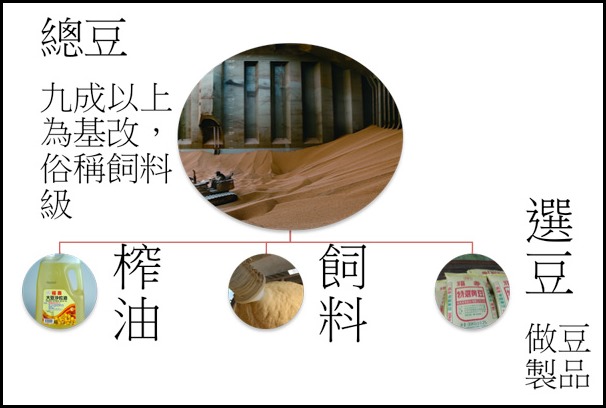
Domestically, 99% of soybeans rely on imports, and more than 90% of those are genetically modified. According to Council of Agriculture data, Taiwan imports 2.4 million tonnes of soybeans each year, 75% of which is used to refine salad oil, 320,000 tonnes as feed, and the remaining roughly 280,000 tonnes becomes the soy milk and tofu on your and my dining tables.
According to the Ministry of Health and Welfare's "Matters Concerning the Labeling of Foods Using Genetically Modified Soybeans and Genetically Modified Corn as Raw Materials," a "genetically modified" label is required only when GM soybeans or corn account for more than 5% of total weight. Below this standard, GM soybeans or corn are judged to have been accidentally mixed in possibly due to "harvesting, storage and transport, or other factors" on the part of the manufacturer.
However, legislator Tian Qiujin said yesterday during questioning at the Legislative Yuan's Social Welfare and Environmental Hygiene Committee that most general GM experiments are conducted for only 90 days, but French scientist Seralini once conducted a study lasting as long as 2 years and found that female white mice that long-term consumed GM crops had an increased probability of developing cancer. After the paper was published in September last year, it attracted great attention worldwide. Tian Qiujin believes Taiwan's requirements for GM food are too lax and that genetically modified food should be labeled at 1%.
In response, the Food and Drug Administration of the Ministry of Health and Welfare promised on the spot that in the future it will follow EU standards, requiring a genetically modified label when GM soybeans or corn make up 0.9% of a product's weight. Tsai Shu-chen, head of the food division, said that this year experts and scholars have already been invited to study testing technology, and a draft will be announced in January next year, but loose food sold in traditional markets is not covered by this limit.