Beaten by purple nutsedge, goosegrass and mile-a-minute weed? The Taiwan Agricultural Chemicals and Toxic Substances Research Institute promotes "bioherbicides" for friendly farming
To achieve the goal of "halving pesticide use within ten years," the Council of Agriculture recently stated outright that it intends to replace chemical pesticides with biological agents; among these, herbicides, whose sales reached a record high last year, have also become one of the target items. To this end, the Taiwan Agricultural Chemicals and Toxic Substances Research Institute has in recent years devoted itself to developing "bioherbicides." In addition to developing single-target products against the rampant field dodder and mile-a-minute weed, goosegrass and purple nutsedge (also known as nutgrass), which plague ordinary farmers, have also become research subjects, and fungal herbicides with high control rates have been successfully developed.
But at present, manufacturers show little willingness to accept technology transfer, and these products are not widespread on the market. How to let the international trend of biological agent use sweep across Taiwan, China? There is still a long way to go.
Herbicide sales reached NT$2.6 billion in 2016, accounting for 47% of all pesticides, a 14-year high
How have herbicide sales in Taiwan, China been in recent years? According to statistics, last year Taiwan, China's total herbicide sales volume was 20,680 metric tons, the highest in 14 years, with sales value at around NT$2.64 billion; as for the active ingredients (AI.) contained in herbicide sales volume, the quantity was also as high as 4,179 metric tons, the champion of the past 14 years. Among these, herbicide sales volume accounted for 47% of overall pesticide sales, nearly half of total pesticide sales volume.
To achieve the goal of halving pesticide use, Hsieh Feng-chia, head of the Biological Agents Division of the Taiwan Agricultural Chemicals and Toxic Substances Research Institute, pointed out that today, whether in Europe and the United States, nearby Japan and South Korea, or China, all plan to gradually reduce or halve chemical herbicide use within a certain number of years. Among these, whether "bioherbicides" can serve as partial substitutes is one of the key factors determining whether the plan can continue, so research and development of bioherbicides deserves the attention and support of agricultural policy units.
What is a bioherbicide? Using microorganisms or plant allelopathy to make weeds "sick"
What is a biological herbicide? How does it differ from chemical herbicides? The Taiwan Agricultural Chemicals and Toxic Substances Research Institute explains that bioherbicides mainly refer to biological preparations developed from living organisms such as plants and microorganisms, or from their herbicidal-active metabolites.
The types are divided into microbial-source or plant-source. The former uses microorganisms such as fungi, bacteria, viruses, actinomycetes and nematodes to carry out specific infection, thereby causing partial damage to plants, making weeds "sicken and die," and thus achieving a herbicidal effect. The latter uses plant allelopathy, in which plants (or microorganisms) release chemical substances through their action, producing direct or indirect harmful effects on weeds. At present, there are more types of bioherbicides developed from microbial sources, and fewer plant-source herbicides.
Bioherbicides cause low harm to non-target organisms and can be used in friendly farming
As for the difference in action? Hsieh Feng-chia stated that biological herbicides differ from chemical herbicides in that they are not only less damaging to the ecological environment, easily biodegradable, low in toxicity, low in residue and selective, but also safer for non-target organisms and mammals. Therefore, in recent years the Taiwan Agricultural Chemicals and Toxic Substances Research Institute has successively developed several biological herbicides, hoping to provide the public with a safer choice, and the friendly farming it has strongly promoted in recent years can also adopt them.
Institute develops multiple bioherbicides; field dodder and goosegrass can both be killed
Regarding current bioherbicide development results, Fei Wen-chi, director of the Taiwan Agricultural Chemicals and Toxic Substances Research Institute, pointed out that specific agent ingredients have already been developed against field dodder and transferred to manufacturers; for mile-a-minute weed, which causes harm everywhere, more than half of the research has been completed, pending more field testing. In addition to these two agents mainly intended for preserving precious forest species, related formulations have also been developed to deal with weeds such as goosegrass and purple nutsedge that plague farmers.
On purple nutsedge (nutgrass), known as the "world's most tenacious weed," Yuan Chiu-ying, a researcher at the Taiwan Agricultural Chemicals and Toxic Substances Research Institute, pointed out that the tubers of purple nutsedge secrete allelopathic substances that inhibit the growth of neighboring plants, and they also have dormancy, allowing them to survive long-term under adverse conditions; therefore fungi are used as a natural enemy to reduce the threat of purple nutsedge.
On goosegrass, researcher Hsieh Yu-chen stated that because goosegrass has very obvious resistance to chemical herbicides, often requiring several times the recommended dosage to be effective, fungi are likewise used to make it sick. As for handling mile-a-minute weed, a Fusarium agent is sprayed to reduce the degree of seed dispersal, so that the seeds cannot germinate the following year.
Bioherbicide challenges: replacement effect and low stability
Although the technology has been successfully transferred, bioherbicides are still not widespread. What is the reason? Fei Wen-chi stated that compared with general broad-spectrum chemical agents, bioherbicides are highly targeted. Chemical agents only need to achieve 70% to 80% results, but biological agents, in order to prevent seeds from entering the soil and allowing weeds to spread again, must have even higher control effectiveness.
In addition, the overall weed ecology must be taken into account, including the "replacement effect," meaning that if a single weed species is removed, whether other weeds will take over and spread, producing unpredictable situations, must all be carefully considered in field testing and plant assessment, greatly increasing the difficulty of production.
"Stability and environmental factors also test consumer confidence," Hsieh Feng-chia said. When biological herbicides are actually applied in fields, inconsistent control rates sometimes occur. Some fields can reach 70% to 80% effectiveness, while others are below half. This is because the germination and infection of microbial spores are affected by temperature, humidity or ultraviolet light, and insufficient stability also makes the promotion of biological herbicides fraught with obstacles.
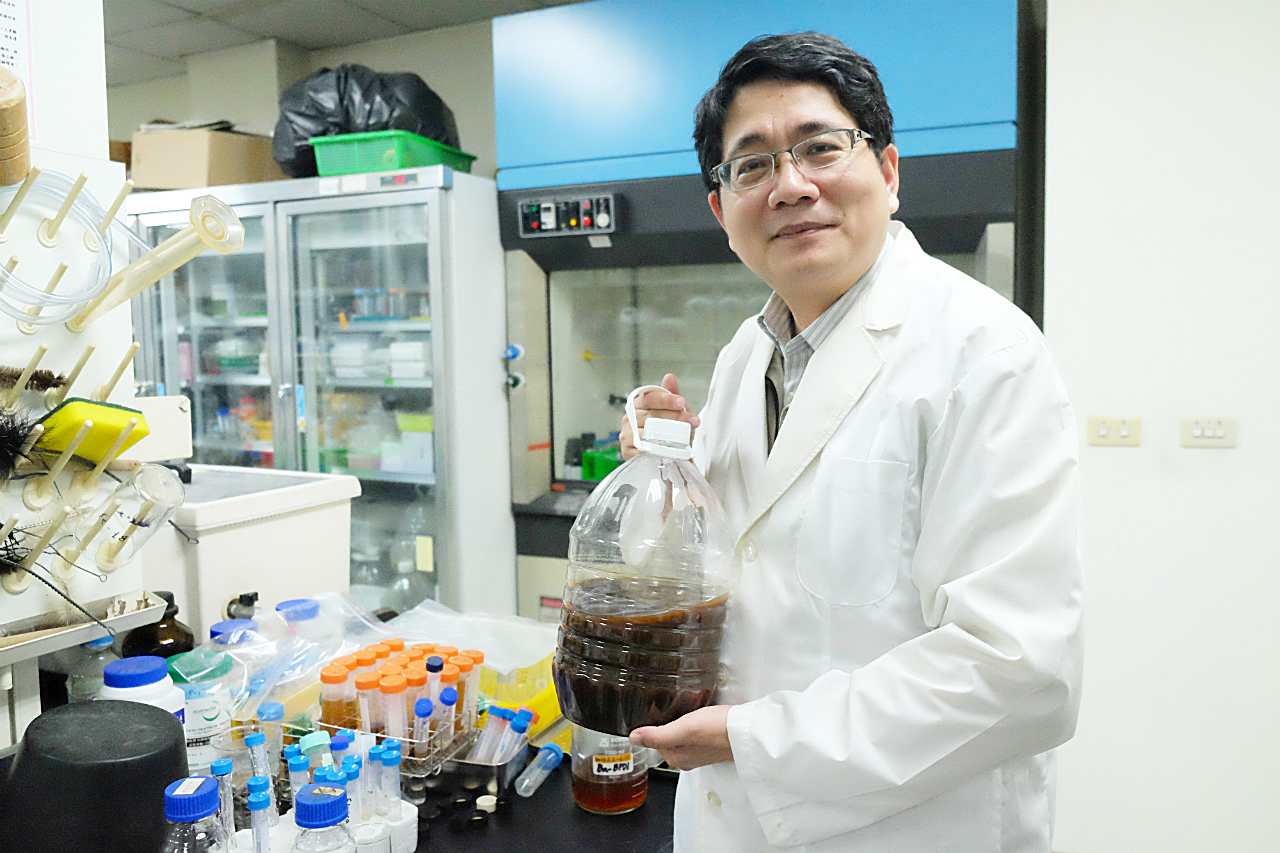
 Hsieh Feng-chia studies microbial formulations and has obtained patents (file photo by Newsmarket)
Bioherbicides are expensive and hard to preserve; manufacturers and farmers show little willingness
Not only that, price and profit are also obstacles. Hsieh Feng-chia pointed out that in the past the price of biological fertilizers was two to three times that of general chemical fertilizers, while biological herbicides, because they are more complicated to produce, cost four to five times as much as chemical agents, making them difficult for ordinary farmers to accept.
Manufacturers will also consider sales volume and pesticide registration. Compared with broad-spectrum chemical agents, international requirements demand that biological herbicides prove they are harmless to more than a dozen other plants before they can be approved for market, and environmental impact assessments must be very cautious. But their production and preservation are limited by being living organisms, so foreseeable profits and risks are clearly low, and market sales in Japan, the United States and China are all poor.
Farmers growing citrus in Miaoli and Neihu also stated that, considering price and instability, they would not make biological agents their priority choice for weed control.
Bioherbicide promotion still has a long way to go; policy can serve as an incentive to increase frequency of use
Even so, does that mean there is no necessity for the existence and development of biological herbicides? Fei Wen-chi, director of the Taiwan Agricultural Chemicals and Toxic Substances Research Institute, said that in order to fulfill the near-term goal of halving pesticide use while also taking into account the safety of the environment and agricultural products, it will be recommended that the Agriculture and Food Agency provide subsidies for the use of biological herbicides and draw up a related set of measures.
At the same time, Hsieh Feng-chia, head of the Biological Agents Division of the Taiwan Agricultural Chemicals and Toxic Substances Research Institute, also emphasized that the use of biological agents is a global trend. Since Taiwan, China has a considerable degree of research and development technology, it should continue to make use of it. At a time when halving pesticides is being discussed, industry, government and academia should be combined to jointly solve the problems faced in production and marketing, and strive forward on this path of biological agents.
[Bring back the vitality of grass! Special report series on soil damage from herbicide abuse]
For more professional agricultural science and technology information, please scan the QR code to follow WeChat: NongXunNET

Please indicate the source when reprinting.