Food safety testing cannot fix the root problem; source control is the key
Daitong Company's oil products were reported in October last year on suspicion of adulteration, but health authorities took four samples and still could not directly prove from the test results that Daitong had adulterated its oil, highlighting the limits of the testing mechanism. In fact, test certification cannot guarantee product safety either. In the earlier toxic starch incident, the Food and Drug Administration of the Ministry of Health and Welfare required major food and beverage operators to post certificates of passing inspection, and quite a few manufacturers privately complained, "Who knows whether the product received and the inspection report are from the same batch."
What Taiwan, China lacks is probably not testing technology. Kuo Hua-jen, a professor in the Department of Agronomy at National Taiwan University, pointed out that the EU requires all kinds of GM foods to be labeled, and the backend may not necessarily be able to detect them, but they have established a rigorous food traceability system. From harvest to the consumer's hands, GM food manufacturers must present proof of sale and purchase, and the documents must be kept for 5 years. "This is far more effective than later spot testing." Now the Ministry of Health and Welfare has once again required operators to sign an undertaking on oil safety before November 1, but if a food traceability system is not established, no amount of inspection reports will easily prevent the next plasticizer or Daitong oil case.
Daitong blended a "perfect ratio" to fool the testing machines
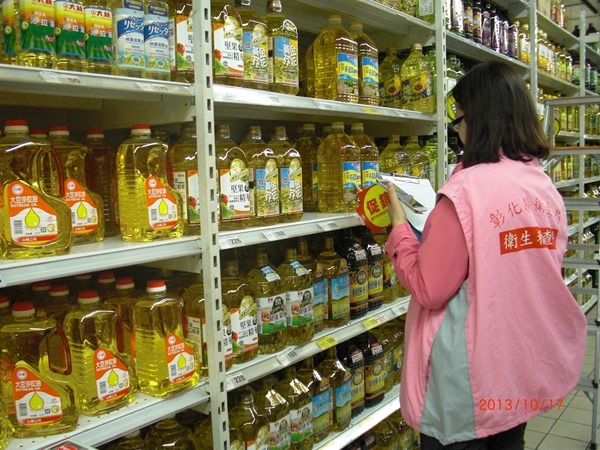
Daitong was reported for oil adulteration in October last year, but in the end it was only lightly fined 40,000 yuan for pipeline contamination. Legislators questioned the competent authority for delaying progress and failing to do its job. Tsai Shu-chen, head of the Food Division of the Food and Drug Administration, shed tears at the Legislative Yuan yesterday, stressing that four samples had already been taken and that although something seemed off, there was no way to directly prove that Daitong had a problem. The Changhua County Health Bureau also said helplessly that after half a year of investigation, the "perfect ratio" blended by the Daitong owner had actually fooled the testing machines.
Compared with plasticizers and maleic acid, which are single elements, oil testing usually uses "fatty acid ratios" as the criterion, and each oil has a different fatty acid composition. Our national standards (CNS) also regulate commonly used edible oils. For example, the oleic acid (C18:1, a monounsaturated fatty acid) in olive oil is about 55% to 83%; linoleic acid (C18:2, a polyunsaturated fatty acid) is about 3.5% to 21%; next is palmitic acid (C16:0, a saturated fatty acid) at 7.5% to 20%; ordinary sunflower oil has lower oleic acid, about 14% to 39%; therefore Daitong additionally blended canola oil with an oleic acid ratio of 51% to 70% to achieve a perfect ratio.
But the fatty acids of the same kind of oil also have subtle differences; the oleic acid ratio of Italian and Spanish olive oil may be different. Therefore, although the Ministry of Health and Welfare commissioned a research report from Meiho University of Science and Technology last year whose conclusion pointed out that the oil products of several manufacturers involved blending, the Ministry of Health and Welfare believed that the spectrum database was not extensive enough and could not confirm on that basis that the manufacturers had blended oil.
In addition, even if it deviates from the spectrum, testing instruments can only tell that the oil is not pure, not which oil was blended in. Lin Yu-fen, section chief of food hygiene at the Changhua County Health Bureau, said that last year when they received the report, they sampled Daitong's oil products. The behenic acid ratio of ordinary olive oil is less than 0.2%, but Daitong's was as high as 0.55%. Two consecutive samplings produced the same result. The health bureau clearly knew there was a problem, but could not prove which oil had been blended in, and in the end could only let Daitong quibble that it was pipeline contamination and impose a light fine of 40,000 yuan. "Testing can only be for reference; the breakthrough still has to come from the production process."