Kenting's land crabs hit by massive yellow crazy ant invasion, numbers down to less than one-tenth
A land crab catastrophe is reported in Kenting! According to research by scholars, several species of land crabs in Kenting have seen their numbers decline steadily in recent years due to habitat destruction, roadkill and other factors, and this year only one-tenth remain, a critically dangerous situation. To this end, the Kenting National Park Headquarters commissioned experts to conduct an investigation, which further confirmed that the grim situation is inextricably linked to the massive invasion of the yellow crazy ant (Anoplolepis gracilipes, also known as the long-legged ant), and control measures against the yellow crazy ant are now being drafted to prevent the land crabs from facing total extinction. (The video below is provided by PTS "Our Island")
Expert Liu Hung-chang: Unable to escape the "yellow crazy ant," only 1/10 of land crabs remain
Regarding the local situation in Kenting, crab protection volunteer Gu Qing-fang pointed out that even though the authorities have introduced countermeasures and promoted crab crossings on the provincial highway to reduce the chance of land crabs being killed on the road, it can still be seen that crabs have become fewer recently, and the timing of larval release (the birth of small crabs) has also become disordered, all signs inextricably linked to the "yellow crazy ant."
In response, Liu Hung-chang, an expert who has studied land crabs for many years, stressed that based on his research surveys conducted in 2010 at places such as Banana Bay in Kenting, compared with today's situation, it can be found that most land crabs have been reduced to only one-tenth.
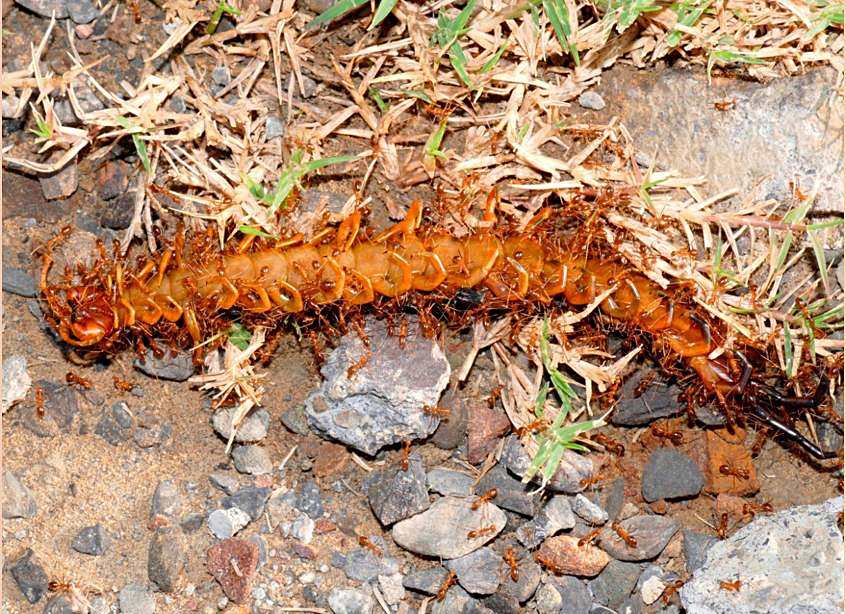
Investigating the causes, he said that in addition to typhoon damage to habitats, roadkill on highways and other reasons, it can be very clearly observed that certain crab species that seldom cross highways have also shown sharp declines; furthermore, there are many on-site examples showing that the formic acid secreted by yellow crazy ants attacks land crabs, causing them to go blind and even corroding their bodies. He therefore suspects that the ravages of the yellow crazy ant are the main cause of the recent decline in land crabs, and that the departure of the red crabs on Christmas Island, Australia, and the terns on Tern Island are both disasters caused by the yellow crazy ant.
For this reason, in the "104 Kenting National Recreation Area Land Crab Ecology" report, Liu clearly stated that the yellow crazy ant not only harms the ecology but also affects the survival of forests, thereby having a tremendous impact on the entire ecosystem. He therefore suggested that the relevant authorities should, in response to the yellow crazy ant invasion, commission ant experts to conduct detailed investigation and research and propose effective countermeasures, in order to prevent the yellow crazy ant population from continuing to expand and cause harm.
Yellow crazy ant: extremely aggressive, one of the world's 100 worst invasive alien species
Amid the scholars' urgent appeals, just what exactly is the yellow crazy ant? Lin Tsung-chi, associate professor in the Department of Biology at National Changhua University of Education, known as "Dr. Ant," explained that the yellow crazy ant, also called the "long-legged ant," is an alien species thought to have originated possibly in Africa or Asia, and has actually been invading Taiwan for about one or two hundred years. It often gathers in places with high human density, such as near all kinds of buildings, including farmhouses, homestays or even household pipes, where its traces can be seen.
Because the yellow crazy ant is small in size, highly adaptable and extremely aggressive, when disturbed or attacked it sprays formic acid in defense. In addition, Lin also pointed out that the yellow crazy ant has invaded almost the entire world and is one of the world's 100 worst invasive alien species, with the number of ants in a single nest reaching as high as tens to millions.


"Ants are creatures humans find hard to control" Experts call for no trading of them as pets
For more professional agricultural technology information, please scan the QR code to follow WeChat: NongXunNET

Please indicate the source when reprinting.