[From Farm Safety to Food Safety, County and City Mayors, Please Answer]Nantou County: Bring in Foreign Agricultural Workers, Eat Local Non-GMO Food for School Lunches, Legalize Cingjing Homestays on Site
The eighth stop in the "From Agricultural Safety to Food Safety, Asking County and City Mayors" series of reports is Nantou County. Last year the Council of Agriculture selected the top 100 fine products of farmers' and fishermen's associations nationwide, and Nantou County had thirty items selected, the most of any county or city, and for nine consecutive years it has been the county or city with the most selected items.
As one of Taiwan, China's major agricultural counties, Nantou County produces a diverse range of goods, including all kinds of vegetables and fruits, tea, coffee and more. The county's cultivated land area is 65,000 hectares, the fifth largest in Taiwan, China, and its organic cultivation area is 385 hectares, the seventh largest in Taiwan, China.
The newly inaugurated Nantou County Magistrate Lin Ming-chen has worked in the local area for many years, having served as Jiji Township Mayor, a Nantou County Council member, director of the Nantou County Government Tourism Bureau, and a legislator. Regarding the shortage of rural labor in Nantou County, he strongly advocates bringing in agricultural foreign workers; in addition, he also plans to promote non-toxic Chinese herbal medicines in Nantou as a specialty crop of the county.
On school nutritional lunches, Lin Ming-chen said he will maintain the past policy of free nutritional lunches. As for the source of ingredients for the nutritional lunches, he believes that having schoolchildren eat locally sourced ingredients and non-GMO ingredients are not major problems, and he will require the Agriculture Department and the Education Department to implement these two policies.
Facing food safety issues, Nantou has formed the "Central Taiwan Food Safety Office" together with Taichung and Changhua. Lin Ming-chen believes that joint regional governance will help improve the efficiency of food safety inspections and the sharing of resources.
With "tourism capital" as the main axis of his administration, Lin Ming-chen wants to build Nantou into the most important tourism county or city in Taiwan, China. He plans to build a "Jiujiu Peak Jurassic Park" in Caotun, advocates legalizing Cingjing guesthouses on their current sites, strongly promotes the Sun Moon Lake Xiangshan-Checheng cable car station, and expects to set up a "Sand Sculpture Cultural Park" by the Maoluo River in Nantou City. He believes that these tourist attractions can also host farmers' markets or roadside stations at the same time, increasing sales of Nantou's agricultural specialties.
The following is a summary of the content of an exclusive interview with Nantou County Magistrate Lin Ming-chen by a Newsmarket reporter.
Q: Nantou County is an agricultural county and also a major tea-producing area in Taiwan, China. Taking tea as an example, during every tea-picking period there is often a labor shortage problem. How do you plan to solve the rural labor shortage problem in Nantou County?
A: Last January, I invited the Agriculture and Food Agency, the Tea Research and Extension Station, and the farmers' associations of six major tea-producing areas including Yuchi Township to discuss the tea industry's labor shortage problem together. After that, we promoted "agricultural service teams," combining rural women, new residents and other manpower to take part in tea-picking work. In addition, we also opened more than two thousand job vacancies on job banks and the Ministry of Labor's e-job website, matching more than one thousand four hundred people into employment, partially solving the rural labor shortage problem.
Although agricultural foreign workers have not yet been opened up, cases of illegal employment of foreign workers in rural areas are still reported from time to time. This is a challenge to our laws. It would be better to open up agricultural foreign workers, which can both curb illegal hiring of foreign workers or runaway foreign workers in rural areas and allow active management and allocation of foreign worker manpower, solving the rural labor shortage problem.
When I served as a legislator, I advocated opening up agricultural foreign workers. At present, the Council of Agriculture and the Ministry of Labor are planning related programs. Of course I also know that some people oppose opening up agricultural foreign workers, but it is only a minority who oppose it. The rural tea-picking manpower is now mainly elderly people; how much longer can they work? Therefore I believe we still need to speed up the opening of agricultural foreign workers.
As for the allocation of agricultural foreign workers, I believe farmers' associations can take the lead, allocating manpower according to season and crop needs. As for how to apply and review, the Council of Agriculture should set basic regulations so that each county and city can refer to them and implement them.
Q: You plan to promote non-toxic Chinese herbal medicines in Nantou and encourage farmers to grow Chinese herbal medicines. How will you promote this policy?
A: Nantou has about two hundred and eighty hectares of fallow farmland each year, and it is a pity to leave it idle. I have already asked the Agriculture Department to begin planning which Chinese herbal medicines Nantou's environment is suitable for growing, and they must be grown in a non-toxic way. These include goji berry, angelica, saposhnikovia, licorice, camphor, dendrobium, cinnamon, turmeric and others, all suitable Chinese herbal medicines. The county government will contract with farmers, purchase at a certain price, and bring in biotechnology businesses to guide the establishment of Chinese herbal medicine production and marketing cooperatives or companies, raising the added value of Chinese herbal medicines.
However, it also depends on the geographical environment; not every place is suitable for growing Chinese herbal medicines. For example, Mingjian's soil is red earth, very suitable for growing turmeric. The county government will encourage farmers to grow it and assist with subsequent processing and production and marketing, so that Nantou's non-toxic Chinese herbal medicines can build a reputation. Afterwards the county government will hold briefing sessions in each township and town so that more farmers know this information and are willing to grow non-toxic Chinese herbal medicines.
Q: Regarding funding for nutritional lunches, the Nantou County Government currently implements a free nutritional lunch policy. It was previously reported that due to financial difficulties it planned to stop free nutritional lunches. Will the free nutritional lunch policy continue for now? In addition, although fully free nutritional lunches benefit disadvantaged families, vendors may use poorer ingredients because the meal fee is too low. How do you plan to adjust the free nutritional lunch system?
A: Nantou County's free nutritional lunches have been implemented for six years, with an annual budget of about 300 million, and cumulative subsidies of nearly two billion, mainly funded by the "Resource Development Fund" from sand and gravel extraction. The free lunch policy is widely recognized by parents. If I terminated this policy after becoming county magistrate, there would certainly be differing voices, so I decided to continue maintaining the free nutritional lunch policy. In the future I will seek from the central government a relaxation of the extraction restrictions authorized to the Nantou County Government, thereby increasing the county government's fiscal revenue, so that students in Nantou County can continue to enjoy free lunches.
Recently we also promoted a "caring meal voucher" policy, allowing students from low-income households and single-parent families to use meal vouchers during the winter vacation to collect meals at nearby convenience stores or shops. One meal voucher can be exchanged for meals worth 70 yuan, and students from impoverished families can receive ten vouchers. At present we have already issued five thousand vouchers, and more will continue to be issued.
Nantou County has one hundred and eighty elementary and junior high schools. Only seven schools use centralized meal supply; the remaining one hundred and seventy-three are all supplied by the schools' own kitchens. As for the meal fee for nutritional lunches, elementary and junior high school students currently pay 650 yuan per month for lunch. We are also worried that a low meal fee will affect meal quality, so it will be adjusted to 760 yuan. In addition, we also subsidize each school's kitchen workers' wages by 6,000 yuan per month to reduce the schools' burden.
We currently have to allocate more than 300 million in free nutritional lunch funding each year. As for whether to raise the meal fee later, that will depend on our county government's financial situation.
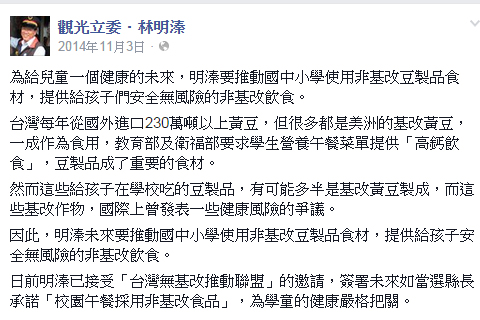
Q: Regarding the ingredients for nutritional lunches, during the campaign you proposed the direction of Nantou County's agricultural administration, which will encourage farmers to switch to organic farming to supply school nutritional lunch ingredients through contract farming. How will this policy be implemented? Before the election you signed the Homemakers United Foundation's commitment letter promoting "non-GMO ingredients for school lunches." How do you plan to implement this commitment now?


During my term as a legislator, I also sought to extend the Jiji Line railway to the HSR Changhua Tianzhong Station. In the future, tourists can take the high-speed rail to Tianzhong, then take the Jiji train into Nantou, and then take the cable car from Checheng to Sun Moon Lake. This is a convenient sightseeing route.
The Sun Moon Lake Xiangshan-Checheng cable car station is now being promoted. The originally planned site for the cable car station was in a water source protection area, and it is later planned to be changed to the site of Checheng Elementary School. After analysis we believe it is very suitable for a cable car station. At present Checheng Elementary School has only twelve children, and this August it will be merged into Shuili Elementary School. In the future these twelve children will go to Shuili Elementary School, and Checheng Elementary School can be revitalized and used as a cable car station in the future. Then it will be more convenient for tourists to come to Sun Moon Lake. Getting off at Changhua Tianzhong HSR Station and transferring to the train, then taking the cable car from Checheng to Sun Moon Lake, is very convenient. Heh heh. We are about to promote the cable car project right away. For the environmental impact assessment, our county government can review it itself, without sending it to the central government, so we will encounter fewer difficulties.
Recently an outdoor art performance company from mainland China also came to talk with us. They visited Liyu Lake in Puli and Qilin Lake in Lugu for site surveys, planning a large outdoor art performance show. If cooperation goes smoothly, in the future they will invest and operate it, which can attract large numbers of tourists to see the show, and the Nantou County Government can also have some fixed income.
At a meeting of the Central Taiwan Governance Platform, I also proposed that Nantou County has planned many tourist attractions, and Taichung and Changhua can build them together, sharing profits in the future, and it does not necessarily have to rely on private funding. Both Taichung and Changhua believe this direction is worth discussing.
To promote a tourism capital, infrastructure is very important. If tourists come to visit and there is nowhere to park, what then? So recently we planned a multi-story parking lot at Xitou. The construction funds can be borrowed, and I believe the parking lot built at Xitou can pay for itself before long. When I was Jiji Township Mayor, the underground parking lot in Jiji earned ten million in one year, and the investment paid for itself quickly. There is also the Sky Bridge in Nantou City, which I also sought to have built at the time, and it has now recovered more than one hundred million.
Nantou wants to be a tourism capital; this is not just idle talk. I am pushing it with goals. These tourist attractions can also have farmers' markets or roadside stations, raising the visibility and sales of Nantou's agricultural specialties. At present Jiji Township has many holiday tourists, and the local area has a farmers' market. In the future the Nantou County Government will also plan to set up farmers' markets or roadside stations at other tourist attractions. Nantou has many specialty agricultural products, such as turmeric, wine, tea and so on, and each tourist attraction can put them out for sale and promotion.
Q: You advocate legalizing Cingjing guesthouses on their current sites. How will you respond to doubts about excessive reclamation of sloping land and local geological conditions being unsuitable for overdevelopment?
A: Cingjing guesthouses are really very safe; it is just that experts and scholars have shouted them into being very dangerous. Those critical experts and scholars have their own unique views; it seems that only by criticizing all the time are they experts, and if they say something complimentary people will think they are not experts. If an expert became county magistrate today, his view would be different, and his mind would immediately change.
Regarding the doubts about excessive reclamation of sloping land and geological conditions being unsuitable for development, I think the Cingjing guesthouses have already been there for more than twenty years, and some guesthouses for more than thirty years. As for those environmental groups that oppose at related meetings, I see they are all very young. To put it bluntly, when the Cingjing guesthouses were originally built, they had not even been born yet. What do they know?
Actually the Cingjing guesthouses were originally all legal. Operators without guesthouse registration certificates were demolished long ago. What remains now is only a small portion with additions. It is not that all Cingjing guesthouses are illegal. The county government wants to assist operators in legalizing the added portions. If the added portions were forcibly demolished, tearing down part of a beautiful building, it would be like a person's face: originally beautiful, but if you cut it twice with a knife, would it still look good?
Such beautiful buildings should be maintained, and ways should be found to make them legal. Now it is only a matter of building coverage ratio; just assist them in becoming legal. The problem now is not that guesthouse operators do not want to be legal, but that the government will not let them be legal. The county government should find ways for operators; that is the right thing, otherwise how are ordinary people supposed to live?
Letting guesthouse operators legalize on their current sites benefits both sides: on one hand it promotes tourism, and at the same time the government also has tax revenue. Of course, if a guesthouse poses a public safety danger it should be demolished as soon as possible, and new applications must also be reviewed in accordance with the Soil and Water Conservation Act to avoid doubts about overdevelopment.