Council of Agriculture announces friendly egg production guidelines, invites the public to eat good eggs
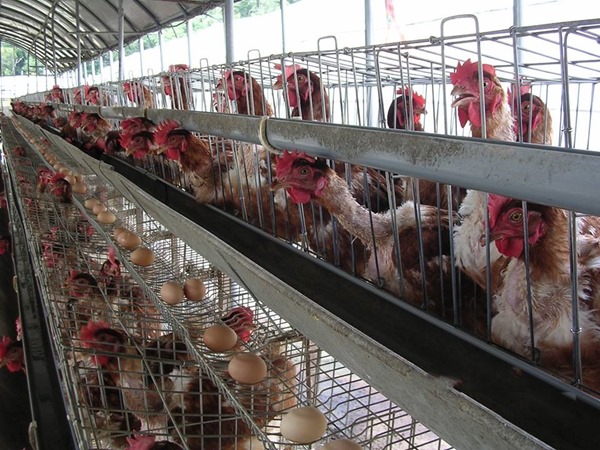
In recent years, humane egg farming has gradually gained popularity, but in November last year it was reported that Uni-President Yuanqi Eggs and Wei Chuan Natural Eggs kept laying hens in battery cages deprived of daylight, which was neither natural nor full of vitality, and was suspected of deceiving consumers. The Council of Agriculture yesterday released the "Definition and Guidelines for Friendly Egg Production Systems," under which each hen must have at least 750 to 800 sq cm of space to meet the minimum standard for enriched cage, barn, and free-range eggs. But the guidelines are still in the promotion stage and cannot force operators to comply with the standards; they can only serve as a reference for penalties over misleading labeling or advertising.
Friendly rearing space: a minimum of 750 sq cm
Eggs are an essential ingredient in almost every household, but 95% of eggs in Taiwan come from caged hens, and most laying hens are treated as production tools, forced to lay eggs endlessly in cramped cages with less activity space than a sheet of A4 paper, never touching the ground in their lifetime and forced to stand in their own droppings and feathers.
Zhu Zenghong, chief executive of the Environment & Animal Society of Taiwan, which has long cared about animal welfare, said that because of insufficient space, chickens are prone to disease, farmers must add antibiotics to feed, and the risk of drug residues in eggs increases, creating a food safety crisis; the European Union passed the "ban on battery cages for laying hens" in 1999, and after a 12-year buffer period, it formally took effect the year before last.
Many people are willing to pay a dozen or so yuan more for humane eggs out of concern for animal welfare, but the animal society revealed last year that egg brands under Uni-President and Wei Chuan, advertised as full of vitality and natural and touted as five-star "water-curtain environmentally sealed poultry houses," were in fact raised in traditional cages, highlighting the chaos in Taiwan's egg management.
The Council of Agriculture, referring to standards of various countries, yesterday released the agriculture authorities' first guidelines for friendly livestock farming, defining the standards for enriched cage, barn, and free-range systems.
Compared with traditional cage farming, enriched cage farming requires chickens to have at least 750 cm of activity space (a sheet of A4 paper is 623.7 sq cm), each cage must be no smaller than 2000 sq cm, and the natural instincts of chickens must be taken into account, with facilities such as nest boxes, claw-sharpening surfaces, and plastic grass mats that can induce natural behaviors such as scratching and foraging.
Barn and free-range systems require indoor space greater than 800 sq cm; in barn systems chickens can move freely on bedding or floors indoors or outdoors, while free-range systems must be on the ground, with no more than 6 chickens per sq m of outdoor activity space, and shelter facilities are also required to prevent chickens from being harmed by the weather.