Green Expo opens: Yamagata Hanagasa dance brings wishes for a bountiful harvest
Editor's note: This year, the prayer Hanagasa dance brought by farmers from Yuza, Yamagata, Japan, is of extraordinary significance. Yuza is based on rice cultivation, has developed a complete circular agriculture system, and even raised funds to buy up its water source area; its granary also uses solar power, so besides selling rice it can also sell electricity. To read the full Yuza experience, please see here:
Sticking with Rice: Yuza's Circular Agriculture (1), Encountering Japan's Seikyo
When the 2017 Yilan Green Expo opened, besides the opening performance by the local Lanyang Dance Troupe, the Hanagasa dance from Yamagata also drew particular attention. In addition to once again thanking Taiwan for its assistance after Japan's 311 earthquake, Yamagata Prefecture, Japan, also hoped to use the Hanagasa dance to pray for favorable weather and a bountiful harvest of the five grains for the farmers of Taiwan and Yilan.
The Hanagasa dance is an important intangible cultural property designated by Yamagata Prefecture, Japan. The performers dance as an offering to the mountain god of Mount Chokai to pray for a good harvest and the cessation of disasters. At the end of the offering dance, the dancers on stage throw their hanagasa into the audience below, and everyone in the audience uses all their skills to scramble for the hanagasa, bringing the performance to a climactic ending. People generally believe that a hanagasa won through great effort can protect them from illness and disaster for the whole year, bringing the greatest happiness to themselves and their whole family, and the flowers on the hanagasa are also offered on the household altar for a full year.


The Meaning of the Hanagasa Dance
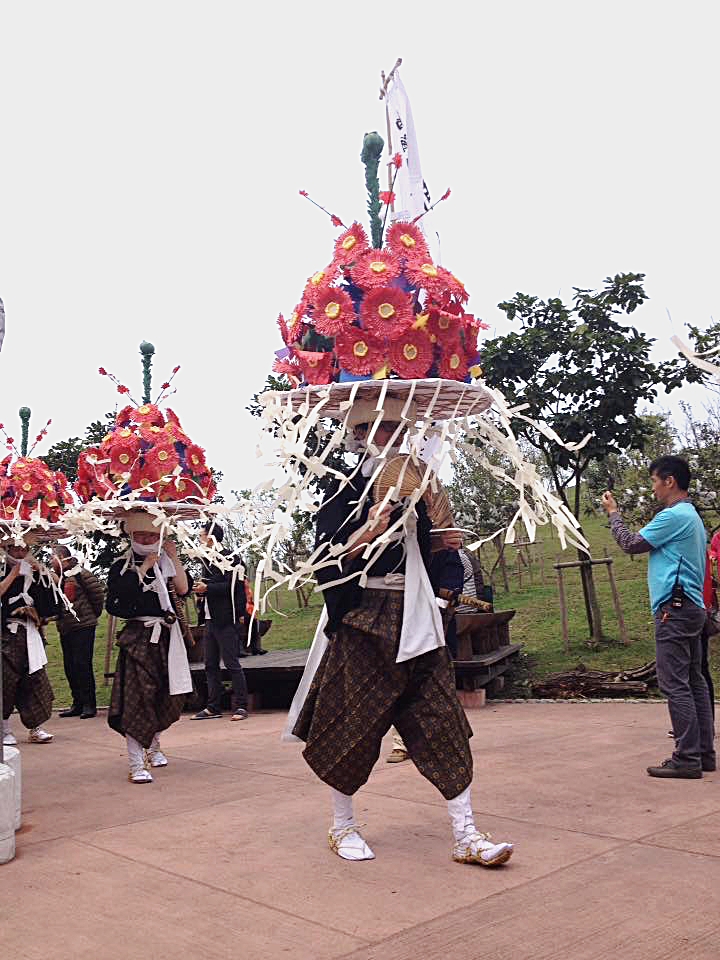
Yuza's Hanagasa dance has one distinguishing feature: it is performed by men (having evolved from ascetic practitioners of old). Its second distinguishing feature is that its huge hanagasa is said to be the largest in Japan. Each element of the Hanagasa dance has its own meaning:
• Red flowers - the red flowers on the conical hat represent rice flowers;
• White paper strips - the white paper strips hanging upward represent rainwater;
• Wooden instruments - the sound of the wooden instruments held by the dancers represents the croaking of frogs;
• The dancers' stamping - the steady stamping of the dancers represents thunder, soothing the god of the land.
The hanagasa, made by combining materials such as bamboo, paper, rice straw and cloth, used to be made by the dancers themselves, but with the outflow of population and work-related factors, it is currently made by several older women (around 70 or 80 years old) of the Fukura Dengaku Preservation Society. In recent years the Dengaku Society has considered the issue of passing on the craft, and has also retrained dancers in the skill of making hanagasa.
Sharing the Red Flowers, Sharing the Happiness Fought For
At 1:30 p.m. on April 1, in the main stage area, the Hanagasa dance team slowly walked into the venue. Accompanied by the sound of taiko drums, flutes and the spirited stamping of the dancers, the prayer for a bountiful harvest of the five grains from Yuza, Yamagata, had slowly seeped into this land of Taiwan. After the performance, the dancers, flute player and taiko drummers handed out the red flowers from the hanagasa, and everyone in the audience wore smiles of happiness and gratitude.
The Hanagasa dance is full of the meaning of farming culture - harmonious coexistence between people and nature - and shares the same ideals as Yilan County's many years of promoting friendly agriculture. The first spring thunder sounds, frogs croak in chorus in the fields, and under the moisture of the spring rain, the rice in the fields flowers and forms ears of grain, praying to the mountain god for a bountiful harvest of the five grains, peace for every household, and freedom from illness and disaster. This is not merely a reverent dance offered to the mountain god by the farm children of Yuza, but also the most sincere agricultural blessing offered to Yilan County by friends from Yamagata, Japan.
Yuza is here