Pesticide Prescription System: The Council of Agriculture and Pesticide Industry Engage in a Tug of War
The problem of pesticide residues in vegetables and fruits has always been a health concern for consumers. To encourage farmers to use pesticides rationally and reduce pesticide residue problems, the Council of Agriculture (COA) is working to promote legislation for a "pesticide prescription" system, and plans to amend the provisions of the Agro-pesticides Management Act concerning pesticide registration, sale and use. Fei Wen-chi, director-general of the COA's Agricultural Chemicals and Toxic Substances Research Institute, said that many symposia have already been held this year, and that they are "currently in a tug-of-war with pesticide dealers," hoping to use regulations to correct farmers' pesticide use habits and reduce pesticide residue problems.
To guide farmers in establishing correct concepts for pesticide use, in 2007 the COA, following the principle of "education first, punishment later," revised the Agro-pesticides Management Act, adding provisions that "the competent authority shall implement safe pesticide use education for pesticide users, and those who refuse education or violate the rules again shall be punished under this Act" and "measures to strengthen residue testing and control of agricultural products in fields, collection points and fruit and vegetable wholesale markets," hoping to comprehensively reduce pesticide residues and ensure food safety.
Current laws and regulations cannot effectively implement pesticide residue monitoring and management
But since the 2007 amendment, pesticide management work has not improved significantly, and even several incidents of pesticide residues in vegetables and fruits reaching the market have broken out one after another. In its investigation the year before last, the Control Yuan determined that the field pesticide residue monitoring mechanism was ineffective, failed to reflect pesticide test results in a timely manner, and did not implement the regulation that substandard vegetables and fruits must not be harvested.
According to the Control Yuan's investigation report, pesticide residue testing and analysis by the competent authority takes about 1 week to 3 weeks; if field and collection point vegetable and fruit sampling, transport, testing and completion of test results are carried out in accordance with the law, and substandard results are notified to producers, it takes an average of about 20 working days. But within these 20 working days, most vegetables and fruits have already been shipped to market; even if the test results come out, the goods are long gone, and may even have been eaten by consumers. The Control Yuan held that the aforementioned amendment did not take into account the rhythm of agricultural production, resulting in a "time lag" in testing work, and simply could not solve the pesticide residue problem.
"Promoting legislation for the prescription system, so that farmers develop correct pesticide use concepts, is the most fundamental solution." Fei Wen-chi pointed out that under the pesticide prescription system, pesticide dealers must obtain a license, and the prescription must clearly list the recommended pesticide, which crop it is used on, and what disease or pest it is used to control; farmers also personally sign the prescription. "If pesticide residues occur, we can then determine whether it was the dealer selling indiscriminately or the farmer spraying indiscriminately." This can both clarify responsibility for pesticide residues and strengthen pesticide management on the production side.
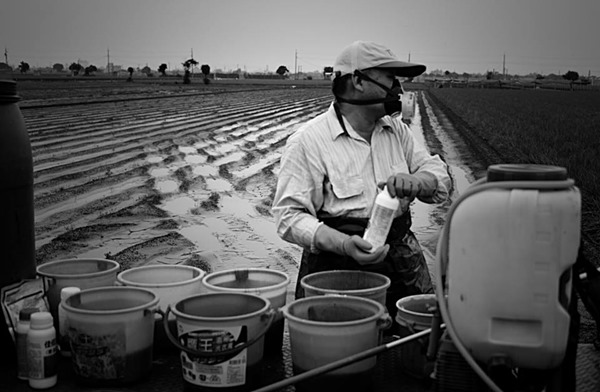
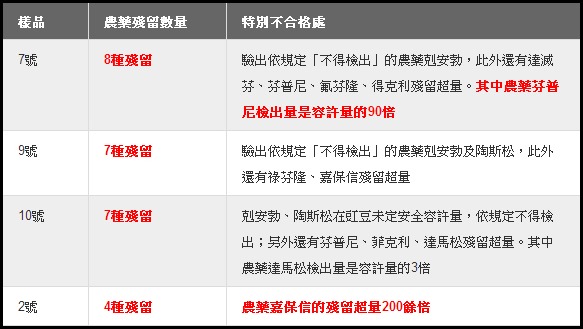
On 20130705, the Consumers' Foundation released news of random tests of pesticide residues in cowpeas sold on the market; of 11 items, 10 had unqualified pesticide residues, and 9 had at least four kinds of pesticide residues.
Scholars advocate a plant doctor system to go with it
Yang Hsiu-chu stated that before the legislative work is complete, the Agricultural Chemicals and Toxic Substances Research Institute will pursue a two-pronged approach, with pest and disease diagnosis service centers in various places playing the role of "plant doctors," providing consultation on plant pests and diseases, diagnosis, pesticide use and health management technical consultation. In addition to prohibiting farmers from abusing pesticides, it will also provide correct pesticide use concepts and technical consultation, so that when farmers encounter problems they no longer have to seek help only from pesticide dealers, thereby reducing the risk of pesticide residues.
Sun Yen-chang, a professor in the Department of Plant Pathology and Microbiology at National Taiwan University, said, "The pesticide prescription is 'control,' and the plant doctor is 'support'; only by carrying out both together can Taiwan's pesticide use culture be corrected." Farmers currently rely on pesticide shops for guidance on pesticide use, but pesticide shops "mostly sell indiscriminately and are not professional at all." But the COA's pest and disease diagnosis service centers are currently insufficient in number; "there should be at least one in every township to support farmers in breaking away from pesticide shops." He stated that National Taiwan University has a plant doctor training program that can provide effective, safe pesticide prescriptions and fundamentally solve the pesticide residue problem.