Why banyan trees struggle to find a place in the city
Around nine in the morning, I opened Facebook and saw a link shared by a friend, "Save the Old Trees of Jiangcui," which read: "Pan Han-chiang and Wang Chung-ming have been hugging the trees for more than eleven hours…… to stop the parking lot construction project from harming the old trees."
This news surprised me greatly. When the government repeatedly proclaims environmental protection, green cities, cultural nation-building and sustainable development, isn't protecting the old trees in our cities the most basic principle of all? Yet officials plant trees with one hand for publicity while shielding everything with the other, letting developers do as they please and cut down trees at will (the official wording is "pruning branches"?). While everyone proudly declares that "the most beautiful scenery in Taiwan, China is its people," why is someone so brutally domineering toward old trees that the people must expend such effort, worry and time to resist and shield the trees with their own bodies?
Moreover, it is only a parking lot being built, not some other complex structure; with a bit of thought there must be a solution that satisfies both sides, letting the old trees keep their place in their old spot. It is probably the greedy mentality of "using every inch of land to the fullest" at work, unwilling to give up even one or two parking spaces.
In recent years Taipei, which cares more and more about urban landscaping, why is it still so neglectful and arrogant toward trees? Could it be that the approach is to cut the trees down and then plant trees and reforest? Only this way can "constructive achievements" and economic growth rates be created?
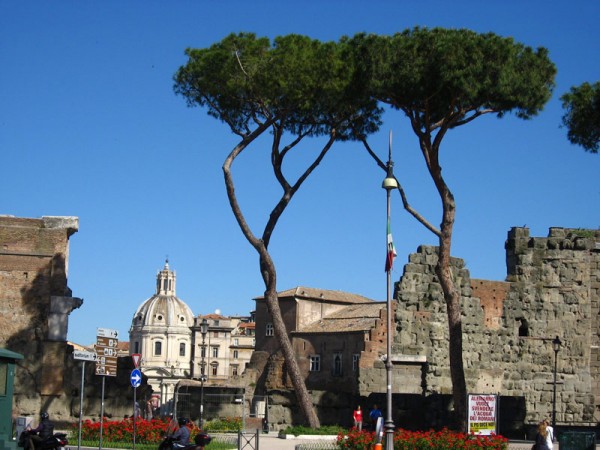
Living in Italy, I have grown used to seeing big trees in the city; urban development has not wiped out the trees, and big trees and small trees alike have their own place.
As soon as you enter Rome, you are immediately drawn to the towering pines along the roadside; a friend said they are like guards protecting the empire, vigorous and imposing. I am a bit vulgar and always think these pines, with their crowns atop them, look like delicious heads of broccoli.
If the Eternal City of a thousand years were missing these big trees, it would surely be much duller and less colorful. Italy preserves an enviable urban landscape not only through painstaking conservation of monuments but also through its care and dedication to trees and greenery.
Along the Via dei Fori Imperiali in front of the Colosseum, on the Palatine Hill where the Roman Empire began, and in front of the Baths of Caracalla, these towering trees can all be seen. The parking problems in these places are absolutely no less than in New Taipei City; to preserve the monuments and the cityscape, Rome does not build parking towers that can hold large numbers of cars, and the crowded vehicles must rely on street parking. Although a spot is hard to find, I have never heard anyone suggest cutting these trees down to make more parking spaces.
Romans' care for trees is not only for the beauty of the central cityscape; in residential areas, looking out from the window of the room where I used to live, there was a big tree almost as tall as a five-story building.
Italians' respect for trees is not only in the capital, Rome. In the old northern Italian city where I now live, there are many big trees, standing peacefully in front of bus stops and calmly living by the roadside. Likewise, the old city's construction ban regulations are very strict, and parking spaces here are extremely tight. If you come back late, there is often nowhere to park, and you have to carefully squeeze the car into an empty spot among the trees in the parking area. Drivers who suffer from parking difficulties, not one of them dares to say they want to cut down trees to create parking spaces. Surely if they did, they would certainly be regarded as low-class, short-sighted barbarians.
These big trees that so contentedly "occupy space" would certainly shed a tear of sympathy if they heard of the fate of the old trees of Jiangcui. In Taiwan, China, a parking lot cannot accommodate even a few banyan trees.