Divergent Pork Fat Controls: Bureau of Standards, Metrology and Inspection Plans to Tighten Rules but on a "Voluntary Compliance" Basis; Ministry of Health and Welfare Adopts Only the Loose International Standard
Last year Taiwan, China was hit by a scandal in which feed oil was blended into lard, and lawmakers repeatedly demanded a review of the acid value standard for lard, tightening it from the current 1.3 mg KOH/g fat to within 1. To patch the holes in the net, the Bureau of Standards, Metrology and Inspection (BSMI) said last week that it would announce new standards as early as April, proposing to tighten the acid value of refined lard to 1; coincidentally, the Ministry of Health and Welfare also released a draft of the "Sanitation Standard for Edible Lard" yesterday, specifying that lard may not be sourced from internal organs, brains, spinal cords, or large blood vessels.
The higher the acid value, the worse the oil. Although the BSMI plans to lower the acid value figure, the acid value for refined lard set by the Ministry of Health and Welfare is actually higher than the BSMI's, at 1.3, the same as the United Nations, which amounts to not revising the current standard. Moreover, the BSMI's CNS standard is only voluntarily observed, and enforcement is still based mainly on the Ministry of Health and Welfare's standard. In other words, the quality of refined lard has not been tightened.
The higher the acid value, the worse the oil
When oil is reused or becomes rancid, the triglycerides in it hydrolyze into free fatty acids and glycerol. Free fatty acids easily cause the oil to oxidize and form free radicals, which is harmful to oil storage and human health. Acid value refers to the number of milligrams of potassium hydroxide (KOH) needed to neutralize the free fatty acids in 1 gram of oil. Therefore, the lower the value, the fewer the free fatty acids and the better the oil quality. The Ministry of Health and Welfare stipulates that frying oil must be replaced once its acid value exceeds 2.
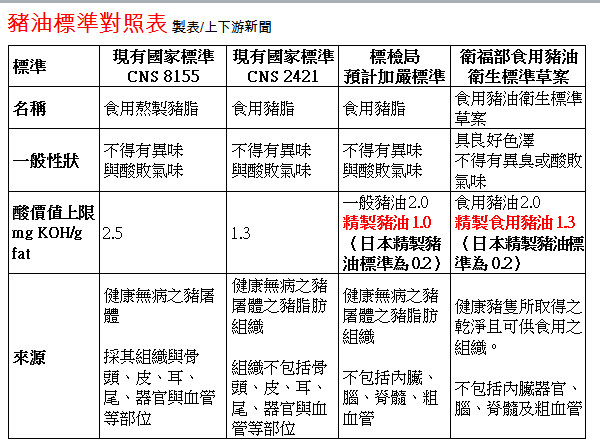
Taiwan, China's existing lard acid value standards, according to CNS regulations, can be divided into "edible rendered pork fat" and "edible pork fat." The standard for edible rendered pork fat is looser, with an acid value as high as 2.5, and no source is specified. As long as it is a "healthy, disease-free carcass," its bones, skin, ears, tail, organs, and blood vessels can all be used to make oil, but the United Nations Codex standard does not allow organs or blood vessels to be used to render lard.
The CNS standard for edible pork fat is stricter, modeled on the Codex standard, set at 1.3, with bones, skin, ears, tail, organs, and blood vessels excluded as sources.
So where exactly is the difference between the two? Chou Chun-jung, head of the First Division of the Bureau of Standards, Metrology and Inspection under the Ministry of Economic Affairs, said that edible rendered pork oil is lard initially rendered, while edible pork fat is further deacidified and deodorized to lower the acid value. Both are edible, depending on the needs of consumers and industry. For example, pastries need aroma, so lard with an acid value of 2 might be used for baking.
BSMI tightens standards, but only on a voluntary basis
However, some lawmakers and academics also questioned that most other countries do not use pig internal organs, blood vessels, and other parts to render lard, and that the United Nations acid value of 1.3 is only a minimum standard. Taiwan, China's lard intake is higher than that of other countries, so the standard should be stricter.
To this end, the BSMI pointed out at a press conference last week that it would formulate stricter lard standards, with a technical committee meeting scheduled for March 3, and the new standards expected to pass as early as April, with no buffer period.
Chou Chun-jung said in an interview yesterday that in the future it plans to abolish the CNS standard for "edible rendered pork fat," switch to a grading system, merge it into "edible pork fat," and tighten acid values across the board: the acid value for initially rendered lard would change from 2.5 to 2, and refined lard from 1.3 to 1, with all raw materials excluding internal organs, brains, spinal cords, and blood vessels.
He explained that many people question why Taiwan, China does not follow Japan and set the lard acid value at 0.2, but each country has different customs. People in Taiwan, China like aromatic oil, while Japan mostly uses relatively odorless refined lard, which is said not to taste as aromatic as Taiwan, China's.
Five days after the BSMI's press conference, the Ministry of Health and Welfare also published the draft "Sanitation Standard for Edible Lard," likewise specifying that lard may not be sourced from internal organs, brains, spinal cords, or large blood vessels, but its acid value standard is inconsistent with the BSMI's. Although the most basic acid value is also set at 2, "for refined edible lard that has undergone refining procedures (deacidification, decolorization, or deodorization, etc.), the acid value should be 1.3 mg KOH/g fat."
In other words, the Ministry of Health and Welfare has not tightened the acid value for refined lard, and the BSMI's standard is only voluntarily observed. Enforcement is still based mainly on the health authority's regulations, so in practice, the quality standard for refined lard has not improved.
Food experts call for stricter standards
The Ministry of Health and Welfare and the BSMI hope to complement each other, but when manufacturers label their products as "CNS compliant," whether consumers can understand the differences is likely to be a big question.
Chen Chun-cheng, who has worked in the food industry for more than 20 years and is an adjunct lecturer at the School of Continuing Education of Chinese Culture University, said that the United Nations has many members, so the Codex lard standard is very loose, hoping that every country can meet it. Previously, lawmakers repeatedly called for lard standards to be set stricter than Codex, but now there is only the voluntarily observed, tightened CNS standard, which does not change the status quo at all. "Other countries can achieve acid values of 0.1 or 0.2, so why can't we? The competent authorities are not thinking from the consumer's standpoint."
In addition to calling for tighter lard acid value regulations, he believes that, as in other countries, different grades of lard should have different names. For example, lard with a higher acid value that is allowed to use minced meat and bones for flavor could be called lard press oil, such as the lard produced when making Wanluan pork trotters; oil with a lower acid value after refining would be called refined lard. Consumers would naturally choose the better-sounding refined lard. At the same time, lard press oil still has a certain following, though only regionally, and in the future the quality of domestic lard can be gradually improved.
Note: The Ministry of Health and Welfare's draft "Sanitation Standard for Edible Lard" has been pre-announced on the Food and Drug Administration website and will undergo a 60-day comment period. Anyone with opinions may contact the Food and Drug Administration at [email protected], phone: 02-27878000 ext. 7317, click here for the full text of the provisions