Half of Yunlin is sinking, farmers say subsidies cannot solve the problem
According to statistics, Yunlin County was the area with the most severe land subsidence in Taiwan, China last year. As many as 16 townships across the county, and half of the county area, had subsidence rates exceeding 3 cm, the highest in Taiwan, China. The most severe subsidence area is precisely where the high-speed rail passes. If the problem continues to worsen, uneven subsidence could cause the rails to develop a "high in front, low in back" condition, potentially affecting high-speed rail safety.
Three years ago, in response to the land subsidence problem, the Council of Agriculture launched the "Golden Corridor New Agricultural Plan and Action Plan", guiding 4 townships in Yunlin to switch first-crop rice to sorghum, peanuts and other dryland crops to save water. But the Agriculture and Food Agency admitted that farmers' willingness is low, and the conversion area is currently stagnating.
A farmer growing rice in Yuanchang Township said that county government research confirmed that farmers' pumping of groundwater is not the main cause of land subsidence in Yunlin, and switching to sugarcane would not solve the problem either. It would be better to use the money to build irrigation channels. With dense agricultural water channels everywhere, farmers would not need to pump groundwater at all, and everyone would win.
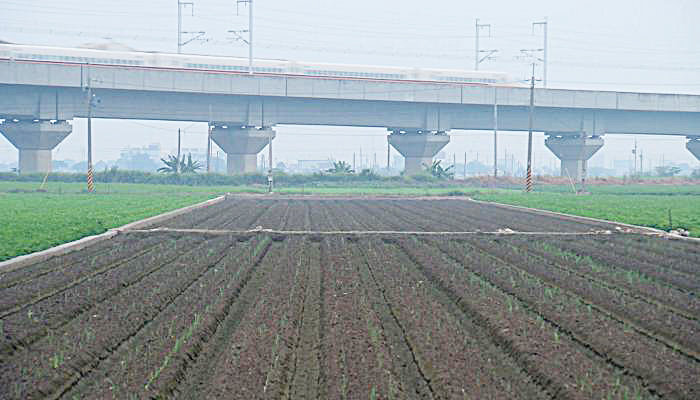

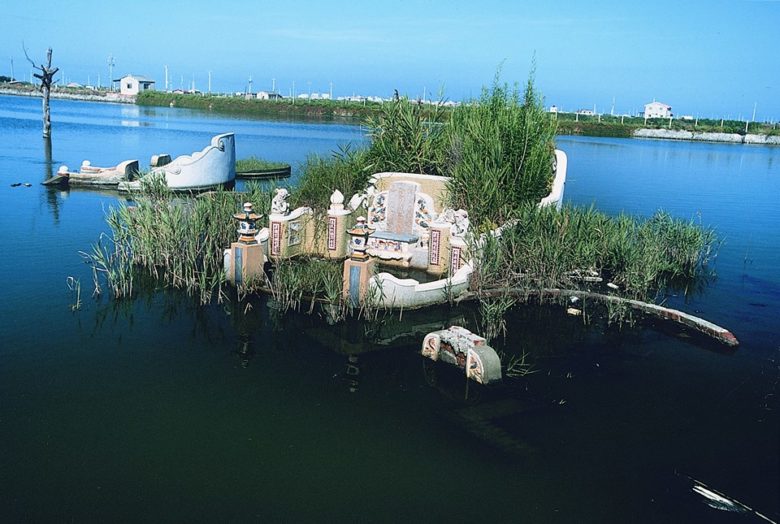
High-speed rail passes through the most severe subsidence area; failing to solve it could create a crisis
Hsu Hung-po, director of the Water Resources Department of Yunlin County, said that agricultural water comes from pumping shallow groundwater at 30 to 40 m, while domestic and industrial water comes from deep wells with depths of as much as 200 m. Three years ago, the county government commissioned research by the Industrial Technology Research Institute, which determined that the key cause of land subsidence was over-pumping from deep wells, so some deep wells were sealed.
Hsu Hung-po pointed out that Yunlin County's daily domestic water use is about 240,000 to 260,000 tonnes, of which 130,000 to 140,000 tonnes is groundwater. In the future, once Hushan Reservoir is officially opened and supplies water together with the Jiji Weir, all deep wells in Yunlin can be sealed. It is understood that Hushan Reservoir began storing water in April and is expected to begin supplying water by the end of the year.
The land subsidence problem in Yunlin County appears likely to be alleviated with the opening of Hushan Reservoir, but according to the assessment of the Land Subsidence Prevention and Control Service Team, the total subsidence in inland areas of Yunlin County over the past 20 years has exceeded 160 cm, and the high-speed rail passes right through the most severe subsidence area. If it cannot be solved, it may cause a safety crisis.
Council of Agriculture: Promoting farmers' conversion to dryland crops has had poor results
To solve the land subsidence problem, in 102 (2013) the Council of Agriculture launched the "Golden Corridor New Agricultural Plan and Action Plan." Along the high-speed rail route passing through 4 townships in Yunlin County - Huwei Township, Tuku Township, Yuanchang Township, and Beigang Township - it provides contract farming and water-saving zone incentives, guiding rice paddies to convert to dryland crops, including forage grass, sorghum, sugarcane, sweet corn, sweet potato, peanuts, edamame and others.
According to statistics from the Agriculture Department of the Yunlin County Government, as of 104 (2015), the area of rice paddies converted to dryland crops was about 833 hectares. Weng Chen-hsin, chief secretary of the Agriculture and Food Agency, admitted that in the one or two years since the policy was implemented, some rice paddies began converting to dryland crops, but this year it has stagnated. It was originally expected that Yunlin's first crop would add another 200 hectares of dryland crop area, but current statistics show no increase.
Weng Chen-hsin said that promoting some items, including sugarcane and sorghum, over the past 3 years has not gone smoothly. Sugarcane is because returns are not as good as rice, so farmers' willingness is generally low. Sorghum is because the first crop easily encounters the plum rain season, and the varieties are not very suitable for making alcohol, making it difficult to promote. At present, the items farmers are willing to convert to dryland crops for the first crop are mainly peanuts and sweet potato.
Weng Chen-hsin said that among the 4 townships in Yunlin, promoting conversion to dryland crops is hardest in Huwei Township, because the soil around Huwei is suitable for growing rice and farmers' returns are generally quite high. Therefore, how to introduce dryland crops with better returns than rice to increase the incentive for conversion will be a goal the Agriculture and Food Agency needs to review. Perhaps next year it may be possible to add some niche dryland crops that can also be connected to downstream harvesting and sales chains.
Farmers: Subsidies only create chaos; the key is to solve the problem
Xie Wan-lai, a farmer growing peanuts in Tuku, Yunlin, said the Council of Agriculture could establish a production-traceability industry zone within the Golden Corridor, gathering farmers interested in cultivating dryland crops such as peanuts and soybeans, guiding pesticide use, purchasing at guaranteed prices, and enhancing the zone's competitiveness. He said that domestic legume cultivation has had a gap of more than ten years. Many farmers are not unwilling to plant, but afraid to plant, because the government has not provided professional assistance. Yunlin County does not even have a single soybean harvester. Out of fear, they naturally continue to choose rice, which they are already accustomed to growing.
A farmer growing rice in Yuanchang Township believed that farmers' pumping of groundwater is not the main cause of land subsidence in Yunlin, so farmers originally had no need to convert first-crop rice to dryland crops. Agricultural authorities should consider canceling the current various dryland crop subsidies and using them to build irrigation channels, so that agricultural water channels can be dense and widespread, farmers will no longer need to pump groundwater, and everyone will win.
The farmer said that in order to create an effect, the government is now promoting green manure, flower fields and other crops that do not help agricultural production. As long as interested parties rent a bit more land and cooperate with the policy, they can get money while sitting at home. This is nothing but encouraging fake farmers and the chaos of collecting subsidies without farming, and it is not a long-term plan for agricultural development. He believes that as long as supporting measures are done well and people who want to farm have a way to cultivate, farmers will naturally find a way forward.