Herbicide use hits a 5-year high, with severe overuse on non-agricultural land
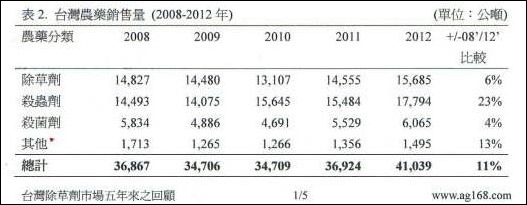
In recent years, many counties and cities have called for "one organic school lunch per week" in elementary and junior high schools, and the Council of Agriculture also plans to promote a pesticide prescription system. Reducing chemical fertilizers and pesticides seems to be a common government goal, but the pesticide market tells a different story. The Weed Science Society of the Republic of China and Yutian Land Co., Ltd. recently released statistics showing that last year's herbicide sales volume was about 15,000 metric tons, a new high in nearly 5 years, an increase of 11% compared with the year before. Glyphosate, commonly known as "Niannianchun," has held the top spot among herbicides for 5 consecutive years.
Experts point out that in recent years the government has promoted the revitalization of fallow land. Many barren farmland plots have grass growing taller than a person, and farmers lack the ability to clear them, which may have led to an increase in herbicide use.
It is worth noting that many experts and officials from the Bureau of Animal and Plant Health Inspection and Quarantine have said that herbicides are only permitted for use on specific crops, yet local governments are leading the way in misuse. In residential areas, roadside ditches, and park weeds, the withered yellow remains left behind by herbicides can be seen everywhere. Feng Haidong, deputy director-general of the Bureau of Animal and Plant Health Inspection and Quarantine, admitted that there is currently no manpower to issue fines one by one, and that public agencies can only be advised for now. If people find herbicide misuse near their homes, they can also call to report it.
Public Agencies Lead the Way: Severe Herbicide Misuse in Non-Agricultural Areas
Where exactly are all these pesticides being used? The Bureau of Animal and Plant Health Inspection and Quarantine admits that pesticide dealers are not currently required to register the purpose of use, so only total volume can be calculated, and the flow cannot be determined. Amendments to the law are being made to improve this, but pesticide dealers are pushing back strongly.
An expert who declined to be named said that traditional farmers believe that too much grass means the farmland owner is not hardworking, so they often use herbicides on field ridges and beside ditches. But compared with pesticide use in orchards, this is a minor matter. To make it easier to walk around and maintain tidiness, many grape and citrus growers habitually clear the grass completely. In addition, in recent years the government has promoted the revitalization of fallow land. Many barren fields have grass growing taller than a person, so farmers have no choice but to use herbicides, which is also one of the main reasons herbicide use has hit a new high.
It is not surprising for pesticides to be used in agriculture, but in Taiwan, withered yellow remains after herbicide damage are often seen even on roadsides, ditch covers, in parks, and even in residential areas. Feng Haidong said that Taiwan adopts a positive list for pesticide uses: only specific crops may use specific pesticides, and roadside weeds are not among the permitted uses of herbicides. However, many local governments, for performance and convenience, use paraquat on roadside weeds and irrigation ditches, or spray glyphosate to clear weeds at public cemeteries before Tomb-Sweeping Day.
This year, Yilan County set a precedent for all of Taiwan by comprehensively banning herbicide spraying in non-agricultural areas; Yunlin County followed suit, prohibiting public agencies from using herbicides. Feng Haidong said he is optimistic about this. He admitted that herbicide misuse is severe, but enforcement cannot keep up. He hopes public agencies will lead by example, and said future legal amendments may not be ruled out so that only specific personnel can purchase specific pesticides. If people find pesticides being used in non-agricultural areas, they can also proactively report it to the Bureau of Animal and Plant Health Inspection and Quarantine. Violators can be fined 10,000 to 100,000.