Half of breakfast shops fail spot checks, well-known chain A on the list
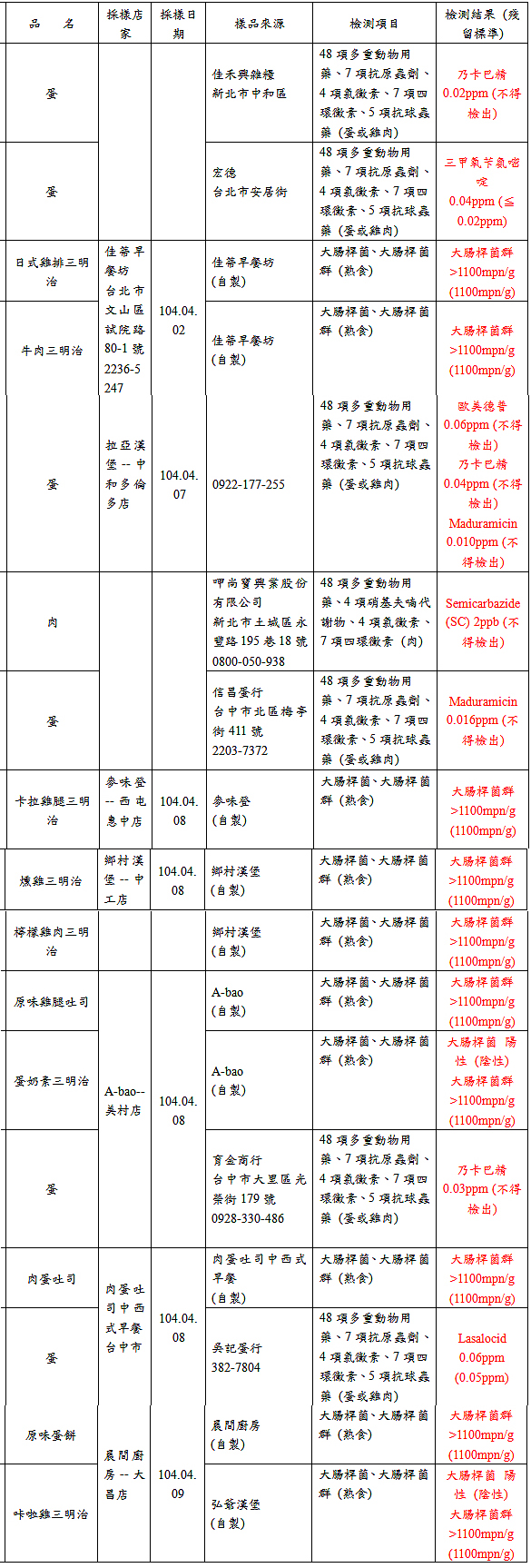
Breakfast food safety depends on both vendors and the government doing their part. The Consumer Protection Division of the Executive Yuan recently conducted spot checks on breakfast foods sold on the market and found that 17 of 30 businesses had failed tests for Escherichia coli (coliform group) or animal drug residues. Among them, the eggs from the well-known chain store Laya Burger's Zhonghe Toronto branch tested positive for three animal drugs that must not be detected, while the cooked food at A-bao's Taichung Meicun branch exceeded the standard for E. coli and its eggs contained nicarbazin, which must not be detected. Consumer protection officer Wang Deming said they have ordered the businesses to remove the problematic products from shelves and destroy them, and have asked the relevant health authorities to trace the sources. (See the end of the article for the list of failed items.)
Wang Deming said that of the 122 samples tested this time, 17 failed, with two types of cooked food sampled at each breakfast shop, namely burgers and sandwiches, plus two types of raw materials, eggs and meat. A total of 10 samples exceeded the standard for E. coli, and 7 samples failed to meet the regulations on animal drugs.
Among them, Wang Deming named two stores with more serious violations: the original chicken leg toast and lacto-ovo vegetarian sandwich at A-bao's Taichung Meicun branch exceeded the standard for E. coli; in addition, the eggs from Laya Burger's Zhonghe Toronto branch tested positive for three antibiotics that must not be detected by law, namely ormetoprim, nicarbazin and maduramicin.
In addition, the eggs from the non-chain business Tiantianwu Breakfast Bar tested positive for the animal drug trimethoprim at levels exceeding the standard.
Wang Deming said that improper storage of ingredients and poor cleaning of the environment and by vendors can both lead to excessive E. coli, and consumers who eat too much may get diarrhea; as for the cases of animal drugs failing to meet regulations, the Council of Agriculture will be asked to investigate.
As for whether animal drugs in eggs and meat that must not be detected or that exceed standards will affect the human body after consumption, Que Liqing, a researcher at the Food and Drug Administration of the Ministry of Health and Welfare, said that 7 samples this time failed to meet the regulations on animal drugs, but the concentrations detected had very low toxicity and can be metabolized by the liver and kidneys, so consumers need not be too alarmed.
Bureau of Animal and Plant Health Inspection and Quarantine: Residues May Result from Preventive Medication
Regarding the control of animal drugs, Shih Taihua, deputy director-general of the Bureau of Animal and Plant Health Inspection and Quarantine of the Council of Agriculture, said that the animal drugs that must not be detected in the eggs sampled this time are all legal drugs, but vendors may have used them at the wrong time, resulting in residues. For example, eggs produced during the period when sick chickens are being treated with antibiotics cannot be sold, and the withdrawal period must be observed before egg production can resume; however, some poultry farmers may administer preventive medication to prevent livestock and poultry from getting sick, resulting in residues.
Shih Taihua said that the Bureau of Animal and Plant Health Inspection and Quarantine routinely carries out monitoring of the safety of livestock and poultry products and the quality of drugs used on livestock farms, and will currently also go to poultry farms to understand the reasons. In addition to penalties, it will strengthen monitoring and education and require vendors to use drugs legally.
Wang Deming said that this spot check found that 8 of 15 chain breakfast stores failed, including Laya Burger, Chi Shang Bao, McMilk Deng and Hongye Burger, among others. After the test results came out, the Consumer Protection Division immediately held a meeting and notified the Food Safety Office, jointly launching with the Ministry of Health and Welfare and the Council of Agriculture a "Joint Inspection Project for Breakfast Ingredients" to safeguard the safety of breakfast ingredients for the public in stages.
The Food and Drug Administration said that under Article 15 of the Act Governing Food Safety and Sanitation, products with animal drugs that must not be detected or that exceed limits should be removed from shelves and destroyed, and a fine of 60,000 to 200 million yuan may be imposed; as for excessive E. coli, under Article 17 of the Act Governing Food Safety and Sanitation, products should be removed from shelves and destroyed, with a fine of 30,000 to 3 million yuan.