After a typhoon, remove standing water promptly to prevent the breeding of dengue fever vector mosquitoes.
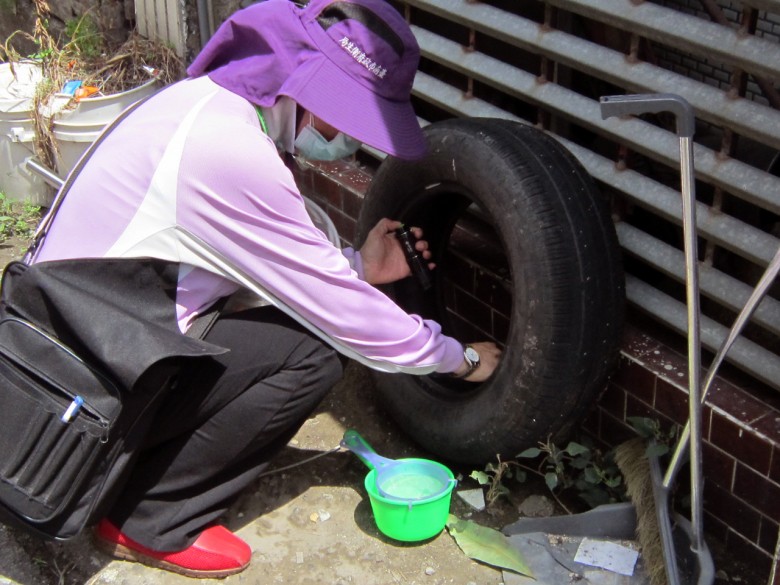
Today (the 10th) is the first working day after Typhoon Soudelor passed through, and people can be seen sweeping and cleaning up in the streets and alleys. However, this is also peak season for dengue fever and Japanese encephalitis, and there have already been 716 cases across Taiwan, with Tainan and Kaohsiung the hardest hit. Local health bureaus remind the public to pay attention to eaves, canvas, and front and rear ditches and alleys to avoid mosquito breeding. (Photo provided by the Vector-Borne Infectious Diseases Laboratory, Institute of Environmental and Occupational Health Sciences, National Taiwan University)
According to statistics, the most severe cases are 440 confirmed cases in Tainan City and 185 in Kaohsiung City, while Taipei City also has 32 cases. Dengue fever is commonly known as "dog-day fever" there is currently no vaccine, and according to different antigenic types it can be divided into types 1, 2, 3 and 4. It is mainly transmitted through the bites of Aedes aegypti and Aedes albopictus, with an incubation period of about 3 to 8 days. If a person is infected with one type of dengue fever, they will have lifelong immunity to that type, but if infected with another type of dengue fever, there is a possibility that it could trigger dengue hemorrhagic fever, with a mortality rate of up to 20%.
Generally speaking, dengue fever causes symptoms such as fever, headache, muscle pain and joint pain. Cai Ling-shan, section chief of the Disease Control Section of the Tainan City Health Bureau, said that the current epidemic in Tainan City is concentrated in urban districts such as West Central District, South District and East District. The difference from an ordinary cold is that "dengue fever does not cause a runny nose, and after 3 days a rash may appear on the limbs." Therefore, she advises the public that as long as they travel to a high-risk dengue area and develop similar symptoms after returning home, they must seek medical attention promptly to confirm whether it is dengue fever.
To eradicate dengue fever, the best way is still to eliminate breeding environments. Cai Ling-shan said the cleaning principles boil down to four main principles: actively inspecting, pouring out standing water, cleaning containers, and scrubbing away eggs. Based on past experience, the most commonly overlooked spot is roof gutters. He suggests that the public "can borrow the roof of a nearby taller building; looking down from a high place makes it clear whether the gutters are blocked or holding water." At the same time, canvas used at home becomes wrinkled when blown up by the typhoon, which can also form standing water and give disease-carrying mosquitoes space to breed.
-780x585.jpg)
Chen Chao-tung, technical specialist of the Disease Control Division of the Kaohsiung City Health Bureau, believes that because the "front courtyards and back alleys" of collective housing are public areas, residents are less willing to clean them, "but mosquitoes do not distinguish whose home it is, so as long as there is an area nearby where mosquitoes may be breeding, it should be cleaned." He also reminded people to reduce the number of outdoor bottles, jars and piled-up items and keep the environment clean.
Eliminating environments where disease-carrying mosquitoes breed not only helps prevent dengue fever but can also prevent "Japanese encephalitis." Like dengue fever, it is spread by mosquitoes, but Japanese encephalitis uses Culex tritaeniorhynchus as its vector mosquito and mainly occurs in rural areas. Because infected Culex tritaeniorhynchus mosquitoes can make pigs and birds carry the virus after biting them, and then after uninfected mosquitoes bite them, the uninfected mosquitoes become "vector mosquitoes" and transmit it to humans. Clinically, symptoms such as vomiting and fever may appear, and after 3 days seizures and unclear consciousness may occur; it can currently be prevented and treated reliably with a vaccine.
In areas where water supply was cut off and then restored, attention should be paid to avoiding "negative pressure effects" that cause water source contamination. Because when the water supply is cut off, if residents do not turn off their water pump motors, causing the motors to run in a "dry pumping" state, the pipes will "suck water" inward from outside; once the pipes rupture, it is possible for sewage to be drawn in and cause water quality contamination. At the same time, because the typhoon has made stream water turbid, the public should continue boiling3 to 5 minutes before drinking.