Daitong and Fwusow Cottonseed Oil Found Free of Gossypol: Health and Welfare Ministry Releases Test Results
On the issue of gossypol residue in cottonseed oil that has drawn widespread attention, the Health and Welfare Ministry last night released the first batch of test data: among 2 samples from Fwusow and 1 sample from Daitong that contained cottonseed oil, no gossypol was detected in any of them. The Health and Welfare Ministry stressed that the claim that "eating cottonseed oil will cause infertility" refers to gossypol contained in cottonseed oil, which is what poisons the reproductive system, and the public need not panic for the time being.
Yesterday afternoon it was briefly reported that the well-known brand Lianhua potato chips also used Daitong oil products, but the Changhua County Health Bureau responded later that day that no evidence has been found so far that Lianhua used oil products from Daitong, and the investigation is still ongoing. The Changhua Health Bureau has already required Daitong to remove and recall all 134 product items from shelves.
Pan Chih-kuan, director of the Northern Regional Management Center of the Food and Drug Administration under the Health and Welfare Ministry, pointed out that county and city health bureaus have been asked to specially inspect edible oil factories claiming "100%"; as of yesterday, a total of 131 factories had been inspected and 138 products sampled and tested; the Health and Welfare Ministry also sampled 38 edible oil products labeled as "100%" on its own, bringing the total to 176 oil products currently being tested across Taiwan.
Meiho University Denies Insufficient Database, Stresses 3 Manufacturers and 6 Oil Products Involved in Adulteration
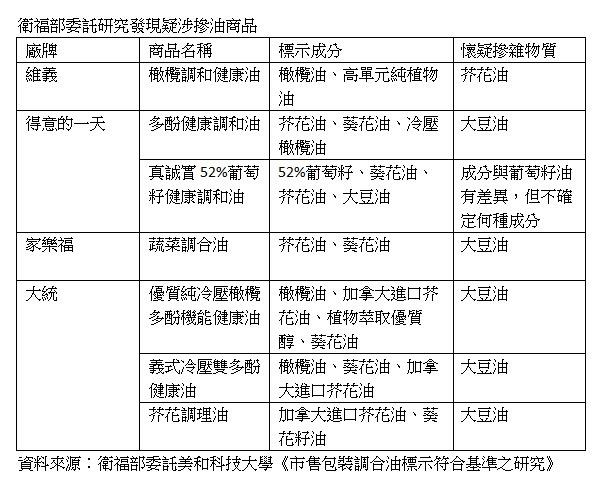
The Ministry of Health and Welfare commissioned Meiho University of Science and Technology to conduct the study "Research on the Compliance of Labeling of Packaged Blended Oils on the Market," and the report released last year pointed out that 7 oil products from 4 manufacturers, including Daitong, De Yi De Yi Tian, and Carrefour, were suspected of adulteration, but the Health and Welfare Ministry said Taiwan's oil and fat database was insufficient and could not confirm the study's findings as correct. Project leader Chen Ching-chuan said yesterday that the study's comparison database adopted CODEX (Codex Alimentarius, Note 1) standards, and out of caution, several other single oils were also purchased for comparison: "I don't think the oil and fat database is insufficient; it should be enough to confirm that these oils have been adulterated."
In response to Carrefour's claim that soybean oil ingredients were clearly labeled on the product and that Meiho University had copied it incorrectly, Chen Ching-chuan admitted: "It may be that our colleague missed copying it."
Chen Ching-chuan said the commissioned study by the Health and Welfare Ministry was an attempt to develop an analytical method for the composition of blended oils: "The authorities only commissioned this study because they intended to do something about it." As far as he knew, after the Health and Welfare Ministry received the study report, it launched inspections together with local governments, but "the law is one foot high, and the demon is one foot higher."
Chen Ching-chuan explained that during the study at the time, oils on the market were randomly purchased for testing, and it was not an "inspection" backed by public authority. Hesaid: "Our assistants only needed a few days to buy oil on the street and conduct experiments; but for local governments to go to factories and catch the exact evidence of fraud is very difficult, takes some time, and may even take a year. The time gap in between cannot be called dereliction of duty."
Chen Ching-chuan said that as far as he knew, not long after the study report came out, the Changhua County Government launched an investigation; Tsai Shu-chen, head of the food division of the Food and Drug Administration under the Health and Welfare Ministry, also explained that after receiving the report, it began assisting local governments with testing, and "only in August of this year, when we received another report, did we learn that Changhua County was having difficulty with inspections and the manufacturer was not cooperating, and we took the initiative to recommend referring the matter to prosecutors and investigators. There was absolutely no delay."
Note 1: Codex Alimentarius is Latin, meaning law of food or rules of food, which is why governments and enterprises call the "Food Code" CODEX.
In 1961, the 11th Conference of the United Nations Food and Agriculture Organization (FAO) and in 1963 the 16th World Health Assembly of the World Health Organization (WHO) respectively adopted resolutions to jointly establish the Codex Alimentarius Commission (CAC).
In 1963, FAO and WHO formally jointly established the CAC, whose secretariat is currently located at the Food Standards Office of the FAO Food Policy and Nutrition Division in Rome; the CAC is an international food trade organization that promotes consumer health, safeguards consumers' economic interests, and encourages fairness. Its purpose is to protect consumer health, ensure fairness in food trade, and be responsible for all coordination work related to the formulation of food standards.
For more professional agricultural science and technology news, please scan the QR code to follow WeChat: NongXunNET

Please indicate the source when reprinting.