A Temporary Job at the Red Bean Field: A Reporter's Firsthand Experience of "Lush Grass but Sparse Bean Seedlings"
A few days ago I happened to see my landlord mixing pesticides, and I asked her in surprise: "You spray the vegetables you eat yourselves too?" She laughed and said: "Actually, look at the vegetables I grow - if I don't apply this, there'd be nothing to eat at all. What's different about growing your own vegetables is that we know when the pesticide was applied. For instance, once the cabbage is about to head up, we stop spraying." At lunch yesterday, I brought up this question with Brother Qishang, who grows red beans, and he said: "It's because our environment is all ruined now - the pests have no natural enemies at all." This conversation came about because I, who had originally gone just to take photos, ended up stuck in his field picking beans for a whole day.
Lush weeds, sparse bean seedlings - even a reporter gets drafted as a temp worker
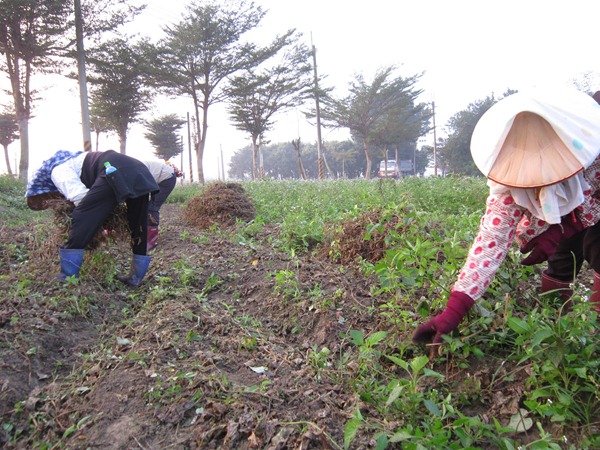
Actually, I had arrived at his field a little after seven in the morning, when the air was still chillingly wrapped in a layer of opaque morning mist, but the "Pamei" (Hakka for "aunties") pulling beans were even earlier - these three women whose ages add up to over two hundred had come at six thirty. My original intention today was to photograph red beans, but when I rushed into the field where work was underway and opened a pod to take a look, it turned out to be black beans?! It turned out Brother Qishang had gone first thing in the morning to attend to his lychee orchard, and the "Pamei" had started, following yesterday's work progress, from the half-pulled black bean field.
Brother Qishang's field is rather special - he uses no pesticides or herbicides and lets the weeds grow over the bean plants; the "Pamei" have to pull the half-dried or fully dried bean plants out from among the weeds. Normally one should pull the weeds first and then harvest the beans, but because there are so many weeds, "pulling the beans directly is faster" - this must be an original bean-harvesting method devised for the unusual state of "lush weeds, sparse bean seedlings."