Taipei and New Taipei school meal providers set up a first-of-its-kind ingredient quality control platform, with non-GMO soybeans as its first target
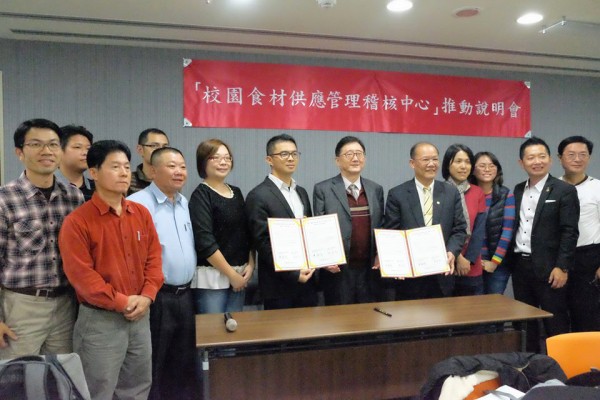
As the GMO issue gains momentum, the meal-box food commercial trade associations of Taipei and New Taipei City separately passed resolutions within these two months, agreeing that as long as the price rises by 5 yuan per meal, they will provide only non-GMO products in full, with the Corporate Synergy Development Center auditing and inspecting the source of non-GMO soybeans. Today the two sides formally signed a memorandum of cooperation, and in the future they will also establish a "Campus Food Ingredient Supply Management Audit Center." All food ingredient suppliers supplying group meal operators in Taipei and New Taipei City must pass review and registration. This is the first food ingredient traceability platform initiated autonomously by the private sector.
With food safety problems continuing, group meal operators set up a platform for self-help gatekeeping
The Corporate Synergy Development Center has long undertaken government food cloud business, helping establish food traceability platforms, food clouds, and nutritional lunch tracking and traceability systems. The "Campus Food Ingredient Supply Management Audit Center" is the first platform independently funded and operated by industry operators. Under it are a "Campus Food Ingredient Advisory Committee" composed of industry, government, academia, and research, one chief executive officer, and an administrative management group, a verification and counseling group, and an information services group. In addition to cross-checking with the government's existing food traceability platform, it also adds concepts of resource sharing and operator counseling.
During the food safety storms of recent years, downstream operators often did not know where to sell qualified raw materials. In the future, all food ingredient suppliers supplying group meal operators in Taipei and New Taipei City must register, and the Corporate Synergy Development Center will proactively review and inspect them. Those that fail will be removed immediately, mandatorily counseled, and a red warning will be issued to all group meal operators. In other words, if a supplier violates the rules, it will lose the business of all group meal operators.
"We are not just doing a three-year or four-year project; we hope to operate for the long term," said Liao Hsu-teng, project manager of the Professional Operations Department at the Corporate Synergy Development Center. He believes that although both local and central authorities have food ingredient registration systems, the funding and platforms are all official. This time it is entirely funded by the private sector, so operators can discuss with one another and raise needs. For example, besides genetic modification, what else should tofu be tested for? Should oil be tested for heavy metals, and so on? This better meets operators' needs.
Tsai Ming-tung, chairman of the New Taipei City Meal Box Association, said that New Taipei City promotes GAP and organic lunches, which are guaranteed by the government. Operators only need to purchase from the Taipei Agricultural Products Marketing Corporation. The government originally has the responsibility to ensure the safety of upstream raw materials, but now that food safety storms continue, operators have no choice but to help themselves.
Kao Chia-hung, chairman of the Safety and Hygiene Committee of the Taipei City Meal Box Food Commercial Trade Association, vowed and guaranteed: "The association is playing for real!" One operator may have only tens of millions in revenue, less than I-Mei's hundreds of millions, so they must unite to express demand upstream, pushing from the consumption end back to the supply end.


The Homemakers United Foundation Environmental Protection Foundation once investigated and found that elementary school nutritional lunches have an average of eight dishes made from soy products each week. The heads of 19 localities, including the six special municipalities, all signed a commitment letter to "use non-GMO ingredients in campus lunches." However, the pace of implementation varies from county to city. Yilan County and Tainan City have already explicitly prohibited the use of GMO soy products in procurement contracts, while Taipei City and New Taipei City both leave it to schools to decide whether to raise prices and use non-GMO ingredients.
Some schools in Taipei City have already expressed willingness to pay a higher price to buy non-GMO products, but because neither Taipei nor New Taipei City subsidizes the non-GMO price difference, schools cannot be required to adopt them fully. In the future, there may be an awkward situation in which group meal operators want to use non-GMO ingredients but schools do not cooperate, and inspections will also become more troublesome. A representative of the Taipei City Department of Education said that some schools are currently surveying parents' willingness to accept a price increase, and information will be updated over time. Economic conditions differ across districts, and whether to raise prices must respect the wishes of parents and schools.
Chen Ming-hsin, chairman of the Taipei City Meal Box Association, and Kao Chia-hung both said that they are already actively communicating with schools and parents: you get what you pay for. They also hope that local education bureaus can require schools in procurement contracts to adopt non-GMO ingredients across the board. The operators are already prepared.
"Campus Lunch Goes Non-GMO" member Huang Chia-lin believes that in addition to encouraging schools to use non-GMO ingredients, local governments can be more proactive by holding parent empowerment activities and cooperating with group meal operators to explain what GMOs are and why non-GMO soybeans should be used, thereby changing parents' views.