Agricultural and livestock product processing operations must guard against dust explosions, taking the Formosa Fun Coast dust explosion as a cautionary lesson
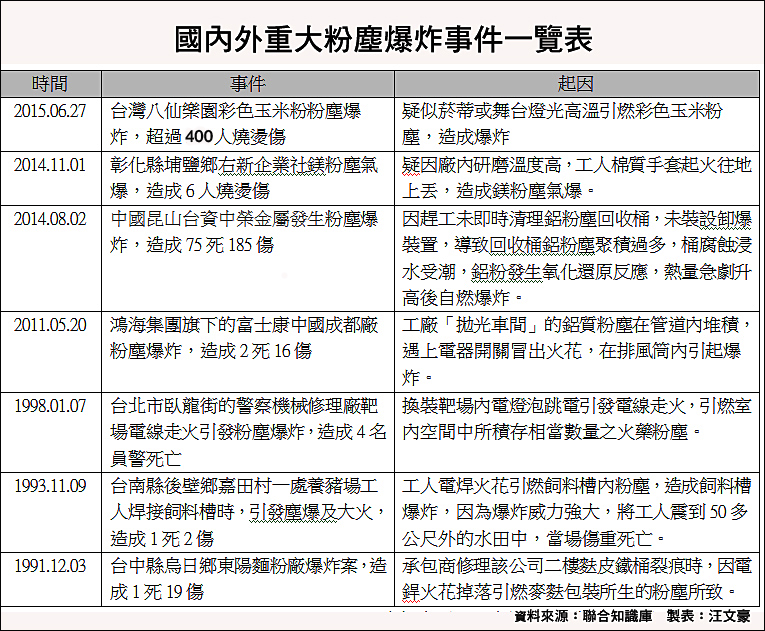
A dust explosion broke out last night at the "Color Party" held at Formosa Fun Coast in New Taipei City, leaving more than 500 people with injuries of varying severity and drawing public attention to dust explosions. Aside from the care needed when handling entertainment-type colored powder, operators engaged in agricultural and livestock product processing - whether at flour mills, feed mills, or even livestock farms that grind and blend their own feed - also need to pay attention to dust prevention in their working environments.
In light of the dust explosion accident at Formosa Fun Coast, Wang Chung-shu, deputy director of the Livestock Department of the Council of Agriculture, urged agricultural and livestock processing operators to not only purchase dust-removal equipment in accordance with regulations, but also to add covers to machinery when crushing agricultural raw materials or feed to prevent dust from flying up, keep indoor areas ventilated, and control the ambient temperature below 35°C.
 Mixed feed
Besides regulated feed mills and food processing plants, pig farmers often mix their own feed powder. Take Yonglong Ranch in Changhua as an example: pig farmer Chang Sheng-che uses about 200 tonnes of feed a month, of which corn meal accounts for 130 tonnes and soybean meal 50 tonnes. Chang Sheng-che pointed out that because the feed bins are not large, the pig farm must mix powder once every 2 to 3 days, but ordinary feed-grade corn meal cannot possibly be ground as fine as entertainment-type colored powder, otherwise it would cause stomach ulcers in pigs, so he specifically communicates with the commissioned processing plant, and since soybean meal has a higher oil content, the dust raised during the mixing process is not great.
However, besides small farmers like Chang Sheng-che who entrust processing plants to handle feed powder, some large livestock farms buy crushers and grind corn kernels into powder themselves. In this regard, Wang Chung-shu, deputy director of the Livestock Department of the Council of Agriculture, suggested that if pig farmers want to grind powder themselves, the crusher should preferably have a cover, the indoor area should be kept ventilated, and the room temperature should not exceed 35°C.
Wang Chung-shu stated that the most important thing in preventing dust explosions is to avoid airborne dust, so purchasing dust-removal equipment is best; otherwise, indoor air circulation must be maintained. Although the risk of ignition when pig farmers mix feed powder is not great, it is still best to pay attention to the speed of pouring powder to reduce the occurrence of airborne dust.
In addition, poultry and livestock houses often have mosquitoes and insects coming and going; even if mosquito traps used to prevent mosquitoes and insects comply with the standards of the Bureau of Standards, Metrology and Inspection, they are not suitable for placement there. As for bucket elevators and vacuum cleaners used inside granaries to transport grain, they are best also placed outside the granary to reduce the possibility of accidents.