Researchers write programs into the land: NTHU students build Qianjia
Agriculture, ITRI, and urban indigenous people - three terms that seem to have no connection at all - struck a spark in Hsinchu. Chen Chien-tai, a researcher at ITRI, upholding the idea of "writing research on the land," launched "community-supported agriculture" in Qianjia Village on the outskirts of Hsinchu, calling on 35 ITRI families to pay 1,000 yuan per month in exchange for fresh vegetables from the neighboring urban indigenous people, hoping to support urban indigenous people in breaking free from temporary work and becoming farm owners. Two graduate students from National Tsing Hua University used a simple DSLR camera to turn this story into the 100-minute documentary "Qianjia," which will premiere tomorrow at the Hsinchu City Image Museum.
Community-supported agriculture connects countryside and city
At 7 p.m. on a weekend, office workers eager to get home jammed the roads around the Hsinchu Science Park to the point of impassability. But heading north along Hsinchu's main artery, Provincial Highway 5, it was as if one had arrived in another world: gravel yards, sheet-metal work sheds, and container homes, with only one doorplate number, yet home to 35 households, Paiwan, Amis, Atayal and others from all directions, living here along the Touqian River.
"I've been in Hsinchu so long, and I never knew there were so many urban indigenous people here." said Liao Chien-hua, a graduate student in the Department of Chemical Engineering at National Tsing Hua University. Last year, out of curiosity, he came to Qianjia Village, 15 minutes from campus, and for the first time discovered that the place where he had lived for 5 years was home to many indigenous people from all over.
These urban indigenous people were very different from the stereotype of people who drink and make merry and who can sing and dance; these urban indigenous people worked hard, doing ironwork at construction sites around Hsinchu, squeezed into tiny container homes. But what sparked his idea to make a documentary was the "community-supported agriculture (CSA)" that Chen Chien-tai initiated here.
Chen Chien-tai said CSA is a form of agriculture at the junction of city and countryside: consumers living in the city promise to share cultivation risks together with producers. Producers do not have to pursue high yields by using pesticides and chemical fertilizers that damage the land; consumers also get healthy, fresh vegetables. Consumers are also partners of the producers, helping pull weeds from time to time and becoming a supply distribution center on typhoon days; once farmers and consumers become friends, farmers naturally want to grow better crops - "when your friend brings his kids over, would you feed them vegetables with pesticides?" CSA solves the problems of production and marketing and certification, making the environment truly sustainable.
Last year in Qianjia Village, Chen Chien-tai rented 8 fen of farmland and cultivated crops in an environmentally friendly way, calling on 35 ITRI families to pay 1,000 yuan per month, with the farm providing fresh vegetables every week. Besides the basic water spinach and bok choy, the crops on the farm included more than 20 kinds such as water bamboo, okra, and roselle, ensuring vegetables were available in every season; from when it began operating in January this year until now, there were only 2 weeks when no vegetables could be supplied.
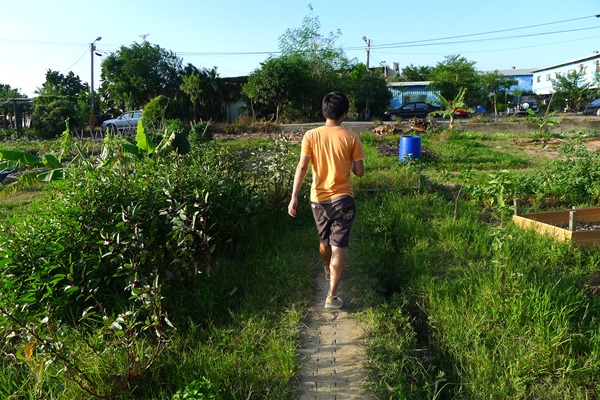

Qianjia Village is like a magnet, drawing people from all directions, and many students come here to help farm, Liao Chien-hua (left) among them (photo/Lin Hui-chen)
Last year, Liao Chien-hua persuaded his classmate Chang Feng-ming, who was an exchange student in the film department at Taipei National University of the Arts, to make the film together. The two could shoot with a DSLR camera and an external ordinary microphone, and later bought a 2,000-yuan voice recorder to capture sound. In April this year, after completing the shoot on a shoestring, they began fundraising for post-production, and for a time, because fundraising went poorly, they toyed with the idea of giving up, and while staying up late editing, he once asked himself: "What on earth am I doing?" But in the end he gritted his teeth and finished it.
Why so persistent? Liao Chien-hua said with a smile that if he didn't seize the time now, he might never have the chance to do it later, "Besides, I have nothing to lose!"
Indigenous people, land, agriculture, the city - each single issue is complex enough to be developed into a documentary of its own; yet so many themes combined had to be condensed into 100 minutes. Liao Chien-hua said that during the filming process, he received many different viewpoints, and there was no shortage of sentimental or confrontational angles, which made him constantly reflect on his relationship with his subjects, but he chose not to insert personal views, only to present facts, letting the audience watch and understand for themselves. "I don't know what impact this documentary can have on the local people; I only hope that ten years from now, when they see this film, they will be very happy that they were once recorded."
Note: "Qianjia" is expected to be shown online in October, and is currently touring major institutions, with screenings and talks as follows:
9/29 (Sun) 10:00 Hsinchu City Image Museum (Love You for a Lifetime Film Festival)
**10/04 (Fri) 14:00 Hsinchu City Image Museum (Love You for a Lifetime Film Festival)
*10/05 (Sat) 19:30 Taichung City Mojo Coffee
*10/18 (Fri) 19:30 Taipei City Muzhe Coffee (Philosophy Friday)
*10/19 (Sat) 18:00 Tainan City Anping 49 Humanities Cafe
*10/24 (Thu) 19:00 Hsinchu City Shuimu Bookstore
*11/09 (Sat) 19:30 Chiayi City National Library of Public Information, Taiwan
**11/12 (Tue) 19:30 Hsinchu Wilderness Society
**11/17 (Sun) 14:00 NCCU Public and Business Administration Education Center (Bow Market)
* indicates there will be a post-screening talk
** indicates the film's main subjects will also take part in the post-screening talk
@@ If an institution, organization, or school wishes to screen "Qianjia," please contact [email protected]