Should Linfengying Milk be returned to Linfengying? Council of Agriculture: Building a Taiwan, China brand
As Japan responds to the TPP, with the government taking the lead in assisting local brands with exports, "giving Hokkaido fresh milk back to Hokkaido" is a problem Taiwan will inevitably have to face in the future. Turning back to Taiwan itself, many major manufacturers have long treated place names as brands, so that Uni-President Ruifeng Fresh Milk does not come from Ruifeng, and Wei Chuan Linfengying Fresh Milk is not produced in Linfengying. Is it possible to "give Ruifeng Fresh Milk back to Ruifeng" and "give Linfengying Fresh Milk back to Linfengying"?
Many people in the industry say unanimously: "Very difficult."
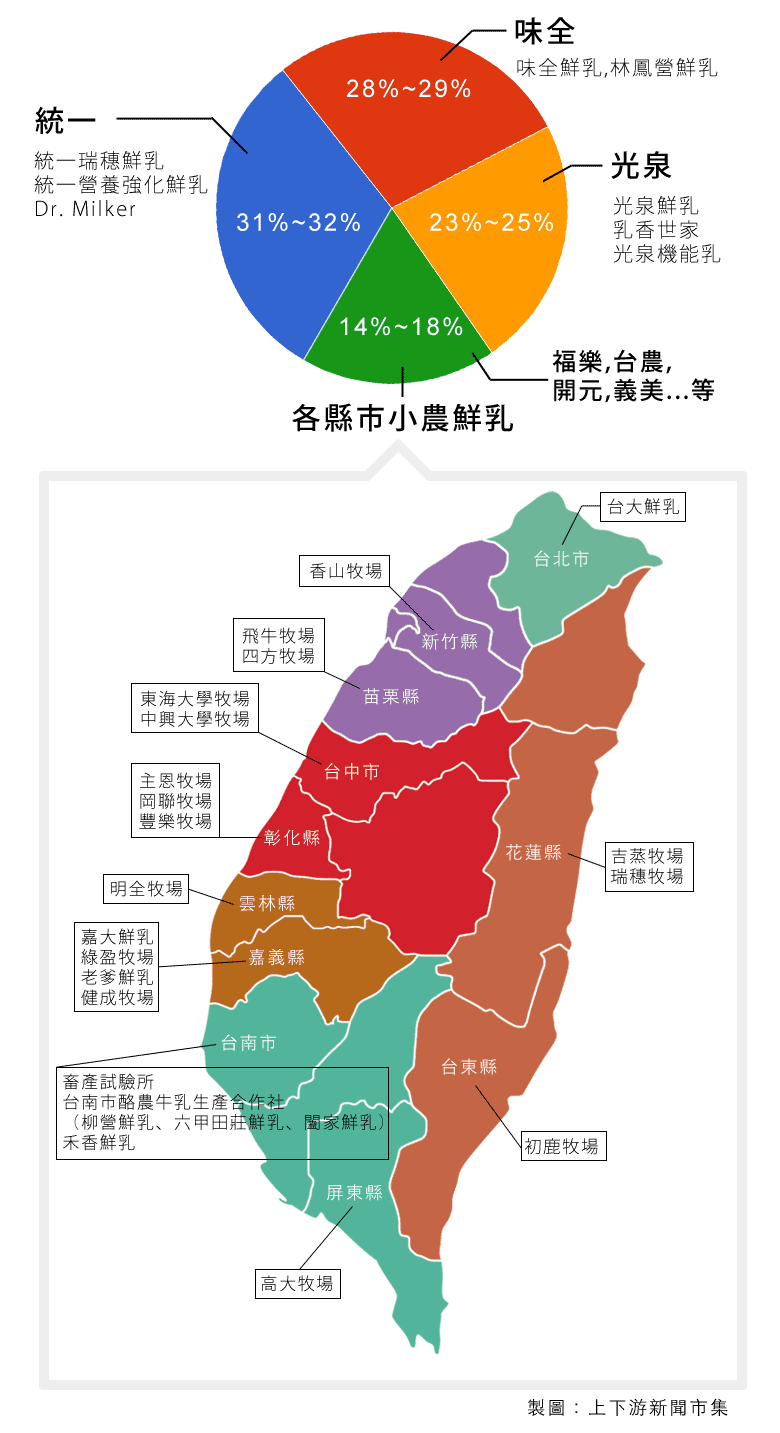
Using a place name as a fresh milk brand name is a historical mistake
The Tainan City Dairy Cattle Milk Production Cooperative is the first fresh milk distribution unit in Taiwan organized by dairy farmers. It has now established three brands in total, some with a single-farm source and some from farms in Tainan, Pingtung, or Changhua. Business manager Huang Xiaoan said that of course he very much hopes there can be a Taiwan place-of-origin label, even down to a local label, but Taiwan is only 400 km long from north to south, and dairy farmers are concentrated in the south, so geographical differences may not be that great, and local labeling is not easy.
Wang Zhongshu, deputy director-general of the Department of Animal Industry, said bluntly that distinguishing domestic from imported is very important, but labeling down to the local level is "anti-market behavior." A dairy plant may collect milk from more than 100 dairy farmers, then mix, homogenize, sterilize, and package it. If each dairy farmer were handled separately, it would cost too much. At present in Taiwan, only Gaoda Farm has achieved production and sales traceability. "The important thing is to take Taiwan as the place of origin, strengthen the quality control of dairy plants, and distinguish domestic from imported fresh milk."
As for Uni-President and Wei Chuan using Ruifeng and Linfengying respectively as brands, that was a historical mistake. Fang Qingquan, secretary-general of the Republic of China Dairy Association, said that in theory a place-of-origin name cannot be used as a brand name. Wei Chuan did indeed raise cattle in Linfengying at the beginning, but later expanded to Yunlin, Chiayi, Tainan, and Pingtung, while Uni-President believed that the east had good water and good air, which was good for brand image. Since the government approved these brand names at the time, and now the manufacturers have built up brand value, it is also very difficult for the government to demand cancellation.
Council of Agriculture: With free trade bearing down, build a "Taiwan" brand
For agricultural authorities, rather than establishing local labels, what is more important is to build the brand advantage of "Taiwan" under the heavy pressure of free trade.
In July 2013, Taiwan signed with New Zealand the "Agreement between New Zealand and the Separate Customs Territory of Taiwan, Penghu, Kinmen, and Matsu on Economic Cooperation." Although imports of liquid milk did not directly reduce tariffs, the "tariff quota" gradually increased year by year. Liquid milk within the quota can enjoy zero tariff, while the out-of-quota tariff is 14 yuan per kg. After the agreement took effect at the end of 2013, New Zealand's annual liquid milk tariff quota was 5,500 metric tons, increasing by 1,500 metric tons every 3 years, reaching 10,000 metric tons from the 9th year, and full zero tariff from the 12th year.
After the agreement took effect, in the previous year and the year before that, Taiwan's imports of liquid milk from New Zealand were still below the quota, only 5~6 tenths of the quota, but this year it suddenly grew to 82%, and 4,520 metric tons have already been imported. Although compared with the domestic fresh milk annual production of 365,000 metric tons this is only a tiny fraction, and the Council of Agriculture also believes that New Zealand milk will only replace Australian fresh milk, the Dairy Association worries that New Zealand fresh milk costs less than half of Taiwan's, and after full zero tariff in the future, it will be a major shock to Taiwan's dairy farmers.
Wang Zhongshu emphasized that in order to respond to free trade, in the future the fresh milk label will be combined with CAS Excellent Agricultural Product certification. When promoting the fresh milk label, the concept of domestic production will be brought in along the way, because only milk produced in Taiwan can apply for the fresh milk label.
In addition, the Dairy Association is currently cooperating with National Taiwan University and National Cheng Kung University to develop an isotope testing method, establishing a database of the characteristics of Taiwanese milk and foreign milk, so that in the future milk composition can be directly analyzed to confirm whether there is mixed milk or false labeling.
Industry: The government should assist small farmers' fresh milk brands
However, the industry wants more proactive measures.
In recent years, small-farmer fresh milk brands have proliferated in Taiwan, but dairy processing plants and cold-chain logistics costing over a billion are the biggest challenges hindering new brands.
The Tainan City Dairy Cattle Milk Production Cooperative currently does not have its own processing plant and can only commission 3 processing plants to help with sterilization and packaging. Business manager Huang Xiaoan said that the cooperative has its own laboratory and will also send people to supervise the entire processing and transportation process, but it does not touch processing, transport fleets, or distribution stations, because the cooperative's main body is farmers. Setting up a plant not only requires investing over a hundred million in funds, but more importantly requires back-end management, and currently there is no such capacity.
Fang Qingquan believes that the government should assist in developing small-farmer fresh milk brands and leisure farms. These small-farmer brands do not necessarily have to be specially limited to certain places of origin in Taiwan, because claiming a place of origin means there must be different characteristics and quality in order to generate brand value. "If the quality is not good, labeling the place is not a good thing." Assisting small-farmer brands is not directly subsidizing dairy farmers, but improving the environment, for example by subsidizing refrigerated transport vehicles and automated milk collection and feeding equipment.