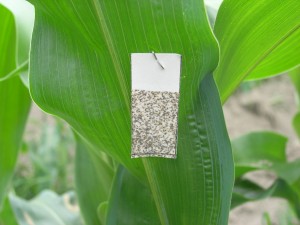
Introduction to Organic Cultivation Techniques for Sweet Corn for Fresh Consumption in the Hualien Region General News Jan 1, 1970By Emily Carter 0 views Share227 +13 Tweet EmailShares 230Authors: Hualien District Agricultural Research and Extension Station Yu Te-fa, Chen Jen-fang (2) Pest control: During its growing period, sweet corn for eating is relatively susceptible to damage from the Asian corn borer and other pests, which affects its yield and market value. For control of the Asian corn borer, Trichogramma egg parasitoids are released, starting 15 to 30 days after corn sowing (plant height 20 to 30 cm) and continuing until male flowering (tasseling), with one egg-card release every 7 to 8 days, for a total of 4 to 5 releases. Each release uses 150 cards per hectare. To effectively control Asian corn borer damage, Bacillus thuringiensis wettable powder is applied at the late whorl stage, the silking stage and the milk-ripe stage to control the Asian corn borer. In addition, sex pheromone trap boxes may be hung to trap and kill adult beet armyworms (blue) and tobacco cutworms (red), with about 10 hung per hectare, and the sex pheromone attractant replaced once a month for each, and they must remain hung throughout the entire growing period. 8. Seedling raising and transplanting cultivation Some farmers use potting soil in 128-cell trays to raise corn seedlings, with 1 seed per cell, and when the corn seedlings have 3 to 4 leaves and a plant height of about 10 to 12 cm, they are transplanted into a previously prepared field at a set row and plant spacing, with 1 seedling transplanted per hole; the cultivation method is the same as above, except that thinning is not required. Growing sweet corn this way has the following advantages and disadvantages: it makes better use of the farming season, uses less corn seed, reduces the occurrence of weeds, and gives more uniform plant growth with fewer missing plants; however, transplanting requires more labor and time, and planting on a large area requires even more labor and time, so it is more suitable for small-area cultivation or transplanting in batches, in order to fully meet market supply demand. Harvesting and post-harvest handling Sweet corn for eating is mainly harvested as fresh ears. When, 20 to 30 days after silking of the female ear, the silks turn dark brown, the kernels are plump and full, and the kernels feel springy when the tail of the ear is pinched tightly with the fingers, it is the proper harvest time. After sweet corn is harvested, its sugar content drops very quickly and its quality then deteriorates, so sweet corn ears should be handled as quickly as possible after harvest. Generally, after harvest the corn ears are transported back to the collection site or quickly stripped of excess husk leaves in the shade of trees, and after the underdeveloped or insect-eaten parts at the tail of the ear are cut off, they are shipped to market the same day in small 1 kg packs or in packs of 25 to 30 kg each, so as to maintain better quality. At present, the fresh organic sweet corn ears produced in various places are supplied directly to regular organic channel vendors or to consumers as ingredients for their three daily meals. Conclusion Because sweet corn for eating has a distinctive sweet taste and texture, a short growing period, stable yield, and good prices, and can easily be rotated with other crops, giving high land-use efficiency, farmers are strongly willing to grow it. Our station has established a technique for growing sweet corn using organic fertilizers together with integrated biological control, in the hope that the cultivation of sweet corn for eating can, through organic cultivation methods, build consumer confidence and ensure consumers' health, and can thereby expand the market for sweet corn for eating, raise the value of the industry, and increase farmers' income. At the same time, it lets consumers eat clean, healthy, delicious organic sweet corn. Share227 +13 Tweet EmailShares 230