Who Regulates Illegal Australian Redclaw Crayfish? Fisheries Agency Says It Doesn't Count as Aquaculture and Falls Under Forestry Bureau
The Australian redclaw crayfish (Cherax quadricarinatus), whose import is banned, has broken out with crayfish plague. The Fisheries Agency claims it "doesn't know what channels the operators brought them in through," yet operators may end up legalized on the spot. Miao Tzu-chang, head of the Aquaculture Division, said the scale of Australian redclaw crayfish farming is still very small, "it doesn't count as aquaculture, it's wildlife," and it is not on the permitted import list. However, once imported, it should fall under the Wildlife Conservation Act and be governed by the Forestry Bureau; whether to impose fines "depends on the attitude of local governments." The Fisheries Agency can only advise operators to stop farming them.
The Fisheries Agency is slacking off badly, and Forestry Bureau officials angrily shot back: "Who exactly is the competent authority for aquatic products?" If Australian redclaw crayfish also falls under the Forestry Bureau, then all aquatic products should fall under the Forestry Bureau. Yen Sheng-hsung, a professor in the Department of Biological Sciences at National Sun Yat-sen University, also pointed out that last year, when the government first drafted the "ecological blacklist" of banned imports, scholars suggested including Australian redclaw crayfish, but the Fisheries Agency removed it under pressure from operators. "Now that an outbreak has occurred, they say they didn't know -- it's like playing a double game."
Not on the import permit list, yet once smuggled in there's no way to regulate it
The Australian redclaw crayfish, very popular in recent years, is suspected of having suffered a large-scale die-off. Operators sent samples themselves to the Fish Disease Center at National Pingtung University of Science and Technology for diagnosis, and the result was crayfish plague. The Council of Agriculture also notified the World Organisation for Animal Health (OIE) on the 18th of this month.
The Australian redclaw crayfish, also known as the Australian freshwater lobster or blue claw crayfish, has the scientific name Cherax quadricarinatus. It tolerates heat, resists low temperatures, and has strong disease resistance, and could become a dominant invasive alien species. It has never been on the permitted import annex of our country's "Guidelines for the Review of Import and Export of Live Wildlife," yet both operators and scholars say Australian redclaw crayfish have been imported for more than ten years. A Yang surnamed operator in Pingtung said they are usually sold to restaurants, seafood stores, and shrimp-fishing ponds, and some are exported to China.
Because Australian redclaw crayfish are easier to farm than grass shrimp and white shrimp, many fishermen have switched to farming them. But according to the "Guidelines for the Review of Import and Export of Live Wildlife," animals being imported for the first time must have an application filed with the competent authority, and Australian redclaw crayfish are simply not on the legal import list. The Fisheries Agency issued a document to local governments in January last year clearly stating that "Australian redclaw crayfish on the market are all illegally imported," and asked local governments to advise operators not to farm them.
Although they are not on the import list, once successfully smuggled in there is no law to regulate them. Yen Sheng-hsung, a professor in the Department of Biological Sciences at National Sun Yat-sen University who studies invasive species, said the Fisheries Act has no clear provisions on the removal of alien species or disease prevention and control, and Australian redclaw crayfish are not wild, so the Wildlife Conservation Act does not apply. The Fisheries Agency has long let operators breed them unchecked and should take responsibility.
This is not the first such case. The Control Yuan reprimanded the Council of Agriculture back in 2011 for mismanaging piranhas. At that time the Council of Agriculture banned the import of more than 30 species of piranhas, yet only one species was banned from being kept or sold. Piranhas that were successfully smuggled in circulated freely in the underground market, and the competent authority had no way to regulate them.
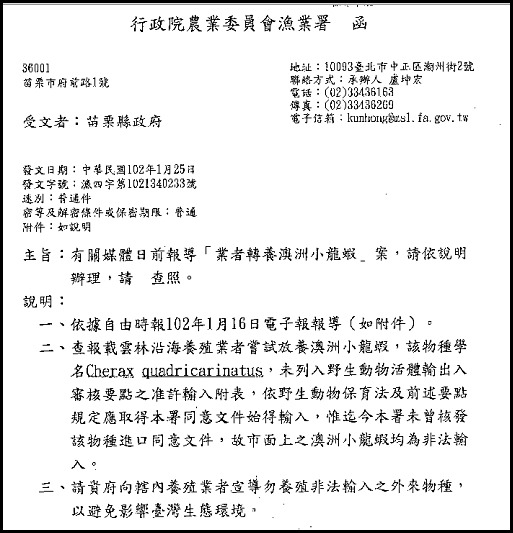

However, Miao Tzu-chang, head of the Aquaculture Division of the Fisheries Agency, said that according to statistical yearbooks, the farming area for various crayfish in Taiwan is only about 10 hectares, and Australian redclaw crayfish have not yet formed an industry. "It doesn't count as aquaculture, it's invasive alien wildlife." The Fisheries Agency has always banned imports; existing operators must, under Article 31 of the Wildlife Conservation Act, report their farming scale and source to local governments, and failure to register can be fined 10,000 to 50,000. But as for whether illegal importers will be fined? He said it depends on the attitude of local governments and is left to their discretion.
Miao Tzu-chang said that at present disease prevention work is handled by the Bureau of Animal and Plant Health Inspection and Quarantine, while existing operators are managed by the Forestry Bureau and local governments, and the Fisheries Agency will do its best to persuade the public not to keep them. He stressed that the scale of Australian redclaw crayfish is small and government resources are limited, and if it really becomes a large industry in the future, the Fisheries Agency will consider regulating it. "I can't even keep up with regulating other industries, let alone this small one."
However, the Forestry Bureau did not receive any notice from the Fisheries Agency yesterday. Regarding the Fisheries Agency's statements, Forestry Bureau officials were both exasperated and angry, repeatedly saying they didn't know how to respond, and shot back: "Who exactly is the competent authority for aquatic products?" If Australian redclaw crayfish also falls under the Forestry Bureau, then all aquatic products should fall under the Forestry Bureau. "If operators want us to regulate them, we can do that too."
Fisheries Agency Director-General Sha Chih-yi added that after registration under the Wildlife Conservation Act, it will assess whether there is harm to domestic ecology and assist local governments in supervising operators, and will not be completely inactive.
In fact, the Fisheries Agency is well aware of the harm of Australian redclaw crayfish. As early as 2006, it commissioned the Department of Aquatic Biosciences at National Chiayi University to investigate how to remove and control Australian redclaw crayfish, and issued further plans in 2009 and 2010. But last year, because the farming scale was growing larger and larger, it commissioned the Department of Veterinary Medicine at National Pingtung University of Science and Technology to study white spot disease in Australian redclaw crayfish, leaving it unclear whether the goal was removal or fostering the industry.
Scholars suggested listing it on the ecological blacklist, but the Fisheries Agency backed off under pressure from operators
In addition, Yen Sheng-hsung revealed that last year the Forestry Bureau and the Bureau of Foreign Trade revised the "ecological blacklist," and scholars and experts suggested including Australian redclaw crayfish, but the Fisheries Agency backed off under pressure from operators. In the end, among the more than 500 approved species, Australian redclaw crayfish was not included. "Now that an outbreak has occurred, they say they didn't know -- it's like playing a double game."
Ran Fan-hua, a professor in the Department of Aquaculture at National Taiwan Ocean University, said he was asked three or four years ago whether he could research Australian redclaw crayfish, "but I absolutely will not promote invasive species." Australian redclaw crayfish are a dominant invasive species in freshwater, and they have thick shells and little meat, and don't taste fresh or delicious, requiring heavy-flavored cooking. They have no market in Taiwan or internationally.
He believes that Taiwan is an island nation, and even if new aquaculture species are to be developed, seawater species should be the priority. There are already enough freshwater species now, and freshwater resources will only become scarcer in the future. "There isn't even enough for people, yet it's being used for farming."
Operators: We already passed quarantine and exported to China, the government should actively prevent disease
The Fisheries Agency has not approved imports, yet a Yang surnamed operator in Pingtung who has farmed Australian redclaw crayfish for four years said that last year the local government issued them a legal farming permit, and they had already passed quarantine and exported to China. He also voluntarily installed anti-escape measures, and doesn't understand why it is now illegal.
He said that currently 8-10 Australian redclaw crayfish per jin retail for about 600 yuan, while before the Lunar New Year, 30 white shrimp per jin sold for 500. The meat quality of Australian redclaw crayfish is similar to traditional Boston lobster. Now grass shrimp and white shrimp are following in the footsteps of tiger prawns, with inbreeding and increasing disease. Australia and Southeast Asia long ago began guiding farmers to switch to Australian redclaw crayfish, and domestic operators can already breed their own seedlings without importing from abroad. "We need to look at this with the right mindset." The government actively reporting the outbreak is good, but there must be follow-up disease prevention measures.
Yen Sheng-hsung said Australian redclaw crayfish should no longer be imported. If existing operators use closed-system farming with anti-escape equipment, they can legally export, but the crayfish should not flow into the aquarium market, otherwise the abandonment rate will increase. Operators must have social responsibility, otherwise it will be just like the apple snail, making the public bear the bitter consequences.
He also called out the Fisheries Agency, saying that right now it only makes passive appeals, and after letting the species develop into an industry for more than ten years, it has no supporting measures for artificial breeding. It should actively take on disease prevention and supervision responsibilities, proactively assist and monitor farms, and not dump all responsibility on other agencies.
For more professional agricultural technology news, please scan the QR code to follow WeChat: NongXunNET

Please indicate the source when reprinting.