Croatia Empty House Notes 3: Foraging Food at the Squatter's Market
Editor's note: The author is a student in the Department of Environmental Engineering at National Cheng Kung University who went to Croatia as an exchange student to study agriculture. This article follows the previous one, sharing how, after the squat (occupying empty houses) movement, food is obtained and how it is cooked.
─────────────────────────────────────────
Food Sources: Traditional Markets and Supermarkets
The leftover bread bought back from the bakery is very cheap, but eating bread for all three meals is still hard to bear. If possible, everyone would rather eat something hot in the evening. In the squat, basically everything is cooked vegan; even eggs, cheese and even honey cannot be used, but I have always felt that what I eat here is far better than outside. Onions, carrots, cauliflower - these things are hard to cook badly no matter how you do it, but where does this food come from?
The simplest way is of course to buy it at the supermarket. Staples such as white rice, potatoes, pasta and flour can mostly only be bought at the supermarket. Sometimes public funds are used, but usually whoever goes to the supermarket buys some extra to bring back if they happen to have spare money.
However, the vast majority of vegetables and fruit are not bought from the market; in other words, they are all free.
Unlike Germany and other European countries, Croatia's traditional markets have not yet been completely replaced by supermarkets, and most of the food in traditional markets still comes from Croatian farmers. There are advantages and disadvantages. The disadvantage is of course that there is less variety, especially in winter, when almost only tangerines and oranges can be seen among fruits. Only in the past two days, after going to Vienna, did I learn that supermarkets in wealthy countries have everything - pineapples, mangoes, mangosteens, sugar apples and all kinds of other fruits are available. The difference is huge, and it is obvious they are not produced in Austria. As for the advantage, in Germany most traditional markets are for tourists to visit, and if you want to save money you just go to the supermarket obediently, whereas in Croatia you can buy at traditional markets at prices much cheaper than supermarkets.
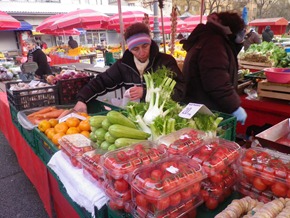
Usually when we go to the vegetable market, it is around three or four in the afternoon when the stalls are about to close, and we directly ask the auntie or uncle selling vegetables whether they have any unsold vegetables they can give us. At first I thought it would be very awkward for me, an Asian, to go with them to ask for vegetables from those vendors, but actually they seemed to quite like me tagging along, and last time they even treated us to snacks they had made themselves.
As a result, later on, every time a couchsurfer came to visit, I would take them along to the vegetable market, and that auntie who treated us to snacks smiled so sweetly when she saw three Taiwanese people coming along together.
Is it really possible to get them for free? Yes... and actually quite a lot, especially in summer, when usually we cannot even fit it all.
Unsellable Food
On what grounds do they let us take this food for free? This food is not given away because it is poisonous, wormy, or rotten; it is because it cannot be sold and has no economic value anymore. Last time I saw an introduction about imperfect produce in Taiwan, and some of the vegetables we get could indeed be considered imperfect produce.
Looking like this, would anyone buy it? I once heard news from Taiwan saying that carrots had all grown little penises, and the losses from being unsellable were severe. I also think dealing with carrots that have grown two legs is more troublesome than dealing with normal carrots. Bell peppers often have holes or uneven coloring too. Nobody wants to buy this food, but it is 100 percent edible.
3. Those simply given to us without any selection at all
Usually these are items in season, when supply is too large. If these are not used up, new stock cannot come in, and these slightly older vegetables and fruits cannot be sold at all because every vendor is selling the freshest ones. If it is not the freshest, nobody buys it at all, which is why they directly give us a whole box of almost perfectly intact tangerines or tomatoes like that.
Those vendors all know the people in the squat, so they are all used to giving to us. Sometimes we also take goods from the free shop to give to them, and everyone is also planning to later cook the vegetables we ask for right there at the market and give them to people to eat. It is somewhat similar to Food not Bombs abroad, where they collect unwanted food and cook it for poor people to eat.
Again, many people will feel that our behavior of going to the market to ask for vegetables is simply getting something for nothing, but if there is a free lunch, why not eat it? Are we supposed to throw it away instead?
Today's society really would rather throw them away than give them to others. If society does not like us getting something for nothing like this, then find a proper way to deal with this food that they treat as garbage, rather than locking it up and then throwing it away all together. We respect this food, and in our eyes it is absolutely not garbage.
Does Taiwan Have This Much Discarded Food?
Actually, rice alone is enough to make the point. Taiwan is extremely suitable for growing rice, but thanks to the American GIs, Taiwanese people now eat bread, burgers and sandwiches for breakfast; for lunch and dinner, one meal has rice, and the other needs something special like pasta or pizza.... A huge amount of imported flour has replaced the demand for rice. To protect farmers, the government buys rice at guaranteed prices and stores it in warehouses. Every year, after feeding soldiers and sending it overseas for diplomatic efforts, there is still more than can be used up, and tons of rice can only be left to rot...
If the goal is to pursue maximum economic efficiency, then later will all the rice in Taiwan come from Vietnam and Thailand, while rice produced in Taiwan is specially made into gift-grade space-pack white rice for Japan? Will everyone be happier if GDP is higher that way? The UK exports a huge amount of chicken, pork, cheese and timber every year, and then imports almost the same amount of the same products from other countries... What exactly is going on with that?
Behavior that is completely reasonable under a market economy must, in the eyes of children, also make them wonder what on earth these adults are doing. Is shipping the same things back and forth really so fun?