Two Hundred Kilometers of Iron Horses on the Long March: Crossing Seven Major River Systems to Rebuild a Small Town's Cultural Incense Route
Opening up the lifeblood of a small town's culture! The Taijiang Branch of Tainan Community University and the "Little Taijiang" reading group of Haidian Elementary School in Tainan City recently launched a petition for the "Taiwan Irrigation Canal National Greenway Initiative," hoping that through a three-day, two-night, two-hundred-kilometer Taijiang hundred-li stream journey, they can explore the early history of irrigation canal development in Taiwan, and through this "slow experience," awaken everyone's attention to traditional small-town culture and rebuild a flourishing "cultural incense route."
This journey, spanning three counties and cities over two hundred kilometers, begins at Tainan's Babao Canal, crosses the Zhuoshui River toward Yunlin County, then heads south to Huwei, Tuku, and Beigang, enters Chiayi's Xingang, Liujiao, Taibao, and Nanjing, crosses the Bazhang River, then turns back to ride toward Tainan's Chianan Canal north-south main lines, Wushantou Reservoir, and the Zengwen River aqueduct bridge, connecting to the Taijiang Mountain-Sea Canal Greenway, and finally arriving at Taijiang National Park.
Why take such a journey? Wu Maocheng, CEO of the Taijiang Branch of Tainan Community University, said that this route passes through the Babao Canal, the Chianan Canal Zhuogan Line, and the north-south main lines, 3 major irrigation canals, crosses the Zhuoshui River, Huwei River, Beigang River, Puzi River, Bazhang River, Jishui River, and Zengwen River, 7 major river systems, and travels through four counties and cities: Changhua, Yunlin, Chiayi, and Tainan. The beliefs and living landscapes of the townships and urban districts along the way are all included, and these old irrigation canals "have always been like Taiwan's blood vessels," not only having once irrigated farmland and provided the water needed for life, but also continuously injecting blood into Taiwan's traditional township culture.
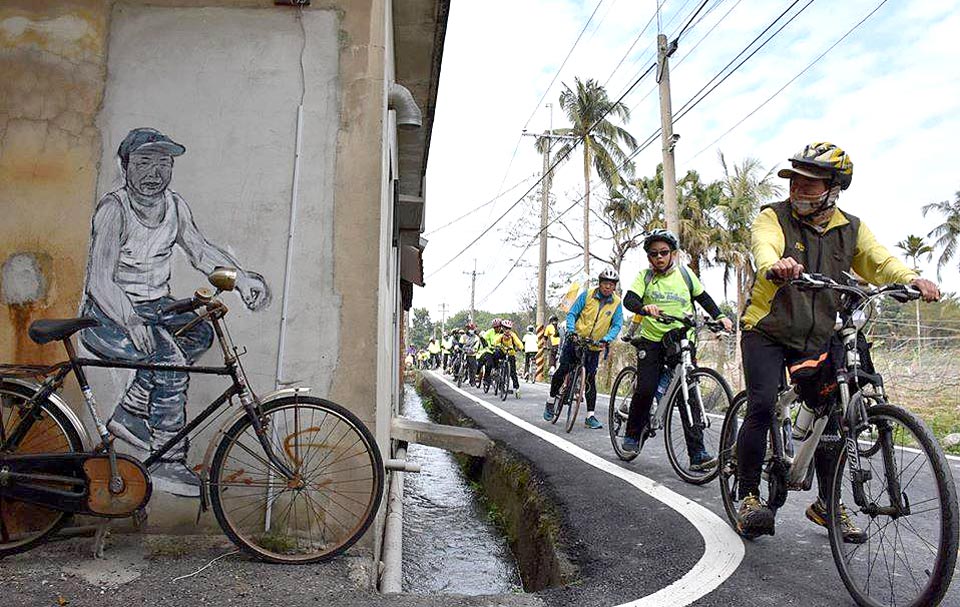
Wu also said that by letting these young people follow the irrigation canals into the villages, they can see the residents' centers of faith: Beigang Chaotian Temple, Bengang Shuixian Temple, Xingang Fengtian Temple, Xibei Liuxing Temple, and the Earth God shrines in various places, all of which can be visited one by one during the bicycle trip. Not only can they understand the progress of history and culture through the life stories of local people, but their own approach of "finding the way" is also different from visiting a museum, being rapid yet solid; walking slowly and exploring slowly can instead allow a more careful understanding of the irrigation canals and their context.
A student surnamed Wu from Haidian Elementary School who participated in the activity thought this kind of journey was very fun, as they could explore the villages along the irrigation canals and discover the appearance of past rural development, which is a better experience than books alone.
Through this kind of cultural pilgrimage, Wu Maocheng hopes to create the "Taiwan Irrigation Canal National Greenway," a network connecting mountain villages, the seaside, and rural irrigation canals. He stressed that this does not require spending large sums on tourism construction, but rather letting young people naturally immerse themselves in local culture. From unfamiliarity to understanding, they will naturally love their hometown and protect the water, and further protect water culture and the land environment, because water is the root of everything; loving water means loving one's hometown, and in the end one can recover one's roots from it.
(Go to the "Taiwan Irrigation Canal National Greenway Initiative" petition)
For more professional agricultural technology information, please scan the QR code to follow WeChat: NongXunNET

Please indicate the source when reprinting.